Table of Contents
- 1. Start With a Home Safety Assessment and Fall Prevention Plan
- 2. Make Practical Home Adaptations for Elderly Residents
- 3. Use Technology to Support Elderly Independence Day to Day
- 4. Protect Mobility, Nutrition and Daily Routines
- 5. Choose Care Agencies in the UK That Respect Autonomy
- 6. Understand Care Quality Commission Standards Before You Commit
- 7. Plan Legal, Financial and Future Care Decisions Early
- 8. Prevent Caregiver Burnout and Protect Emotional Well-Being
- Frequently Asked Questions
Last Updated: September 28, 2026
1. Start With a Home Safety Assessment and Fall Prevention Plan
The most effective first step in supporting elderly independence is a room-by-room home safety assessment. Falls remain the leading cause of hospital admission for older adults, and most of the hazards involved are fixable.
What a Good Home Safety Assessment Covers
- Loose rugs, trailing cables and worn stair carpet
- Grab rails beside the bath, shower and toilet
- Night lighting between bedroom and bathroom
- Clear, uncluttered routes through hallways and doorways
- A working personal alarm or pendant
The NHS guidance on preventing falls recommends reviewing these areas regularly, particularly after any change in medication or mobility.
Photograph each room during the assessment. Small hazards, like a curled mat edge, are easy to miss until you see them in a picture.
2. Make Practical Home Adaptations for Elderly Residents
Home adaptations for elderly residents do not have to mean a full renovation. A handful of targeted changes often deliver more benefit than one large project. The goal is to remove daily friction, not to make the home feel clinical. Keep adaptations subtle and matched to how the person actually moves around their space.
Room-by-Room Adaptations That Make the Biggest Difference
Bathroom
- Lever taps instead of twist fittings, easier for arthritic hands
- A raised toilet seat or perching stool to reduce bending and standing strain
- Non-slip mats inside and outside the bath or shower
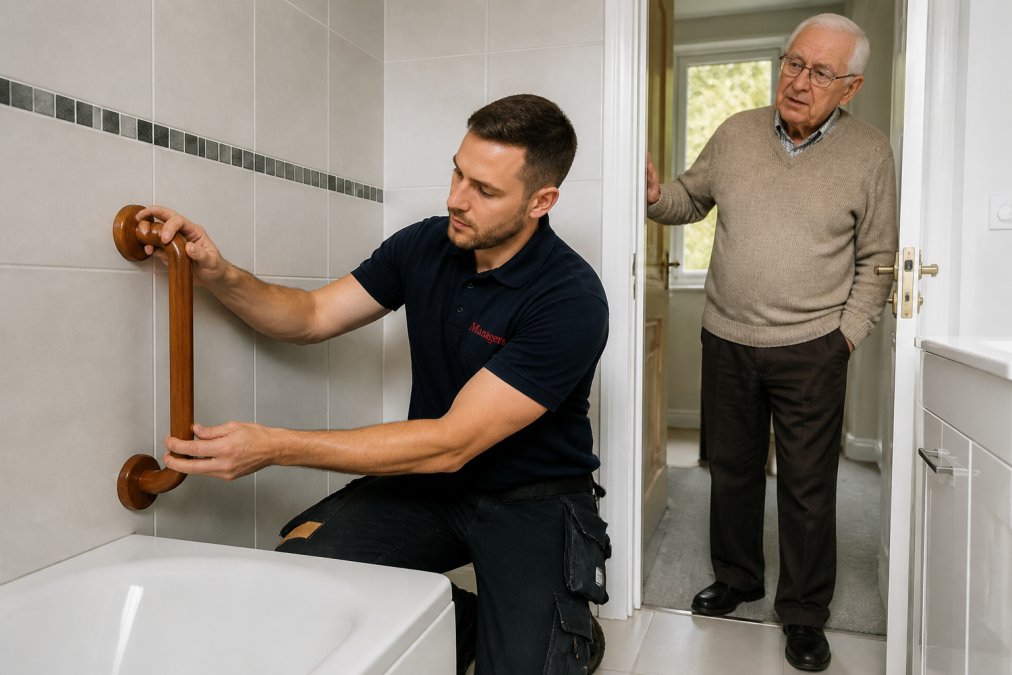
- Grab rails beside the bath, shower and toilet, fitted by a qualified installer
- A walk-in shower or level-access tray if stepping over a bath edge becomes risky
Stairs and hallways
- A second handrail on the stairs, fitted at the height the person naturally reaches
- Motion-sensor plug lights along the hallway and staircase
- Contrasting tape on stair edges to make steps more visible
- A stairlift if climbing becomes unsafe, discuss with an occupational therapist first
Kitchen
- A perching stool to reduce standing time
- Easy-grip utensils and jar openers
- A kettle tipper or lightweight kettle
- Items moved to waist height to avoid reaching or bending
Bedroom
- A bed rail or transfer handle if getting in and out is difficult
- A night light with motion sensor between bed and bathroom
- A telephone or personal alarm within reach of the bed
How to Fund and Arrange Adaptations
Small adaptations like grab rails and lever taps are often low-cost and can be fitted by a handyperson. Larger adaptations, walk-in showers, stairlifts, ramps, may be eligible for a Disabled Facilities Grant through your local council. An occupational therapist assessment is usually the first step; they can recommend what suits the property and the person, and may refer you for grant funding.
Before buying any equipment, ask an occupational therapist to assess the person in their own home. Off-the-shelf items that seem helpful can sometimes create new hazards if they are not matched to the individual’s height, strength and mobility.
3. Use Technology to Support Elderly Independence Day to Day
Technology now plays a genuine role in elderly independence, and it works best when it fades into the background. The right tools handle reminders, safety and connection without demanding technical confidence. Start with one device, not five. A voice assistant can manage medication reminders, heating and calls home with a single spoken command.
Matching Technology to Specific Needs
| Need | Practical Tool | What It Does | What to Check Before Buying |
|---|---|---|---|
| Emergency response | Personal alarm pendant | Connects to a 24/7 monitoring centre | Is there a monthly monitoring fee? Does it work outside the home? |
| Medication timing | Automated pill dispenser | Alarms and locks doses to prevent double-dosing | Can it be filled by a carer? Does it alert a family member if a dose is missed? |
| Visitor screening | Video doorbell | Lets the resident see and speak to callers | Does it need Wi-Fi? Can it be answered from a phone? |
| Daily reminders | Smart speaker | Voice prompts for appointments and routines | Does it understand the person’s accent and speech pace? |
| Movement and strength | Online exercise videos | Guided routines for balance and mobility | Are they designed for older adults? Is a chair needed? |
| Remote monitoring | Passive sensors | Detect changes in movement patterns | Who receives alerts? Is consent clearly given? |
How to Introduce Technology Without Overwhelm
Introduce one device at a time and let the person get comfortable before adding another. A common pattern is to start with a smart speaker for reminders and calls, then add a personal alarm once the person sees the benefit. Involve the person in choosing the device, if they feel it is being imposed, they are less likely to use it.
Privacy and Consent
Remote monitoring and video doorbells raise privacy questions. The person should understand what is being monitored, who sees the data, and how to turn it off. For anyone lacking capacity, decisions about monitoring should follow the principles of the Mental Capacity Act 2005, acting in their best interests and choosing the least restrictive option.
A device with no one to check on it is not a safety net. If the alarm or dispenser is not monitored, missed alerts go unnoticed. Agree who receives the notification before you install anything.
Technology should support independence, not replace human contact. Use it to handle the routine tasks so that time and energy are freed up for conversation, shared meals and the things that make home feel like home.
4. Protect Mobility, Nutrition and Daily Routines
Mobility, nutrition and routine reinforce each other. When one slips, the others usually follow, and independence erodes faster than families expect.
Call us for Free Assessment Today →
Keeping Movement and Meals on Track
Strength and balance work is the single best defence against falls. Short, regular sessions beat occasional long ones.
- Aim for gentle movement most days, seated if standing is difficult
- Keep a stock of easy, familiar meals and snacks within reach
- Set consistent times for meals, medication and sleep
- Use grocery or meal delivery when shopping becomes a strain
- Book a GP review if appetite or weight changes
5. Choose Care Agencies in the UK That Respect Autonomy
Choosing among care agencies in the UK comes down to one question: will the carer work with your relative’s preferences, or around them? Autonomy is not a bonus feature. It is the difference between support and control.
- Who writes the care plan, and is the client consulted?
- How are carers matched to the household?
- What happens when a regular carer is on leave?
- How often are plans reviewed?
6. Understand Care Quality Commission Standards Before You Commit
Care Quality Commission standards are the benchmark every regulated provider in England is measured against. Knowing them gives you a framework for judging any agency, not just the one you shortlist.
Care Quality Commission inspection framework
Ask for the provider’s most recent inspection report, not a summary. The full report shows what inspectors actually observed.
7. Plan Legal, Financial and Future Care Decisions Early
Legal and financial planning is the topic families avoid until a crisis forces it. That delay is what turns a manageable situation into an emergency.
- Register a lasting power of attorney for health and welfare, and for property and financial affairs
- Confirm whether a will exists and whether it is current
- Record care preferences in writing, including where they want to be cared for
- Review any benefits entitlement with an adviser
8. Prevent Caregiver Burnout and Protect Emotional Well-Being
Caregiver burnout is not a sign of weakness. It is what happens when one person carries a load designed for a team, and it affects the carer and the person receiving care.
- Book regular respite, not just emergency cover
- Split tasks between family members and write them down
- Keep your own GP and social contact
- Say yes to practical help when it is offered
Frequently Asked Questions
What are some easy ways to promote independence in the elderly?
Small changes often have the biggest effect. Set up a weekly pill organiser or an automated dispenser so medication is taken correctly without reminders. Add grab rails in the bathroom and a second handrail on the stairs. Use voice assistants for appointment reminders and lighting control. Keep a written or digital routine the person can follow themselves. Each of these supports elderly independence by removing a daily obstacle rather than taking over the task entirely.
How can home adaptations for elderly residents improve safety?
Most falls at home happen on stairs, in the bathroom or on uneven flooring. Grab rails, a walk-in shower with a seat, improved lighting on landings and non-slip mats address the highest-risk areas directly. A stairlift restores access to upstairs rooms when climbing becomes unsafe. Occupational therapists can assess the home and recommend specific adaptations, and some local councils offer grants for essential works, so check your council’s current scheme.
How do I balance safety and independence for an ageing relative?
Start with a conversation, not a decision made for them. Ask what matters most, then look at where the real risks sit. A home safety assessment identifies hazards without removing choice. Technology such as a telecare alarm or video doorbell adds a safety net while leaving daily decisions with the person. Where more support is needed, a care agency can build a plan around existing routines rather than replacing them.
What should I check before choosing care agencies in the UK?
Check the provider’s current Care Quality Commission rating and read the inspection report, not just the headline score. Ask how they match carers to clients, what happens if a regular carer is unavailable, and how they keep family informed. Request a written care plan before you commit and confirm it reflects the person’s routines, dietary needs and preferences. Consistent staffing matters more than a polished brochure.
What is the role of a care manager in supporting home independence?
A care manager coordinates the practical side of care: building the care plan, matching carers, reviewing it as needs change, and acting as the family’s main point of contact. They also handle medication oversight, appointments and liaison with health professionals. The right manager keeps support consistent and adjusts it over time, which is what allows someone to stay in their own home safely rather than moving to a residential setting.