
A care staffing coordinator is the operational backbone of any home care or healthcare service. They sit between care staff and service users, making sure the right person is in the right place at the right time. Without this role, rotas collapse, care continuity breaks down, and the people who depend on support are left vulnerable. The NHS workforce development framework identifies schedule management, care continuity, and staff record compliance as the core duties that define the position.
This guide covers everything you need to understand about the role: what it involves day to day, the skills it demands, the pressures it carries, and why it matters so much to the families and clients at the heart of care.
What does a care staffing coordinator actually do?
The role of care staffing coordinator is one of the most operationally demanding positions in UK healthcare and home care. At its core, the job is about keeping care services running smoothly, safely, and in line with regulatory standards. Coordinators act as the central link between care providers and service users, managing everything from daily rota changes to longer-term workforce planning.
Key responsibilities include:
- Rota organisation and scheduling: Creating and maintaining staff rotas to ensure every service user receives their agreed care visits, adjusting daily for sickness, annual leave, and last-minute changes.
- Care continuity: Minimising disruption to service users by keeping the same care workers assigned wherever possible, which is particularly important for clients living with dementia or complex needs.
- Staff record management: Keeping accurate, up-to-date records in line with Care Quality Commission (CQC) requirements and UK data protection legislation.
- Regulatory compliance: Working within frameworks set by bodies such as the Scottish Social Services Council and NHS workforce guidance to uphold care standards.
- First point of contact: Acting as the primary contact for care workers, service users, families, and managers when issues arise during the working day.
The role is not purely administrative. Coordinators make real-time decisions that directly affect the dignity and safety of the people in their care.
Core duties and responsibilities of a care staffing coordinator
The day-to-day work of a care staffing coordinator spans scheduling, communication, compliance, and people management. Each of these areas carries genuine accountability.
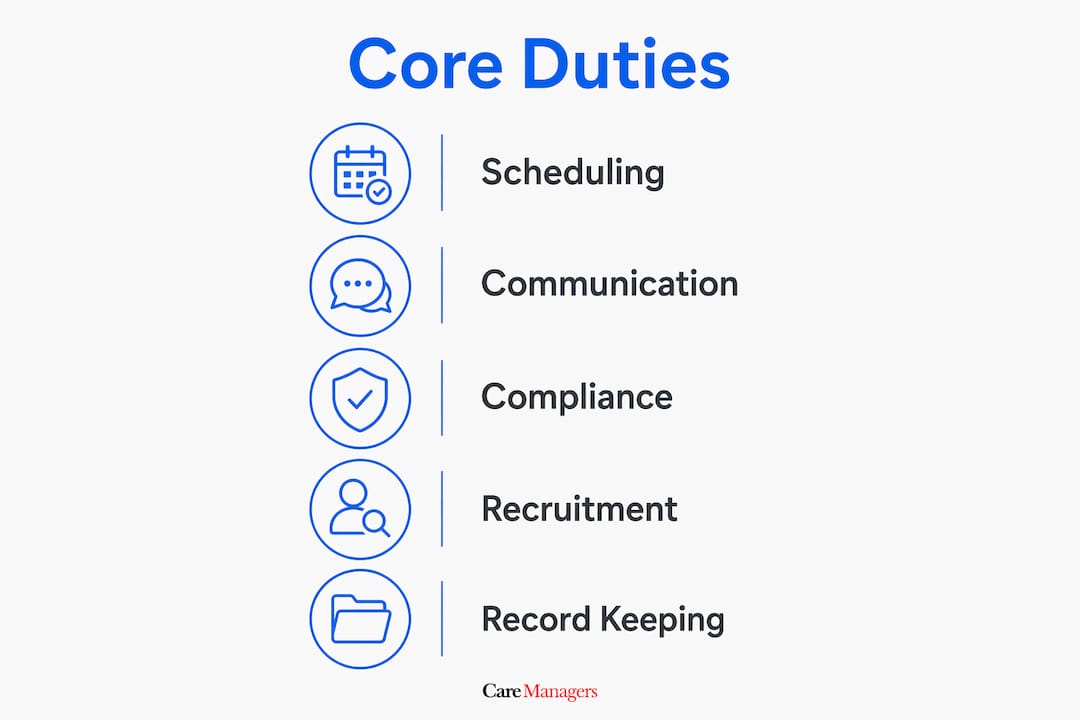
Scheduling and workforce deployment
Coordinators create rotas that deploy staff efficiently across a geographical area, ensuring care workers are not spending excessive time travelling between visits. They manage sickness cover, planned leave, and emergency absences, often at short notice. Proactive risk management is central to this, with coordinators monitoring staff availability patterns to prevent coverage gaps before they become critical.

Communication and liaison
A large part of the role involves keeping multiple parties informed and aligned. Coordinators liaise with service users, their families, care workers, GPs, community nurses, occupational therapists, and social workers. Families with power of attorney expect regular updates on care arrangements, and coordinators are responsible for maintaining that line of communication.
Record keeping and compliance
Accurate record keeping is non-negotiable. Coordinators maintain care plans, staff records, and incident logs in line with CQC standards and information governance requirements. Knowledge of data protection and confidentiality is a formal requirement in most job specifications across the NHS and independent sector.
Recruitment and onboarding support
Many coordinators support the recruitment process by assisting with interview scheduling, induction arrangements, and ensuring all compliance documentation is completed before new staff begin working with clients.
| Duty | Frequency | Key Compliance Standard |
|---|---|---|
| Rota creation and amendment | Daily | CQC fundamental standards |
| Staff record updates | Ongoing | UK GDPR and data protection |
| Family and professional liaison | Daily | Care plan requirements |
| Emergency cover management | As required | CQC continuity of care |
| Recruitment support | Periodic | Safer recruitment guidelines |
What skills and qualifications does the role require?
Effective care staffing coordination draws on a mix of technical ability, interpersonal skill, and personal resilience. The Scottish Social Services Council emphasises that emotional intelligence is as important as technical competence in this sector.
Professional and technical skills
- IT proficiency: Coordinators use rota management software such as CareLineLive or Roundsys, alongside standard tools like Microsoft Office. Confidence with database systems is a common requirement in NHS and independent sector job adverts.
- Organisational ability: Managing multiple care packages, staff schedules, and compliance deadlines simultaneously demands strong prioritisation skills.
- Data protection knowledge: Understanding of UK GDPR, information governance, and CQC record-keeping requirements is expected from day one.
- Communication skills: Both written and verbal communication must be clear and professional, whether drafting care reports or handling a difficult call from a distressed family member.
Personal attributes and emotional intelligence
The NHS workforce framework notes that transferable skills are highly valued, and many organisations will train candidates who demonstrate strong organisation and communication ability, even without prior care experience. Temperament often matters more than a specific qualification. Patience, calm under pressure, and genuine empathy for both staff and service users are qualities that no training course can fully substitute.
Qualifications
Prior experience in a health or social care setting is typically expected. Desirable qualifications include NVQ Level 2 or Level 3 in Health and Social Care. In Scotland, coordinators may be required to hold a practice and supervisory qualification, such as the PDA Health and Social Care Supervision, as outlined by the Scottish Social Services Council. Employers across England and Wales increasingly look for candidates with CQC regulatory knowledge, though full training on internal systems is usually provided.
Pro Tip: If you are moving into a coordinator role from a care worker background, focus on demonstrating your scheduling experience and any supervision responsibilities you have held. These transferable skills carry real weight with hiring managers.
What is the work environment really like?
Care staffing coordination is fast-paced, emotionally demanding, and rarely predictable. The NHS workforce framework describes it as one of the most critical office-based healthcare positions precisely because of the breadth and variability of its demands.
The daily reality
Most coordinators work in busy office environments, managing a constant flow of phone calls, emails, and system updates. A typical morning might involve covering three unplanned staff absences, updating a care plan following a GP review, and fielding a call from a family member concerned about a change in their relative’s routine. The pace rarely lets up.
Balancing automated rota scheduling software with the practical and emotional realities of human staffing is one of the role’s defining challenges. Software can flag a gap in a rota; it cannot account for the fact that a particular service user only feels comfortable with one specific care worker.
Out-of-hours and on-call responsibilities
Care coordinators frequently participate in on-call rotas, extending their availability well beyond standard office hours. NHS staffing coordinator services often operate from early morning to late evening, seven days a week. This on-call element adds genuine complexity and stress to the role, particularly for those managing large or geographically spread care packages.
Common challenges
- Covering last-minute absences without compromising care quality or breaching working time regulations.
- Managing the expectations of families who want consistency when staffing resources are stretched.
- Maintaining accurate records under time pressure, where errors can have safeguarding consequences.
- Supporting care workers’ wellbeing while simultaneously managing their deployment and performance.
Understanding how to coordinate family elderly care responsibilities can help families appreciate the complexity coordinators navigate on their behalf every single day.
How Caremanagers approaches care staffing coordination
At Caremanagers, care staffing coordination is treated as a clinical and relational responsibility, not just an administrative function. The team understands that getting the rota right is only part of the picture. The deeper work is ensuring that every service user receives care from someone who knows them, respects their preferences, and can respond to their needs with confidence.
Coordinators at Caremanagers work closely with families throughout the care journey, keeping them informed of any changes and responding quickly when circumstances shift. For clients receiving personalised home care services, this means a coordinator who understands the full picture of their needs, not just their scheduled visit times.
How coordination directly affects client outcomes
| Coordination practice | Impact on service users |
|---|---|
| Consistent staff assignment | Reduces anxiety, builds trust, improves care quality |
| Proactive absence cover | Prevents missed visits and safeguarding risks |
| Regular supervision of care staff | Maintains skill standards and staff retention |
| Family liaison and updates | Keeps families informed and reduces worry |
| Care plan review and adjustment | Ensures care reflects current needs |
Staff wellbeing and regular supervision are management duties that coordinators carry directly. A team that feels supported performs better, and that performance is felt by every client on the rota.
Pro Tip: When evaluating a home care provider, ask specifically how their coordinators handle last-minute staff changes. The answer tells you a great deal about how seriously the organisation takes care continuity.
For families navigating dementia care challenges, the quality of staffing coordination can make a tangible difference to daily life. Familiar faces, consistent routines, and a coordinator who communicates proactively are not luxuries. They are the foundation of safe, dignified care at home.
Coordinators also play a key role in community case management, working alongside multidisciplinary teams to ensure that care plans reflect the full range of a service user’s health and social needs.
Key takeaways
A care staffing coordinator holds together the operational, relational, and regulatory threads of a home care service, and the quality of that coordination is felt directly by every service user on the rota.
| Point | Details |
|---|---|
| Central operational role | Coordinators link care staff, service users, families, and healthcare professionals in one function. |
| Compliance is non-negotiable | CQC standards, UK GDPR, and data protection requirements govern all record keeping and staff deployment. |
| Skills over qualifications | Organisations often train capable candidates, valuing communication and resilience above prior care experience. |
| On-call demands are real | Many coordinators work beyond standard hours, participating in on-call rotas to maintain service continuity. |
| Coordination shapes outcomes | Consistent staffing, proactive cover, and regular supervision directly affect client safety and satisfaction. |
FAQ
What are the main responsibilities of a care staffing coordinator?
A care staffing coordinator manages staff rotas, arranges emergency cover, maintains compliance records, and liaises with service users, families, and healthcare professionals to ensure consistent, safe care delivery.
What duties does a care coordinator carry out day to day?
Day-to-day duties include creating and amending care schedules, managing staff absences, updating care plans, communicating with families and multidisciplinary teams, and monitoring service quality in line with CQC standards.
Is being a care staffing coordinator stressful?
Yes, the role carries genuine pressure. Coordinators manage unpredictable staffing variables, out-of-hours on-call responsibilities, and the emotional weight of balancing staff welfare with service user safety, often simultaneously.
What qualifications do you need to become a care staffing coordinator?
Prior experience in health or social care is typically expected, with NVQ Level 2 or Level 3 in Health and Social Care considered desirable. Many employers provide full training on internal systems and rota software for candidates who demonstrate strong organisational and communication skills.
How does staffing coordination affect the quality of care?
Good coordination ensures service users see consistent care workers, visits are never missed, and care plans reflect current needs. These factors directly reduce anxiety for clients and families, and lower the risk of safeguarding incidents.