Table of Contents
- 1. Start with a Professional Home Safety Assessment for Elderly Residents
- 2. Remove Tripping Hazards and Improve Lighting Levels
- 3. Install Grab Bars, Handrails and Other Home Adaptations for Fall Prevention
- 4. Try Exercises to Improve Balance for Seniors
- 5. Review Medications and Book Regular Vision and Hearing Checks
- 6. Use Assistive Technology and Emergency Response Systems
- Financial Assistance and Grants for Home Modifications
- The Psychological Impact of Fall Fear and How to Address It
- Frequently Asked Questions
Last Updated: September 26, 2026
1. Start with a Professional Home Safety Assessment for Elderly Residents
A home safety assessment for elderly residents is a room-by-room review of how someone moves through their home, carried out by an occupational therapist or trained assessor to prevent falls. It identifies tripping hazards, weak lighting, missing grab bars and obstructive furniture, then sets out what to change and in what order.
What a Home Safety Assessment Covers
A thorough assessment walks the whole route a person uses daily: bed to bathroom, kitchen to front door, living room to stairs. Assessors check floor surfaces, lighting levels, doorway widths, stair edges and how well the person can reach everyday items.
Ask the assessor to watch your relative move around the house rather than just inspect the rooms. How someone turns, reaches and sits down reveals far more than a static checklist.
2. Remove Tripping Hazards and Improve Lighting Levels
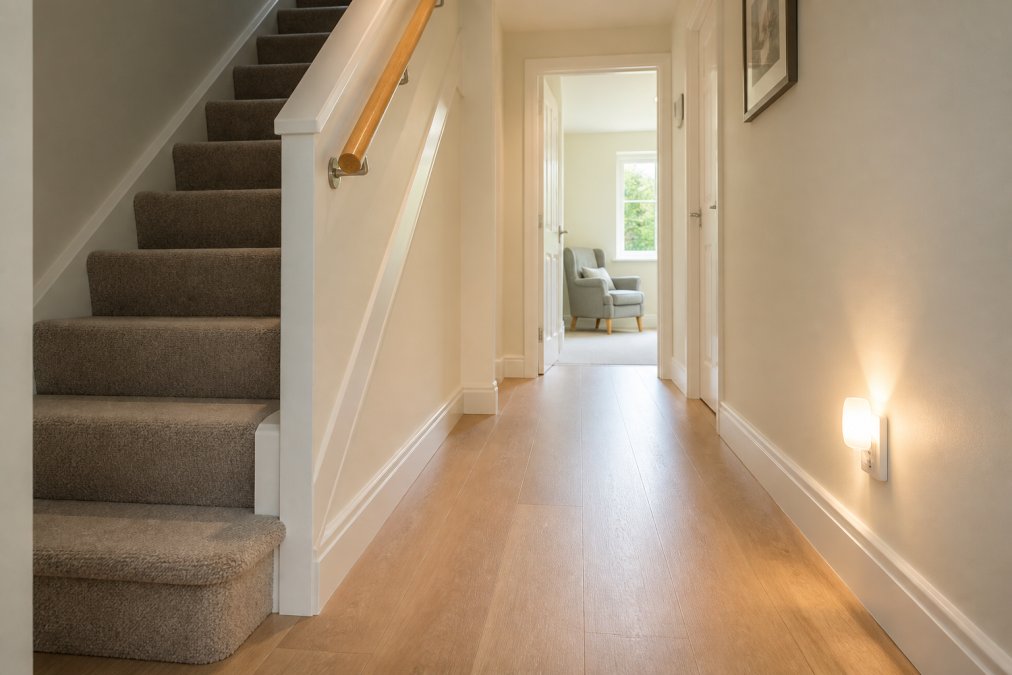
Clutter removal and better lighting are the cheapest ways to prevent falls, and usually the fastest to complete. Loose rugs, trailing cables, low coffee tables and piles of newspapers cause a large share of falls at home.
- Fit brighter bulbs in hallways, stairs and bathrooms
- Add plug-in night lights along the route to the toilet
- Keep a torch within reach of the bed
- Use lampshades that direct light downward onto walkways
Rooms That Need the Most Attention
Stairs, bathrooms and hallways cause the most falls. Stairway safety depends on clear steps, a secure carpet and light switches at both ends. Bathroom safety depends on dry floors and something solid to hold.
3. Install Grab Bars, Handrails and Other Home Adaptations for Fall Prevention
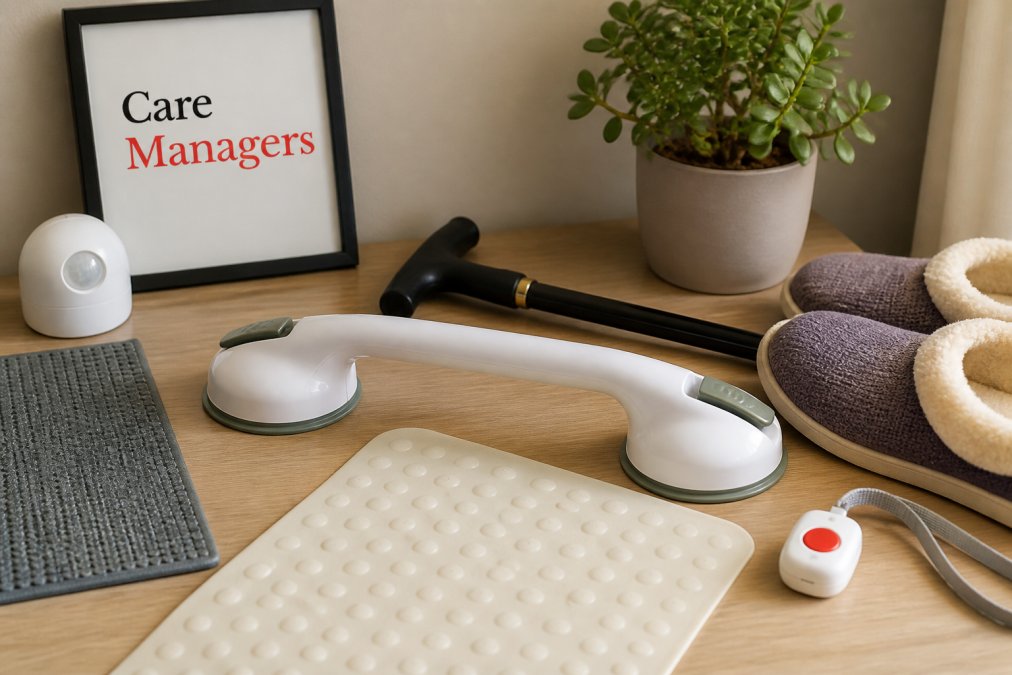
Home adaptations for fall prevention are fixed changes to the property: grab bars, handrails, ramps and adapted bathing equipment. They are the single most effective category of modification because they give the body something to lean on when balance wobbles. The key word is fixed. A suction rail that pops off under load is worse than no rail at all, because it teaches the user to trust support that will not hold.
Where to Fit Rails, and at What Height
Fit rails on both sides of the stairs, beside the toilet, inside the shower and next to the bath. Stair handrails should run the full length of the flight and continue past the top and bottom step, so the hand does not have to let go while the feet are still moving. A common mistake is fitting them too high or too low; an assessor will mark the correct height, typically level with the wrist when the arm hangs relaxed at the side.
Bathroom Safety Products Worth Considering
| Product | Typical Use | Why It Helps | What to Check Before Buying |
|---|---|---|---|
| Non-slip bath mat | Inside shower or bath | Grips wet floor surfaces | Suction base condition; replace when edges curl |
| Shower chair | Standing is difficult | Removes fatigue-related slips | Weight limit and non-slip feet |
| Transfer bench | Stepping over a high bath side | Reduces the need to lift legs high | Fits the bath width; adjustable legs |
| Grab rails | Toilet, shower, hallway | Provides steady support | Fixed to solid structure, not suction |
| Stairlift | Stairs are no longer safe | Removes stair use altogether | Survey, charging point, and turning space at top |
Stairlifts are a significant investment and need a home survey, so treat them as a last step rather than a first one. A straight flight is straightforward; a curved or narrow staircase costs more and takes longer to install, and the user still needs to transfer on and off the seat safely.
Funding Adaptations Through a Disabled Facilities Grant
Apply for the occupational therapy assessment first. The grant cannot be approved without it, and the assessment report is what tells the council which adaptations are necessary and appropriate.
For smaller jobs, some councils offer a handyperson service or a minor adaptations grant for low-cost items such as grab rails and lever taps. Ask what is available locally before assuming you must pay privately.
Smart Adaptations That Reduce Reliance on Rails
A newer option is to remove the need to move unsafely in the first place. Voice-activated lighting means no reaching for a switch in the dark. A fall-detection sensor or smart wearable can raise an alert without the user pressing anything, which matters if a fall leaves them unable to reach a pendant. These sit alongside physical adaptations rather than replacing them, but they close the gap between the moment of a fall and the arrival of help.
4. Try Exercises to Improve Balance for Seniors
Exercises to improve balance for seniors work best little and often. Strength training and balance work together: stronger legs catch a stumble before it becomes a fall.
- Stand on one foot while holding a worktop, building up the seconds
- Practise sitting to standing from a firm chair, ten times
- Walk heel to toe along a clear hallway
- Try tai chi or a falls prevention class
Do not start balance exercises unsupervised if your relative has already fallen or uses a walking aid. A physiotherapist should set the programme first, because the wrong exercise can increase the risk.
5. Review Medications and Book Regular Vision and Hearing Checks
Medication review is one of the most overlooked parts of fall prevention. Polypharmacy, taking several medicines at once, raises the risk of dizziness, drowsiness and unsteadiness, especially when doses change. The risk is not limited to sedatives: blood pressure medicines can drop pressure on standing, causing postural hypotension and a momentary blackout; diuretics increase the need to reach the toilet quickly, often at night; and some antidepressants, antihistamines and painkillers slow reaction time. Taken together, the effects compound.
Call us for Free Assessment Today →
Never stop or reduce a prescribed medicine without clinical advice. Some drugs cause rebound effects if stopped abruptly, and the GP needs to see the whole picture before changing anything.
How Vision and Hearing Loss Translate Into Falls
Vision screening matters just as much as medication. Cataracts, untreated glaucoma and outdated glasses prescriptions all blur depth perception, which makes stairs and kerbs harder to judge. Bifocals and varifocals are a particular trap on stairs, because the lower part of the lens is set for reading and distorts the view of the step directly below. Ask the optometrist about single-vision distance glasses for walking outdoors and on stairs.
Building a Simple Review Routine
- Once a year, book a medication review with the GP or pharmacist and bring the full list
- After any hospital stay or new diagnosis, ask for a repeat review, because discharge letters often add medicines without removing any
- Book an eye test at least every two years, or sooner if vision has changed, and mention any falls
- Get hearing checked if the television volume is creeping up or conversation in groups is difficult
- Keep a written list of medicines in the house, updated after every change, so any clinician can see it quickly
A GP, pharmacist or falls clinic can tie these threads together. If your relative has already fallen, ask for a referral to a falls service, which reviews medication, vision, hearing, balance and home hazards as one package rather than separately.
6. Use Assistive Technology and Emergency Response Systems
Assistive technology covers a growing range of devices that keep people safe at home, from simple mobility aids to connected sensors. Emergency response systems are the most established option: a pendant or wristband alarm that connects to a 24-hour monitoring centre.
Financial Assistance and Grants for Home Modifications
Help with the cost of adaptations is available, but the route depends on where you live and what is needed. In England, a Disabled Facilities Grant from the local council can fund adaptations such as stairlifts, ramps and level-access showers, subject to a means test and an occupational therapy assessment.
The Psychological Impact of Fall Fear and How to Address It
Fear of falling is a genuine health issue in its own right, not simply a reasonable reaction to a near miss. It causes people to reduce walking, avoid stairs and give up activities they enjoy, which weakens muscles and worsens gait stability, raising the risk of a real fall.
Frequently Asked Questions
What are the 5 P’s of falls prevention?
The 5 P’s are a practical checklist used by carers and healthcare professionals: Pain, Positioning, Personal needs (such as toileting), Placement of items within reach, and Possessions like glasses, hearing aids and walking aids. Running through this checklist regularly helps identify whether someone is uncomfortable, needs the toilet, or cannot reach what they need, all of which increase the likelihood of a fall. It is a simple framework that families can use daily to reduce risk.
How can home modifications help prevent falls for the elderly?
Home adaptations for fall prevention address the environmental factors that cause most falls: uneven floor surfaces, poor lighting levels, missing handrails and slippery bathroom surfaces. Simple changes such as fitting grab bars beside the toilet, installing a shower chair, adding non-slip mats and improving stairway lighting can make a significant difference. For larger properties, a stairlift or widened doorways may be appropriate. A professional home safety assessment can identify which modifications will have the greatest impact for your specific circumstances.
When should you consult a GP about fall risks?
Book an appointment with a GP if you or a loved one has had a fall, feels unsteady on their feet, experiences dizziness, or has started avoiding certain activities because of a fear of falling. A GP can review medications for side effects that affect balance, check for underlying conditions, and refer you to specialist services such as physiotherapy or an occupational therapist. Early intervention is far more effective than waiting for a fracture to occur.
Are there specific NHS resources for fall prevention at home?
The NHS provides several fall prevention resources, including strength and balance programmes often referred to as falls clinics, which are available through GP referral in many areas. Community physiotherapy services can assess gait stability and recommend exercises to improve balance for seniors. Occupational therapists can carry out a home safety assessment and advise on equipment and home adaptations. Contact your GP surgery or local health board to find out what is available in your area.
How can professional care support fall prevention?
Professional carers can help with medication reviews, prepare meals, assist with mobility aids, and ensure the home remains free of tripping hazards. They also provide reassurance and companionship, which reduces the psychological impact of fall fear. For families in South Wales and England, Care Managers offers tailored home care and live-in care services designed around individual routines, including specialist dementia care and supported living. A personalised care plan ensures consistent, dignified support that keeps your loved one safe at home.