
TL;DR:
- Families seeking care alternatives to brighterdayscare.co.uk can consider live-in care and reputable domiciliary agencies offering personalized support without moving into a care home. Key providers include Caremanagers, Everycare, Caremark, Atwell Care, and Livein.care, each with unique strengths and coverage. Verifying CQC registration and reading inspection reports ensures quality, while early planning and clear communication facilitate a smooth transition to trusted home care.
For families seeking alternatives to brighterdayscare.co.uk, live-in care and reputable domiciliary agencies such as Caremanagers offer the closest match to full-time, personalised support without requiring a move into a care home. The shortlist below covers the providers most worth considering, each with a one-line differentiator.
- Caremanagers — specialist live-in care, dementia support, and hospital discharge care across South Wales and England; bespoke care plans from the first assessment
- Everycare — established domiciliary agency network with local branches across Central Hampshire and beyond; suited to hourly visiting care
- Caremark — national franchise network offering hourly home care visits; wide geographic reach across the UK
- Atwell Care — smaller, relationship-led provider focused on consistent carer matching and personalised routines
- Livein.care — UK marketplace connecting families with vetted live-in carers; useful for comparing live-in options quickly
To verify any provider, search their name on the CQC inspection register and check the date and rating of their most recent inspection before making contact.
Table of Contents
- What do ‘alternatives to brighterdayscare.co.uk’ actually mean?
- How do the main alternatives to brighterdayscare.co.uk compare?
- How do you choose between home-care providers?
- How do you verify a provider’s quality using CQC reports?
- What does home care typically cost, and who can help fund it?
- Why Caremanagers stands out as a recommended alternative
- Detailed comparison: pricing tiers, service packages, and contract terms
- What do reviews and testimonials tell you about care quality?
- How flexible are providers with care plans?
- How responsive are providers when you need them?
- Key takeaways
- What families actually find matters most
- Caremanagers can help you find the right fit
- Useful UK sources to check now
- FAQ
What do ‘alternatives to brighterdayscare.co.uk’ actually mean?
The word “alternatives” covers several distinct care models, and the right one depends on your relative’s level of need, not just personal preference.
Live-in care places a trained carer in the person’s home to provide continuous, one-to-one support. It can often be arranged more quickly than a residential placement and keeps the person in familiar surroundings. How live-in care works differs from agency to agency, so understanding the contract structure matters from the outset.
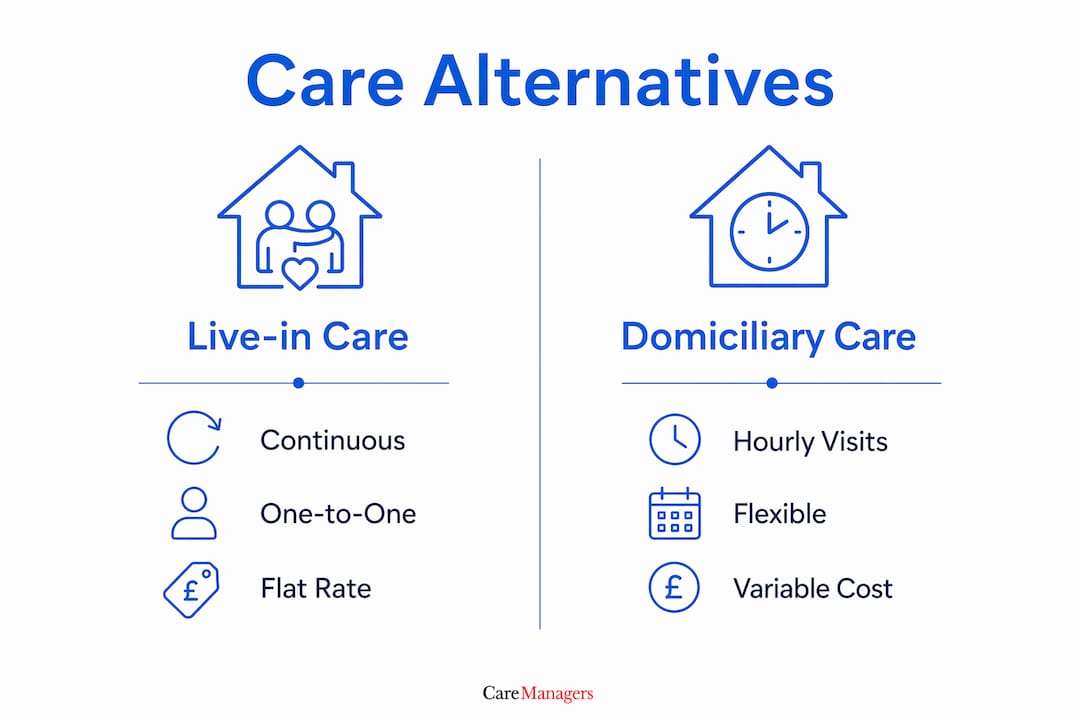
Domiciliary care (hourly home visits) suits people who need help at specific times of day but retain reasonable independence between visits. There are two main routes: using a registered homecare agency or employing a private carer directly. Agencies vary considerably in whether they supply the same carer each visit or rotate staff.
Extra-care housing and supported living can bridge independent living and residential care by combining self-contained accommodation with flexible on-site support. This is worth considering when hourly domiciliary care is no longer sufficient but a full care home placement feels premature.
Respite care gives family carers a planned break, either through a short residential stay or a temporary live-in arrangement at home. For people living with dementia, the Alzheimer’s Society recommends thinking carefully about respite and sheltered housing options early, since moving twice can be unsettling.
The model you choose also affects cost and speed of start. Live-in care typically carries a flat daily rate; domiciliary care is priced by the hour. Both can usually begin faster than a residential placement.
How do the main alternatives to brighterdayscare.co.uk compare?
| Provider | Best for | Service types | CQC registered | Geographic coverage | Pricing model | Speed of start |
|---|---|---|---|---|---|---|
| Caremanagers | Dementia, hospital discharge, live-in | live-in, hourly visits, respite, specialist dementia | Yes | South Wales and England | Live-in flat daily rate; hourly visits | Fast — assessment-led |
| Everycare | Hourly domiciliary, older adults | Hourly home visits, companionship | Yes | Central Hampshire and wider group branches | Hourly rate | Typically within days |
| Caremark | Wide geographic reach, hourly care | Hourly domiciliary, personal care | Yes | Nationwide franchise network | Hourly rate | Varies by franchise |
| Atwell Care | Consistent carer matching, personal routines | Hourly domiciliary, personal care | Yes | Selected UK areas | Hourly rate | Relationship-led; varies |
| Livein.care | Live-in carer search and comparison | Live-in care marketplace | Marketplace (carers individually registered) | UK-wide | Daily rate (carer-set) | Depends on carer availability |
A few practical notes beneath the table:
- Contract minimums vary. Some agencies require a minimum number of hours per week; live-in arrangements typically involve a minimum engagement period. Ask before signing.
- Notice periods for cancellation range from one week to one month. Confirm this in writing before care starts.
- Carer consistency is not guaranteed by all providers. Ask specifically whether the same carer attends each visit or whether a rota of staff is used.
For families ready to take the next step, Caremanagers offers a no-obligation assessment to discuss needs and match the right level of support. Details are on the home care services page.
How do you choose between home-care providers?
A consistent checklist makes comparison far easier, especially when you are speaking to several agencies at once.
- Assess your relative’s needs first. Write down the tasks they need help with, the times of day, and any specialist requirements (dementia, PEG feeding, post-hospital recovery) before you call anyone.
- Confirm CQC registration. Any provider of personal care in England must be registered with the CQC. Ask for their registration number and check it yourself.
- Ask about staffing consistency. Will the same carer attend regularly? What happens when the regular carer is on leave?
- Check specialist training. For dementia care, ask whether staff hold a recognised dementia qualification and whether personalised routines and environment adaptations are part of the care plan.
- Verify DBS checks. All carers should hold a current enhanced DBS certificate. Ask to see the policy, not just a verbal assurance.
- Request a written care plan. A good agency produces an individual care plan before care starts, not after. Ask who writes it and how often it is reviewed.
- Clarify contract terms. Get the minimum hours, notice period, and cancellation terms in writing.
Questions to ask on first contact:
- How quickly can you start?
- How do you match carers to clients?
- Is there a trial period?
- What is your complaints process and how quickly are concerns resolved?
- Are there any additional fees not included in the quoted rate?
Red flags to watch for: no CQC registration number offered, vague answers about staff training, pricing that changes significantly after the first quote, and no written care plan process.
How do you verify a provider’s quality using CQC reports?

The CQC rates every registered home-care agency on five questions: Safe, Effective, Caring, Responsive, and Well-led. The headline rating (Outstanding, Good, Requires Improvement, or Inadequate) is a starting point, not the whole picture.
Follow these steps to go deeper:
- Search the provider’s name on cqc.org.uk/care-services.
- Note the date of the most recent inspection. A ‘Good’ rating from several years ago tells you less than a recent one, particularly if the provider has changed management or expanded.
- Open the full report and read the ‘Well-led’ and ‘Safe’ sections in detail.
- Look for enforcement notices or warning notices, which appear separately from the rating.
- Check whether the report mentions specific improvements required and whether a follow-up inspection has since taken place.
Pro Tip: The ‘Well-led’ section is the single best predictor of consistent daily care. Look for phrases like “staff feel supported to raise concerns” and “the registered manager has a clear oversight of quality.” Vague or absent references to management visibility and staff feedback are worth probing in your first call with the provider.
Other trust signals worth checking: staff DBS certificates, evidence of specialist training (dementia, end-of-life), local authority contracting (councils only commission from providers they have assessed), and published family testimonials with verifiable detail.
What does home care typically cost, and who can help fund it?
Costs vary by care type and region, but the broad shapes are consistent across the UK.
- Live-in care: charged as a flat daily rate covering the carer’s time in the home. The rate varies depending on the level of need and whether the agency employs the carer directly or uses a separate payroll arrangement. Always check whether the quoted daily rate includes agency management fees, travel costs, and sleep-in allowances, since these contract details materially affect overall cost.
- Domiciliary (hourly) care: priced per hour, with rates varying by region and time of day (evenings and weekends typically attract a higher rate). Minimum visit lengths (often 30 or 45 minutes) affect the real cost per task.
- Hidden fees to ask about: travel time between visits, bank holiday premiums, and agency administration fees.
Funding routes:
- Self-funding: the most common route for families arranging care quickly. Get an itemised written estimate before committing.
- Local authority funding: means-tested. Contact your relative’s local council social services department to request a needs assessment. Funding is not immediate, so plan for a self-funded bridging period where needed.
- NHS Continuing Healthcare (CHC): available for people with a primary health need. Eligibility is assessed by the NHS, not the council. Ask the hospital discharge team or GP to initiate a CHC checklist if your relative has complex health needs.
A practical first step is to request a dated, itemised cost estimate from each provider before any commitment, alongside their most recent CQC inspection report.
Why Caremanagers stands out as a recommended alternative
Caremanagers covers a specific and meaningful range of services: live-in care, dementia support at home, hospital discharge care, and respite care across South Wales and England. What distinguishes the offer in practice is the assessment-led matching process. Before care starts, a care manager works with the family to understand the person’s routines, preferences, and clinical needs, then matches a carer accordingly rather than allocating whoever is available.
For families dealing with a hospital discharge, this matters considerably. Caremanagers’ hospital discharge care service is designed to move quickly, supporting a safe return home and reducing the risk of readmission. For dementia care, the team follows current best practice around personalised routines, environment, and family communication.
The live-in care guide for families on the Caremanagers website explains the full assessment and matching process in plain language, which is a useful read before making any provider calls.
Detailed comparison: pricing tiers, service packages, and contract terms
| Provider | Service packages | Pricing model | Contract terms |
|---|---|---|---|
| Caremanagers | Live-in, hourly domiciliary, dementia, hospital discharge, respite | Live-in flat daily rate; hourly for visits | Assessment-led; written care plan before start |
| Everycare | Hourly domiciliary, companionship, personal care | Hourly rate | Varies by branch; confirm minimum hours |
| Caremark | Hourly domiciliary, personal care, specialist support | Hourly rate | Franchise-set; confirm locally |
| Atwell Care | Hourly domiciliary, personal care | Hourly rate | Relationship-led; confirm notice period |
| Livein.care | Live-in carer matching | Daily rate (carer-set) | Carer-specific; check individual terms |
Pricing is not publicly listed by most providers, which is standard practice in the UK home-care market. Always request a written, itemised quote. For live-in care specifically, confirm whether the daily rate is all-inclusive or whether agency fees, travel, and sleep-in allowances are added separately.
What do reviews and testimonials tell you about care quality?
Published reviews on platforms such as homecare.co.uk and Google give a useful signal, but the detail matters more than the star rating. Look for reviews that mention specific carers by name, describe consistent attendance, and reference how the agency responded when something went wrong. Generic five-star reviews with no specifics are harder to rely on.
For dementia and complex care, family testimonials that describe the carer’s understanding of the person’s individual routines carry more weight than general praise. Caremanagers publishes family-facing guides and case studies on its website that explain how care is arranged and adapted over time, which gives families a clearer picture of what to expect in practice.
One useful cross-check: ask the provider whether they are commissioned by any local authority. Councils carry out their own due diligence before contracting with an agency, so local authority commissioning is an independent quality signal.
How flexible are providers with care plans?
Flexibility in care planning is one of the clearest differentiators between providers. A good agency treats the initial care plan as a starting point, not a fixed document. Needs change, particularly after a hospital discharge or as dementia progresses, and the care plan should be reviewed and updated accordingly.
Ask each provider how often care plans are formally reviewed and who initiates a review if the person’s needs change between scheduled dates. The answer tells you a great deal about how responsive the agency is in practice. Caremanagers builds bespoke care plans from the first assessment, with the expectation that they will be revised as the person’s situation evolves. Families who want to understand how care plan customisation works in practice will find the Caremanagers guidance pages a useful reference.
How responsive are providers when you need them?
Responsiveness covers two things: how quickly a provider can start care, and how reliably they communicate once care is running. Both matter, and they are worth testing before you commit.
On first contact, note how long it takes to receive a call back and whether the person you speak to can answer specific questions about staffing, training, and costs, or whether they defer everything to a follow-up. A provider that takes several days to return an initial enquiry is unlikely to respond faster once care has started.
Once care is running, ask how you will be updated if a carer is running late or needs to be substituted. The best agencies have a named point of contact for families and a clear escalation process for concerns. Caremanagers assigns a care manager to each family, giving you a consistent person to contact rather than a general enquiries line.
Key takeaways
Caremanagers is the recommended starting point for families seeking a CQC-registered, assessment-led alternative to brighterdayscare.co.uk, covering live-in care, dementia support, and hospital discharge care across South Wales and England.
| Point | Details |
|---|---|
| Verify CQC registration first | Check every provider on cqc.org.uk before making contact; confirm the inspection date, not just the rating. |
| Read the ‘Well-led’ section | This section of the full CQC report predicts management quality and training culture more reliably than the headline rating. |
| Get itemised written quotes | Ask for a dated, itemised cost estimate covering all fees before any commitment, especially for live-in care. |
| Plan funding early | Local authority funding is means-tested and not immediate; arrange self-funded bridging cover while an assessment is pending. |
| Caremanagers | Offers bespoke assessment-led care across South Wales and England, covering live-in, dementia, and hospital discharge needs. |
Typical timeline: initial provider calls (days 1–3) → care assessment (days 3–7) → care plan agreed (days 7–10) → care starts (days 10–14). Hospital discharge cases can often be arranged faster.
What families actually find matters most
Switching care providers is rarely a purely practical decision. Families consistently report that the hardest part is not finding a provider on paper, but trusting that the new arrangement will feel safe and familiar for their relative from day one.
Consistency of carer is the factor families mention most often. A rota of different faces each week is unsettling for anyone, and particularly so for someone living with dementia. The trade-off between a larger agency with wider geographic cover and a smaller provider who can guarantee the same carer most days is a genuine one, and there is no universal right answer. It depends on how much your relative values familiarity versus how important it is to have cover arranged quickly.
Cost versus specialist skill is the other common tension. A lower hourly rate from a general domiciliary agency may look attractive, but if your relative needs dementia-specific support or post-hospital rehabilitation, a provider with trained staff in those areas will deliver better outcomes. The emotional preparation for change is real too. Giving your relative time to meet the new carer before the first solo visit, and involving them in the decision where possible, makes the transition considerably smoother.
Caremanagers can help you find the right fit
Choosing between providers is easier when you have someone to talk it through with. Caremanagers offers a no-obligation assessment for families across South Wales and England, covering live-in care, dementia support, respite, and hospital discharge arrangements.
The assessment process starts with a conversation about your relative’s needs, routines, and preferences. From there, a care manager matches the right level of support and explains exactly what the care plan will include, in plain language, before anything is agreed.
- Phone: call Caremanagers directly to speak with a care manager about your situation
- Web enquiry: request a no-obligation assessment via the home care services page
Families in the Southampton area can also find local contact details and service information on the Southampton home care page.
Useful UK sources to check now
| Source | What it provides | Practical use |
|---|---|---|
| CQC — Find care services | Inspection reports and ratings for all registered providers | Verify any provider’s registration, rating, and inspection date |
| NHS — Help at home from a paid carer | Overview of homecare routes and national provider list | Understand agency vs private hire options and find national providers |
| NHS — Supported living services | Explanation of supported living and when it applies | Assess whether supported living is a better fit than domiciliary care |
| Alzheimer’s Society — Care options for dementia | Dementia-specific care options including respite and sheltered housing | Plan ahead for dementia care transitions |
| Caremanagers — Choosing home care services | Practical guidance on selecting a UK-registered home-care agency | Decision support before contacting providers |
| Caremanagers — Live-in care guide for families | Full explanation of live-in care assessment and matching | Understand what live-in care involves before enquiring |
FAQ
What is the best home care company in the UK?
No single provider suits every situation, but CQC-registered agencies rated ‘Good’ or ‘Outstanding’ with a recent inspection date are the safest starting point. Caremanagers is a strong option for families needing live-in care, dementia support, or hospital discharge care across South Wales and England.
Who are the largest care home groups in the UK?
The largest residential care groups in the UK include HC-One, Barchester Healthcare, and Care UK, but these are residential providers. For home care and live-in alternatives, national domiciliary networks such as Caremark and regional specialists such as Caremanagers are the more relevant comparison.
How do I check whether a home-care provider is properly registered?
Search the provider’s name on cqc.org.uk/care-services. Every provider of personal care in England must be registered with the CQC; if they do not appear, do not proceed.
How quickly can home care usually start?
Most domiciliary agencies can begin soon after an assessment is completed. Live-in care typically takes somewhat longer to arrange due to carer matching, though urgent hospital discharge cases may be arranged quickly.
What questions should I ask a home-care provider before agreeing to anything?
Ask about CQC registration, staffing consistency, specialist training (especially for dementia), DBS checks, care plan creation, minimum hours, notice periods, and any fees not included in the quoted rate. A provider that cannot answer these clearly at the first call is worth treating with caution.