
Table of Contents
- Why a Consistent Daily Routine Matters in Dementia Care
- What You’ll Need Before You Start
- Step 1: Build the Routine Around Their Natural Day
- Step 2: Structure Morning, Afternoon and Evening
- Dementia Care Activities at Home That Fill the Day Well
- Using a Dementia Care Plan Template to Keep the Routine on Track
- Managing Sundowning Symptoms with Routine
- Adapting the Routine as Dementia Progresses
- Frequently Asked Questions
Last Updated: September 18, 2026
Why a Consistent Daily Routine Matters in Dementia Care
Knowing how to create a daily routine for dementia patients is one of the most effective non-pharmacological tools in dementia care. It reduces confusion, eases anxiety, and helps maintain a person’s sense of dignity and control. At Care Managers, we see this daily across South Wales and England: when the day follows a predictable shape, behavioural symptoms often settle.
Predictability is not boring. For someone with cognitive impairment, it is calming. The same wake-up time, the same breakfast, the same chair all act as quiet signals that everything is fine.
What You’ll Need Before You Start
Gather a few basics before you build anything. This makes the process smoother and gives you something to adjust later.
- A notebook or a simple printed sheet for the plan
- A list of the person’s current medications and timings
- Notes on their preferences: food, music, hobbies, faith
- A calendar for appointments and family visits
- A dementia care plan template you can fill in and update
Step 1: Build the Routine Around Their Natural Day
Start with the person’s existing habits, not an idealised schedule. Watch their natural sleep-wake cycle for a week. Note when they wake, when they eat, and when they have more energy.
Rushing a new routine in one day rarely works. Introduce changes one at a time over a week or two. Sudden overhauls can increase agitation and set progress back.
Step 2: Structure Morning, Afternoon and Evening
Divide the day into three clear blocks. Each block has its own pace and purpose.
Morning: Waking, Washing and Breakfast
Keep mornings calm and unhurried. Open curtains at the same time each day to signal the start. Lay out clothes the night before to reduce choices.
Afternoon: Meals, Movement and Meaningful Activity
Afternoons are good for physical exercise and social engagement. A short walk, gentle chair exercises, or gardening all work.
Evening: Winding Down Towards Sleep
Evenings should slow down. Dim the lights, lower the noise, and avoid caffeine after mid-afternoon.
| Time Block | Focus | Example Activities |
|---|---|---|
| Morning | Orientation and care | Waking, washing, dressing, breakfast |
| Afternoon | Activity and connection | Lunch, walk, hobby, family visit |
| Evening | Wind-down | Light supper, music, bath, bed |
Dementia Care Activities at Home That Fill the Day Well
The right dementia care activities at home match the person’s stage and interests. They should feel useful, not childish.
- Folding laundry or sorting buttons
- Listening to music from their younger years
- Looking through photo albums and naming faces
- Simple baking or preparing vegetables
- Watering plants or light gardening
- Walking to the shop for one item
Keep a small box of “activity cards” on the shelf. When the person seems restless, pull one out. This removes the pressure of thinking of something on the spot.
Using a Dementia Care Plan Template to Keep the Routine on Track
A dementia care plan template turns good intentions into a repeatable day. It also gives every carer the same instructions, which reduces confusion for the person and friction between family members. The best templates are simple, visible, and updated regularly.
What to Include
Your template should cover:
- Wake, meal, and bed times
- Medication management timings
- Personal hygiene prompts
- Preferred activities and hobbies
- Calming strategies for difficult moments
- Emergency contacts and medical notes
- Cultural or faith-based practices (prayer times, dietary rules)
Making It Work Day to Day
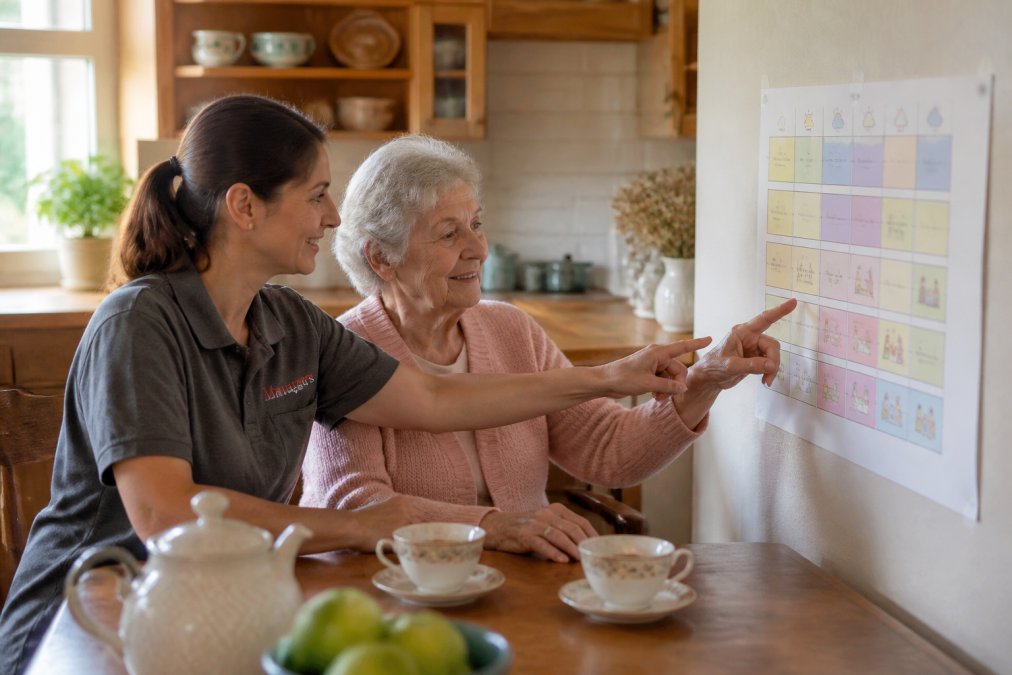
Print the template and keep it on the fridge or a noticeboard. Review it weekly. Note what worked and what caused distress, then adjust one thing at a time. A common pattern is that families change too many things at once and cannot tell what helped.
Call us for Free Assessment Today →
Technology-Assisted Scheduling
Digital tools can support the routine, especially when more than one person is involved in care. They work best as a backup to human cues, not a replacement.
- Shared digital calendars (e.g. Google Calendar, Apple Calendar) let family members see and update the day’s plan in real time. You can set recurring events for meals, medication, and activities.
- Medication reminder apps (e.g. Medisafe, MyTherapy) send alerts and can log when a dose was taken. This is particularly useful if multiple carers are involved.
- Smart speakers (e.g. Amazon Echo, Google Nest) can play voice prompts at set times, “It’s time for lunch”, or play familiar music. Voice prompts can be less confrontational than a person giving instructions.
- Smart plugs and lamps can turn lights on or off at set times to reinforce the body clock.
- Digital photo frames can display family photos and rotate them automatically, providing a gentle orientation cue.
If the person with dementia uses a smartphone or tablet, a shared calendar can help them keep track of appointments and family visits. Keep the interface simple and remove unused apps to avoid confusion.
A Note on Printable Templates
Many carers still prefer paper. A wall planner and a folder work well and never run out of battery. You can find free printable templates from dementia charities and some GP surgeries. If you use a paper template, keep a pencil handy so you can adjust times as the routine evolves.
Managing Sundowning Symptoms with Routine
Sundowning is a pattern of increased confusion, agitation, or anxiety in the late afternoon and early evening. A steady routine is one of the most reliable ways to reduce it, but generic advice to “dim the lights” rarely goes far enough. What follows is a concrete, hour-by-hour evening sequence you can adapt. It is built around the principle that the body clock needs clear signals well before dusk, not at bedtime.
A Sample Late-Afternoon to Bedtime Routine
Use this as a template. Adjust the times to match the person’s natural patterns, but keep the sequence and the gaps between steps consistent.
| Time | Action | Why It Helps |
|---|---|---|
| 15:30 | Close curtains and switch on a warm lamp in the main room | Prevents the abrupt light drop that can trigger confusion |
| 16:00 | Offer a light, protein-rich snack (e.g. cheese and crackers, yoghurt) | Steadies blood sugar without a heavy meal |
| 16:30 | Begin the wind-down playlist, familiar music from their twenties or thirties | Music taps into long-term memory and calms without requiring conversation |
| 17:00 | Serve a simple supper in the same seat, with minimal crockery and cutlery | Fewer choices reduce decision fatigue |
| 17:45 | Gentle hand massage or brushing hair | Provides calming sensory input and human contact |
| 18:30 | Reduce background noise, turn off the television, lower the radio | Overstimulation is a common trigger |
| 19:00 | Begin the personal care sequence: wash, change into nightclothes, brush teeth | Repetition builds a predictable cue that sleep is coming |
| 19:30 | Warm milky drink (caffeine-free) in a familiar mug | A consistent pre-sleep cue |
| 20:00 | Sit together in a dimly lit room, perhaps looking at a photo album or listening to quiet music | Allows the nervous system to settle without pressure to sleep |
| 20:30 | Guide to bed with the same words and actions each night | The brain associates the sequence with sleep |
Light, Meals and Activity Timing
- Get bright natural light in the morning to anchor the body clock. A walk outside before 10am is ideal.
- Serve the main meal at midday, not in the evening. A heavy evening meal can disrupt sleep and increase restlessness.
- Avoid stimulants like tea and coffee after lunch. Herbal teas such as chamomile are a gentler alternative.
- Schedule demanding tasks in the morning, quiet ones late afternoon. This matches the natural energy curve.
- Reduce noise and clutter as evening approaches. Turn off the television by early evening if it causes agitation.
- Keep the same wind-down sequence every night. Even small changes can unsettle.
When to Seek Help
If sundowning is severe, new, or worsening, speak to the person’s GP. A sudden change can signal infection, pain, or a medication issue. The GP can also review whether any prescribed drugs are contributing to late-day confusion. In some areas, community dementia nurses can offer further advice.
Keep a simple diary for two weeks, noting what happened in the two hours before agitation started. Patterns often emerge, a late appointment, a noisy visitor, or a missed snack, that you can then adjust.
Adapting the Routine as Dementia Progresses
Carer burnout is a real risk. If you are exhausted, the routine will suffer and so will you. Build in respite breaks and accept help. Respite care exists for exactly this reason.
Also consider cultural and dietary considerations. Prayer times, fasting, and specific foods matter deeply to many families. A routine that ignores them will feel wrong to the person, even if it is efficient on paper.
Frequently Asked Questions
What is the best daily routine for someone with dementia?
There is no single best routine, but the strongest ones share the same features: they follow the person’s natural sleep-wake cycle, keep meals, medication and personal hygiene at roughly the same times each day, and build in rest and meaningful activity in between. A predictable structure reduces anxiety because the person does not have to work out what happens next. Build the routine around their existing habits rather than imposing a new timetable, and keep it flexible enough to adapt as dementia progresses.
How can a structured routine reduce anxiety and sundowning symptoms?
Late-afternoon agitation often builds when the person is tired, hungry or confused about what is happening next. A structured schedule addresses all three: a mid-afternoon snack, a rest period and a predictable wind-down before dusk reduce the triggers. Keeping the evening calm, with curtains closed and lights on before it gets dark, supports the body clock. If managing sundowning symptoms with routine does not settle things, speak to the GP or a dementia specialist about further assessment.
What activities can I do at home with a dementia patient?
Choose activities that match their current abilities, not their past ones. Folding laundry, sorting buttons, watering plants, looking through photo albums, listening to music from their twenties or thirties, and simple baking all work well. Keep sessions short, around 15 to 30 minutes, and stop while things are still going well rather than waiting for frustration to build. Dementia care activities at home should feel like shared time, not a task to complete.
How do I adapt a daily routine as dementia progresses?
Expect to review the routine every few months, or sooner after a hospital stay or a noticeable change. In the early stage, the person can follow a written or printed schedule with prompts. In the middle stage, simplify each step, use environmental cues such as labels on cupboards, and allow more time for tasks. In the later stage, focus on comfort, familiar voices and gentle touch rather than activity. A dementia care plan template makes these reviews easier to track.