Last Updated: October 31, 2026
Quick Summary
Support groups for elderly caregivers matter because they turn an isolating, unpaid role into a shared experience where nobody needs the situation explained. They provide emotional validation, practical problem-solving and connection, reducing loneliness and restoring hope. Peer support complements but does not replace professional care.
- Sessions blend informal conversation with practical advice, and you are never forced to speak.
- Try two or three sessions before deciding, since leaving a first meeting silent is normal.
- Check step-free access, parking, toilets and hearing loops before choosing an in-person group.
- Under the Care Act 2014, adult carers can request a carer’s assessment from their local authority.
- A support group is peer support, not clinical care, and is no substitute for professional help.
Table of Contents
- The Isolation Crisis Facing Elderly Caregivers
- The Benefits of Caregiver Support Groups
- What to Expect at a Caregiver Support Group
- How to Find a Caregiver Support Group That Fits
- Dementia Caregiver Support Groups: What Makes Them Different
- Overcoming Barriers to Joining a Group
- When a Support Group Is Not Enough
- Book a Call to Build Your Support Network
- Frequently Asked Questions
The Isolation Crisis Facing Elderly Caregivers
Caring for another person can be one of the most rewarding things you will ever do.
The role is often full-time and unpaid, with no colleagues, no lunch breaks and no one to hand over to.
Many carers describe the same pattern:
- Conversations shrink to medication and appointments
- Friends stop calling because they do not know what to say
- Evenings are spent planning tomorrow rather than resting
Social isolation and loneliness wear down mood, sleep and patience.
Support groups break that pattern by giving elderly caregivers a room, real or virtual, where nobody needs the situation explained.
The Benefits of Caregiver Support Groups
The benefits of caregiver support groups come down to three things: emotional support, practical advice and connection.
Emotional Validation and Reduced Loneliness
The first benefit is often the most powerful: someone else says out loud what you have been thinking.
That moment is validation. You are not a bad carer for feeling frustrated. You are not failing because you cried in the car park.
Hearing this from a peer lands differently than hearing it from family.
Shared experience can help ease anxiety and stress, and can restore a sense of hope.
Practical Advice and Shared Problem-Solving
Support groups are also a swap shop for information. Shared problem-solving is where peer support earns its keep.
A common mistake is treating a support group as a talking circle only. In practice, the best sessions are full of practical detail.
Members share how they handle:
- Morning routines when a loved one is confused or agitated
- Getting up safely from a chair or bed
- Managing medication timetables and repeat prescriptions
Much of this practical knowledge comes from people who have already faced these challenges themselves.
What to Expect at a Caregiver Support Group
A caregiver support group is a regular meeting of people who look after someone, guided by a facilitator.
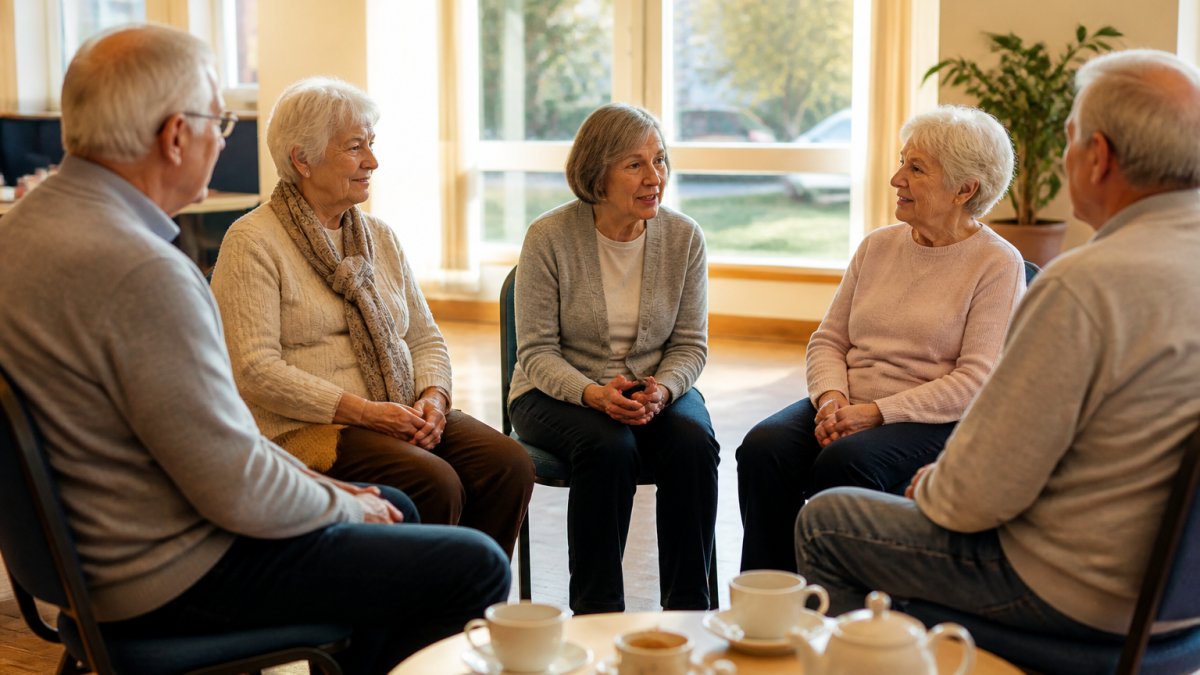
Your first meeting usually looks like this:
- A facilitator welcomes everyone and sets ground rules on privacy
- Each person shares as much or as little as they want
- The group discusses a theme, such as stress or a specific condition
- Members swap practical tips and local resources
- The facilitator closes with referrals and next steps
The tone is calm and nonjudgmental. What is said in the room stays in the room.
Watch out: some people leave a first meeting feeling it was not for them because they did not speak. That is normal. Try two or three sessions before you decide.
How to Find a Caregiver Support Group That Fits
Finding a group is easier than most carers expect. The harder part is judging whether it suits you, so use a simple checklist before you commit.
Start with these sources:
- Your GP surgery, which often holds a list of local carer groups
- The local authority’s adult social care team
- National charities that run helplines and peer support
Then score each option honestly:
- Is it for carers, not the people being cared for?
- Is the timing realistic for my week?
- Is it in person, online, by phone or hybrid?
If you are coming from a large, busy group and want something quieter, expect a smaller, slower session. That is a fit issue, not a failure.
Compare Formats Before You Commit
Older caregivers often rule out groups because of mobility, transport or hearing difficulties. Format matters as much as content. Use this comparison to narrow your options:
- In-person groups suit people who value face-to-face contact and live close to the venue. Check step-free access, parking, toilet facilities and whether the room has a hearing loop. Travel can be tiring, so consider a group that meets fortnightly rather than weekly.
- Online groups remove travel entirely and often run in the evening. They suit carers with unreliable respite or limited local options. Check whether the platform is easy to use, whether captions are available, and whether you can join by video or audio only.
- Telephone groups are the simplest option for people with vision or mobility needs. They usually run by conference call and require only a landline or mobile. Ask how many people typically join and whether the facilitator manages turn-taking.
Judge the Facilitator and the Culture
A group is only as good as its facilitation. A trained facilitator should set ground rules on privacy, manage dominant voices and signpost to professional help when needed.
- What training or supervision does the facilitator have?
- How does the group handle confidentiality?
- What happens if someone becomes distressed?
Group culture is harder to assess in advance, and a first visit tells you more than any description. Look for members who listen as much as they speak, new people being welcomed, and a facilitator who keeps the session on track without shutting people down.
If you are unsure between two groups, try one session of each before deciding. Most facilitators will not mind, and you will learn more from one meeting than from any phone call.
Consider a Group Specifically for Older Caregivers
Many groups mix carers of all ages, which can be valuable. But older caregivers often face distinct pressures: managing their own health alongside caregiving, caring for a spouse rather than a parent, and having fewer local friends who can step in.
Ask whether the group is age-specific or mixed. If it is mixed, ask whether sessions ever split into smaller discussions by care situation.
What to Do If You Cannot Find a Group
Some areas have limited options. If you cannot find a suitable group nearby, consider:
- Asking your GP surgery whether they would host a carer’s coffee morning
- Contacting a national charity about telephone or online groups that serve your region
- Joining a condition-specific online forum as a stopgap
A group does not have to be local to be useful. The key is that it fits your situation, your energy levels and your available time.
Call us for Free Assessment Today →
Format matters as much as content, so use this comparison to narrow your options.
| Format | Best for | Key difference |
|---|---|---|
| In-person groups | Face-to-face contact, living close to venue | Check step-free access, parking, hearing loop |
| Online groups | Unreliable respite or limited local options | No travel; often evening; captions may be available |
| Telephone groups | Vision or mobility needs | Conference call; landline or mobile only |
| Hybrid groups | Flexibility | Remote members can feel sidelined without active inclusion |
Dementia Caregiver Support Groups: What Makes Them Different
Dementia caregiver support groups are built around a condition that changes over time. That shapes how they run.
Members talk about things that rarely come up elsewhere:
- Behaviour that changes from week to week
- Communication that needs new approaches as speech fades
- Deciding when more support is needed at home
If you are caring for someone with dementia, a condition-specific group often fits better than a general one. You can also read more about dementia care and what specialist support looks like.
Overcoming Barriers to Joining a Group
Most carers who avoid groups have a good reason. The barriers are real, and they can be solved.
The most common ones:
- No time. Online and telephone groups often run in the evening or at lunchtime.
- No cover. Ask the local authority about a carer’s assessment and short breaks.
- Guilt. Many carers feel they should cope alone. They should not.
Pick one barrier and solve it first. Momentum matters more than a perfect plan.
When a Support Group Is Not Enough
A support group is peer support. It is not clinical care, and it is not a substitute for professional help. Readers who need more than peer support may want to explore companionship care for elderly people as an alternative source of connection.
There are clear signs that you need more:
- You are not sleeping, eating or managing basic tasks
- You feel hopeless most days
- You have thoughts of harming yourself or the person you care for
If any of these sound familiar, speak to your GP. You can also check whether you are showing signs of caregiver burnout, which is common and treatable.
What to Say to Your GP
Many carers delay seeing their GP because they feel their problems are not medical. But carers are entitled to support, and GPs can refer you to talking therapies, prescribe treatment for anxiety or depression, and signpost you to local services.
When you book an appointment, say clearly that you are a carer. You might say:
- “I am caring for my husband full-time and I am not sleeping.”
- “I am caring for my mother and I feel I cannot cope.”
- “I am a carer and I would like a carer’s assessment.”
You do not need to exaggerate. A good GP will understand that caregiving affects health. If you feel dismissed, ask to see another GP or contact the local carers service for advocacy.
Request a Carer’s Assessment
Under the Care Act 2014, adult carers can request a carer’s assessment from their local authority. Check the official GOV.UK guidance for current details. This is not a test of your ability.
The assessment can lead to:
- Respite care or short breaks
- Help with transport or equipment
- A direct payment to arrange support
You can request an assessment by contacting the adult social care team at your local authority. You do not need to wait for a crisis. Ask for it early, before you are exhausted.
Know the Difference Between Peer Support and Treatment
A support group can reduce isolation and help you feel understood. It cannot diagnose depression, prescribe medication or provide clinical therapy. If you are experiencing persistent low mood, anxiety or intrusive thoughts, peer support is not enough on its own.
Similarly, if the person you care for needs clinical input, such as a dementia review, a medication review or a falls assessment, a support group cannot provide that. Ask the GP or specialist team for a review.
If you or the person you care for is in immediate danger, call 999. If you are having thoughts of self-harm, speak to your GP urgently.
Consider Professional Care as Part of the Solution
For many families, the next step is professional support that adds regular practical help alongside the group.
Practical solutions for hard situations are also worth reading in this guide to common dementia caregiving challenges.
A support group and professional care are not alternatives. They work best together: the group gives you people who understand, and professional care gives you the practical relief that makes it possible to keep going.
Book a Call to Build Your Support Network
A support group gives you people who understand. It cannot provide practical relief on its own.
That is where we come in. At Care Managers, we provide compassionate home care, live-in care and supported living across South Wales and England, built around each person’s routines and preferences.
Our team can support you with:
- Tailored care plans shaped around the individual
- Respite care so you can rest and recharge
- Dementia care
You do not have to choose between a support group and professional help. Use both.
Get started with Care Managers and build a support network that holds you up, not just the person you care for. You can also get a personalised home care quote with confidence.
Frequently Asked Questions
Why are support groups helpful for elderly caregivers?
Support groups give elderly caregivers a regular space to share experiences with people in similar situations, which reduces the loneliness and anxiety that often come with caring alone. They offer emotional validation, practical advice on everything from medication routines to navigating care assessments, and a sense of purpose. For older carers who may have stepped back from work or social activities, the group can become a dependable part of their support network and help them manage caregiver stress more effectively.
What happens at a caregiver support group?
Most sessions are facilitated by a trained coordinator and last around 90 minutes. A typical meeting includes a welcome and check-in, a group discussion on a theme such as managing fatigue or coping with dementia-related behaviour, and time for shared problem-solving. Some groups invite guest speakers from local health or social care services. You are never obliged to speak; listening is a valid way to participate, especially in the first few sessions.
How can I find a support group for elderly caregivers near me?
Start with your GP surgery, which often holds lists of local carer groups, or contact the local authority’s adult social care team and ask about their carer support offer. National carers’ organisations often run search tools and helplines. For those who prefer not to travel, online and telephone groups are widely available. When evaluating a group, ask whether it is facilitated, how large it is, and whether members are mainly caring for people with similar conditions.
Are online caregiver support groups effective?
Online and telephone groups can be just as valuable as in-person ones, particularly for elderly caregivers who have limited transport options or who are reluctant to leave a care recipient alone. They remove travel time and can connect you with people across a wider area. The key factors are the same as for any group: a trained facilitator, a clear structure, and members at a comparable stage of caring. Try one session before deciding whether the format suits you.
Caring for someone you love should not mean carrying it alone. If you want practical, dignified support alongside your peer network, our team is ready to talk through what would help. Get started with Care Managers and arrange a conversation about the right care for your family.
