
TL;DR:
- Companionship care provides non-medical support to elderly people through social visits, emotional reassurance, and light practical help. It helps reduce loneliness, promotes mental and physical health, and serves as an entry point for layered home care services. Starting companionship care early supports independence, eases future transitions, and benefits both seniors and family caregivers.
Companionship care is defined as non-medical, in-home support that provides elderly people with regular social interaction, emotional reassurance, and light practical help to reduce isolation and maintain quality of life. Known formally in the care sector as companion care or social care support, it sits outside the boundaries of clinical or personal care. Social isolation raises dementia risk by 50% and heart disease risk by 29%. Those figures show why consistent human connection is not a luxury for older people. It is a health intervention in its own right.
What is companionship care and what does it include?
Companionship care covers a broad range of non-clinical activities designed to keep elderly people socially connected and emotionally supported at home. The service is flexible by design. It adapts to the individual’s personality, routines, and preferences rather than following a fixed script.
A typical companion care arrangement includes:
- Conversation and social visits. Regular, meaningful conversation is the foundation of the service. Companions listen, share stories, play games, and engage in hobbies alongside the person they support.
- Light household help. This includes meal preparation, light tidying, laundry, and running errands. These tasks are practical rather than personal care.
- Accompaniment. Companions travel with seniors to medical appointments, social clubs, religious services, or simply a walk in the park.
- Emotional support. Companions offer reassurance during anxious periods, particularly for those living alone after bereavement or a health setback.
- Medication reminders. Companions can remind a person to take their medication at the right time. Companion caregivers do not administer medication due to professional liability boundaries. That task remains with qualified nurses or the individual themselves.
- Technology assistance. Tech-savvy companions help seniors use smartphones, tablets, and video calling apps to stay in contact with family and friends.
Pro Tip: Ask any prospective companion care provider whether their carers are matched to clients by personality and interests, not just availability. A good personality match significantly improves outcomes and consistency.
The range of services varies between providers. Caremanagers, for example, tailors each arrangement to the individual, factoring in cultural background, daily routine, and personal preferences before placing a companion.

How does companionship care differ from other home care types?
Families often conflate companion care with personal or medical home care. The three are distinct services with different scopes, training requirements, and purposes.
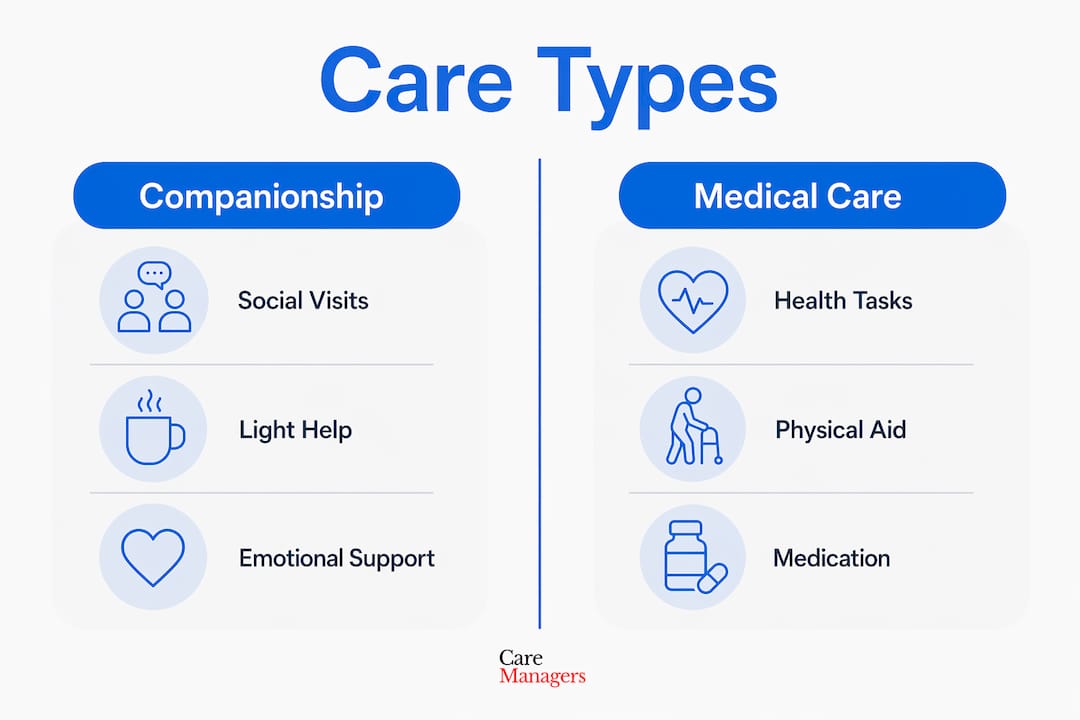
Companionship care focuses entirely on quality of life. It does not involve physical assistance with bathing, dressing, or toileting. Personal care, by contrast, covers those intimate daily living tasks and requires carers with specific training in manual handling and personal hygiene support. Medical home care goes further still, involving skilled nurses who carry out clinical tasks such as wound dressing, catheter care, or post-surgical monitoring.
Knowing these boundaries matters when you are choosing care for a loved one. Selecting the wrong category can leave real needs unmet or result in paying for a level of service that is not yet necessary.
| Care type | Primary focus | Medical tasks | Typical tasks |
|---|---|---|---|
| Companionship care | Social and emotional wellbeing | None | Conversation, light chores, outings, reminders |
| Personal care | Physical daily living support | None | Bathing, dressing, grooming, mobility |
| Medical home care | Clinical health management | Yes | Wound care, medication administration, nursing |
Pro Tip: Many families find that companionship care works best as a starting point. You can layer personal or medical care on top as needs change, without disrupting the existing relationship with a trusted companion.
Companionship care is often an entry point into a broader, layered care strategy. This approach allows gradual adjustments as a person’s needs evolve, avoiding abrupt transitions to higher-intensity care.
What are the health benefits of companionship care for seniors?
The health case for companion services for seniors is well established and measurable. Regular companionship reduces depression risk by 40–43% and increases physical activity levels by approximately 30% among older adults. Those are not marginal gains. They represent a meaningful shift in day-to-day health and mood.
“Loneliness is not just an emotional experience. It is a physiological stressor that accelerates cognitive decline, weakens immune function, and raises premature mortality risk by 26%.”
More than one third of adults aged 45 and over report loneliness. That scale of social disconnection sits behind many of the health crises families witness in elderly relatives. A companion who visits three times a week does not simply provide company. They interrupt a cycle of inactivity, low mood, and cognitive disengagement that compounds over time.
The benefits extend beyond the person receiving care. Nearly 8 in 10 family caregivers report significant stress and burnout. Professional companion care gives family members genuine respite. It means that when you do spend time with your loved one, you are present and energised rather than exhausted.
Cognitive engagement is another underappreciated benefit. Conversation, games, reading aloud, and shared activities all stimulate mental function. Consistent companionship helps seniors maintain cognitive reserve and physical safety at home for longer. The importance of companionship care, viewed through this lens, is not simply social. It is preventive medicine delivered through human connection.
What types of companionship care are available?
Companionship care is a highly customisable service ranging from simple social visits to full live-in support. Families often misunderstand it as a single uniform offering. It is better understood as a flexible umbrella with many configurations underneath.
The main types include:
- Visit-based companionship. A companion visits for a set number of hours per week. This suits people who are largely independent but benefit from regular social contact and light help.
- Live-in companionship. A companion lives in the home and provides round-the-clock presence. This suits people who are at risk of falls, experience night-time anxiety, or simply need consistent company.
- Culturally or religiously matched companionship. Providers who offer matching by language, faith, or cultural background produce significantly better outcomes for clients whose identity is central to their daily life.
- Activity-focused companionship. Some companions specialise in specific interests such as gardening, music, or gentle exercise. Matching on shared interests deepens engagement and motivation.
Choosing the right type depends on your loved one’s personality as much as their practical needs. A sociable person who misses intellectual conversation needs a different companion from someone who is quietly anxious and needs calm, consistent reassurance.
Early introduction of companion care acts as a preventive measure, supporting cognitive and physical health before decline sets in. Waiting for a crisis before arranging support misses this window entirely. Families who arrange companion visits while a loved one is still largely independent find the transition far smoother and the outcomes far better.
When you are ready to choose the right home care arrangement, consider starting with a companionship assessment to establish baseline needs before adding further layers of support.
| Companionship type | Best suited to | Key feature |
|---|---|---|
| Visit-based | Independent seniors needing social contact | Flexible scheduling |
| Live-in | Those needing constant presence or night support | 24-hour companionship |
| Culturally matched | Seniors with strong cultural or religious identity | Language and faith alignment |
| Activity-focused | Seniors with specific hobbies or interests | Shared interest matching |
Understanding why home care matters for families helps you frame companionship not as a last resort but as a proactive choice that protects independence.
Key takeaways
Companionship care is the most effective non-medical tool for reducing isolation, protecting cognitive health, and supporting family carers in elderly care.
| Point | Details |
|---|---|
| Defined scope | Companionship care covers social visits, light chores, and emotional support, not medical or personal care tasks. |
| Proven health impact | Regular companion visits reduce depression risk by 40–43% and increase physical activity by around 30%. |
| Distinct from other care | Companionship, personal care, and medical home care serve different needs and should not be confused. |
| Flexible and customisable | Options range from weekly visits to live-in support, with matching by personality, culture, and interests. |
| Start early | Introducing companionship care before decline sets in preserves cognitive reserve and eases future transitions. |
Why I think we underestimate companionship care
Having worked closely with families navigating home care decisions, I have seen a consistent pattern. Families treat companionship care as the soft option. They arrange it reluctantly, often only after a crisis, and they underestimate how much it does.
The reality is that a skilled companion does more than keep someone company. They notice changes in mood, appetite, and behaviour that family members, visiting less frequently, often miss. They provide the kind of low-pressure, consistent presence that clinical visits simply cannot replicate. That continuity is where the real value lies.
I have also seen the relief on a family carer’s face when they finally accept professional support. The guilt around “handing over” care to someone else is real. But the alternative, a burned-out family member trying to be everything, rarely serves the elderly person well either.
My honest advice is this: do not wait until your loved one is in crisis before arranging companion care. Introduce it early, frame it as a social arrangement rather than a care package, and let the relationship build naturally. The people who benefit most are those who start before they feel they need to.
If your loved one has dementia, the challenges of dementia caregiving make consistent companionship even more valuable. A familiar face and a predictable routine can reduce agitation and improve daily functioning in ways that medication alone cannot.
— Emm
How Caremanagers supports families with companionship care
Caremanagers provides personalised home care and live-in support across South Wales and England, including tailored companion care matched to each client’s personality, interests, and daily routine.

Whether your loved one needs a few hours of social company each week or a full-time live-in companion, Caremanagers works with families to find the right fit from the start. Every arrangement is built around the individual, not a standard package. The team involves families throughout the process, from the initial assessment to ongoing reviews, so you always know how your loved one is doing. To understand the full range of options available, visit the Caremanagers home care services page or read the guide on why home care matters for families like yours.
FAQ
What is companionship care in simple terms?
Companionship care is non-medical support that provides elderly people with regular social visits, conversation, light household help, and emotional reassurance at home. It is designed to reduce loneliness and improve quality of life rather than address clinical health needs.
Who needs companionship care?
Companionship care suits older adults who live alone, feel isolated, or need light practical support but do not yet require personal or medical care. It is also valuable for those whose family carers need regular respite.
Does a companion carer give medication?
No. Companion carers can remind a person to take their medication, but they do not administer it. Medication administration is outside the scope of companion care due to professional and legal boundaries.
How much does companion care cost?
Companion care typically costs between £20 and £28 per hour in many markets, making it a more affordable option than residential or assisted living facilities. Costs in the UK vary by region and provider, so it is worth requesting a personalised quote.
When should I arrange companionship care for a loved one?
Arranging companion care early before significant decline produces better outcomes than waiting for a crisis. Early introduction supports cognitive health, builds trust with the companion, and makes future care transitions smoother.