
You have arrived for a scheduled domiciliary visit, knocked firmly, and waited. Silence. The question that every care manager and field worker eventually faces is this: what happens if a client does not answer the door? It is a moment that pulls you in two directions at once. On one side sits your duty of care, the knowledge that a vulnerable person is inside and expecting you. On the other sits a set of legal, ethical, and practical boundaries: the client’s right to privacy, your own safety as a lone worker, and the policies that govern your actions. This guide walks through the full picture, from understanding why a client might not answer, through the immediate risk assessment, to the step-by-step escalation protocol that keeps everyone safe and keeps your service CQC-compliant.
Table of Contents
Why Clients Don’t Answer the Door (Understanding the Context)
Before you act, you need to understand the range of reasons a client might not come to the door. Jumping to the worst-case scenario is natural, but it is not always accurate, and your response should be shaped by what is most likely, not just what is most frightening.
Safety and stranger anxiety play a significant role, even when a visit is scheduled. Research cited by the Herts Advertiser found that one in five Brits will not answer the door to anyone they are not expecting. For an older or more vulnerable client, that instinct can be even stronger. They may have forgotten the appointment. They may have woken from a nap disoriented. They may simply feel too frail to confront whoever is on the other side, even if that person is a familiar carer. A separate study, referenced by Upworthy, put the figure even higher: 52 percent of people will not answer the door for a stranger. If your agency uses rotating staff and the client does not recognise the face through the glass, that statistic becomes immediately relevant.
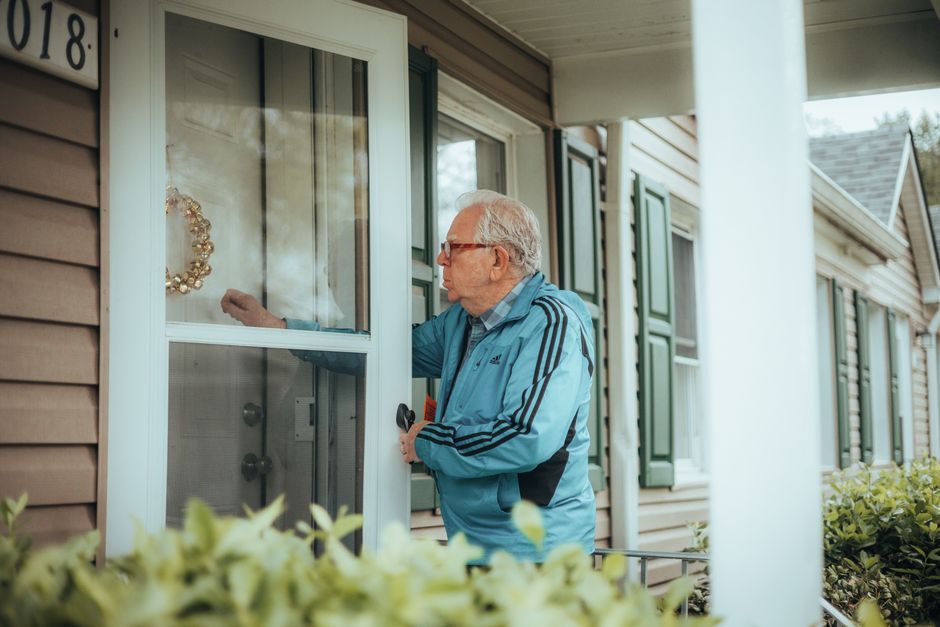
Physical and cognitive barriers are equally common in care settings. Hearing loss can make a standard knock inaudible, especially in a larger home or if the client is in a back room. Mobility issues mean that even if they hear you, reaching the door might take several minutes. A client with dementia may be confused about the time of day or the purpose of the visit, and may choose not to respond out of uncertainty rather than intent.
Then there is the question of personal boundaries. The client may be in the bath, on the toilet, or simply not dressed. A Mumsnet thread on this topic, which drew 128 replies, captured a growing cultural consensus: choosing not to answer your own door is not inherently rude. One user put it plainly: “It’s rude in reverse, people shouldn’t automatically assume that you should be available to talk to them.” For a care recipient who already feels a loss of independence, the right to ignore a knock can feel like one of the few remaining forms of control over their own space. Respecting that does not mean abandoning your duty; it means understanding the context before you escalate.
Finally, consider the unannounced visitor factor. If the visit time was changed, or if the client did not receive or understand the confirmation call, they may genuinely believe you are a salesperson, a charity collector, or a stranger. In their mind, not answering is the sensible, safe choice.
Immediate Safety and Risk Assessment (The First 5 Minutes)
Your first action is not to knock harder. It is to assess. The initial moments after a failed knock are critical, and they should follow a structured thought process rather than a reactive one.
Begin with your lone worker protocol. If you are working alone, which is standard in domiciliary care, you must not enter a property without a clear visual or verbal confirmation that it is safe to do so. This is not only about the client’s wellbeing; it is about yours. An unresponsive client could mean a medical emergency, but it could also mean an unsafe environment that you are walking into blind. Your employer’s lone worker policy exists for precisely this scenario, and deviating from it exposes both you and the organisation to risk.

Conduct a visual sweep of what you can see from outside. Look through any glass panels in the door or front windows. Is there a shadow on the floor that might indicate a fall? Is the back gate open, suggesting the client may be in the garden? Are curtains still drawn at midday, or is a milk bottle still on the doorstep from the morning delivery? These small details build a picture. A single anomaly might mean nothing; two or three together start to tell a story worth acting on.
Listen carefully. Press your ear close to the door or letterbox, but do so discreetly and respectfully. Can you hear a television that is unusually loud, perhaps turned up to compensate for hearing loss or left on overnight? Is there a tap running, which might mean the client collapsed while washing up? Is there a call for help, faint but distinct? Distinguish between the normal sounds of an occupied home and the sounds that suggest something has gone wrong.
Adopt a standard waiting period before you escalate. A sensible benchmark, borrowed partly from delivery driver protocols and adapted for care settings, is five minutes. Use that time actively. Call the client’s landline. Call their mobile. Send a text message. You are not simply standing there; you are gathering evidence that you made every reasonable attempt to establish contact. If the client has a pendant alarm or telecare system, this is the moment to check whether it has been triggered recently, though you may need to contact your office to do so.
Step-by-Step Escalation Protocol for Care Managers
When the five-minute window closes and you still have no response, you move from assessment to action. The following protocol should be embedded in your agency’s policies and understood by every field worker.
Step 1 – Attempt Contact (Phone and Key Safe)
Call the client’s landline and mobile again. This time, leave a clear voicemail stating who you are, that you are at the front door, and that you will wait a further few minutes before taking the next step. Speak calmly and loudly enough to be heard if the client is nearby but unable to reach the phone.
If you have key safe access, this is where the protocol becomes especially sensitive. Do not enter immediately. Unlock the door, open it a few inches, and announce yourself loudly by name and role. Shout that you are coming in and ask if the client is alright. Wait for a response. Entering a property unannounced, even with a key safe code, can be deeply distressing for a client who is disoriented or who simply did not hear the initial knock. It can also place you in a vulnerable position if the client reacts with fear or anger.
Check the care plan. Some clients have specific “no answer” instructions documented in their file. A client with mental health needs might have requested that carers do not enter if they fail to answer before 10am, respecting a known pattern of late sleeping. Another client might have a note that a neighbour holds a spare key and should be contacted first. The care plan is your first reference point, not an afterthought.
Step 2 – Contact the Emergency Contact and Office
Call the nominated family member or neighbour listed in the care plan. Keep the conversation factual: you have arrived for the scheduled visit, you have knocked and called multiple times, and you have received no response. Ask whether they have heard from the client today. Ask whether there is any reason the client might not be answering. If the emergency contact is local, they may be able to attend the property, which can resolve the situation more calmly than a police welfare check.
Simultaneously, inform your office or manager. They need to know that a visit has not gone ahead as planned. They may have access to a GPS check-in system that shows the client’s location, or they may be able to contact a previous carer who saw the client earlier in the day. The office can also begin the process of logging the missed visit in the care notes, which is essential for CQC compliance and for identifying patterns over time.
Log everything as you go. Timestamps matter. Note when you arrived, when you first knocked, when you called, when you contacted the emergency contact, and when you spoke to the office. If this situation ever escalates to a safeguarding review or a complaint, your contemporaneous notes will be the foundation of your defence.
Step 3 – The Welfare Check (When to Call 999 or 111)
The decision to involve emergency services is the most consequential step in the protocol, and it requires clear clinical and situational judgement.
Call 999 for police or ambulance if you have visible evidence of a medical emergency. This includes seeing the client on the floor through a window, spotting blood, smelling gas, or hearing sounds of distress that suggest someone is injured and unable to move. If the client has a known condition that makes a sudden collapse likely, such as advanced heart disease or a history of strokes, and there is no response after repeated attempts, err on the side of calling 999. You are not being alarmist; you are acting on reasonable concern.
Call 111 if the situation is less acute but still worrying. A client with epilepsy or diabetes who misses a scheduled visit may be at risk of a medical event, but if there are no visible signs of an emergency, 111 can provide clinical advice on whether an ambulance is warranted. They may also be able to access the client’s NHS records and advise on next steps.
Do not break the door down yourself. This point needs to be stated plainly because the impulse to act can be overwhelming. Unless you are specifically trained in forced entry and the risk is immediate and incontrovertible, such as visible flames or rising floodwater, wait for emergency services. The police have the legal authority to force entry for a welfare check. You do not. Breaking a door or window without that authority can leave you personally liable for the damage and can complicate the client’s relationship with the care provider.
Legal and Regulatory Considerations for UK Care Providers
The legal framework around missed visits is not always intuitive, but it is consistent. You have a duty of care, but that duty operates alongside the client’s right to privacy, dignity, and autonomy.
CQC compliance requires that missed visits are recorded and reported. A single missed visit, properly documented, is unlikely to trigger regulatory concern. A pattern of missed visits is different. If a client repeatedly fails to answer the door, the CQC will expect the provider to have reviewed the care plan, investigated the underlying causes, and considered whether the current arrangement is appropriate. This might mean a safeguarding review, a reassessment of visit times, or a conversation with the client and family about whether domiciliary care is still suitable.
GDPR and data security impose clear limits on what you can do at the doorstep. Do not leave written notes stuck to the door or pushed through the letterbox that contain personal information visible to passers-by. Do not discuss the client’s condition or care arrangements with neighbours unless that neighbour is a named emergency contact in the care plan. A well-meaning conversation with the person next door can easily become a data breach.
If you call the police for a welfare check, they have the legal right to force entry if they reasonably suspect a person inside is in danger. You are not liable for the resulting damage. This is a point worth reinforcing with families who may be upset about a broken door or window. The alternative, leaving a vulnerable person unassisted during a medical crisis, is far worse.
Perhaps most importantly, a client has the legal right to refuse a visit. If they are inside, aware of your presence, and choose not to answer, you cannot force entry for a routine check. Respecting that refusal is not a failure of care; it is a recognition of the client’s autonomy. The exception, and it is a narrow one, is when there is clear and immediate evidence of a safeguarding risk. A client who simply does not want to see you today is exercising a right, not creating an emergency.
How Technology Is Changing the “Door Answer” Problem
The current conversation around unanswered doors in care settings has largely overlooked the role of technology, but this is changing rapidly. Smart home devices and digital communication tools are closing the gap between a knock and a response.
Video doorbells, such as Ring or Nest, allow a client to see who is at the door without getting up. For a client with limited mobility or anxiety about strangers, this can be transformative. They can speak to the carer through the doorbell’s speaker, confirm their identity, and either grant access or explain that they need a few minutes. Care managers can discuss video doorbells during the onboarding process, framing them as a safety tool that benefits both parties.
Smart locks and key safes are already standard in many care arrangements, but they need to be managed properly. Key safe codes should be updated regularly, especially after a staff change or a security concern. Smart locks that allow remote access can give a trusted carer entry without the client needing to reach the door, but they also require clear protocols about when remote unlocking is appropriate.
Telecare systems and pendant alarms add another layer. If a client has a pendant alarm, the “no answer” protocol should include checking with the monitoring centre to see whether the alarm has been triggered recently. A client who has pressed their pendant but cannot speak may be waiting for help that the monitoring centre cannot dispatch without more information.
SMS and app-based confirmation systems are simple but effective. An automated text reminder sent 30 minutes before a visit gives the client a chance to confirm they are expecting you. A client who replies is far less likely to ignore the knock. If your agency uses a care management app, build this reminder step into the workflow. It reduces anxiety on both sides and cuts down the number of missed contacts.
Communication and Boundary Setting (The “Rudeness” Debate)
The emotional dimension of an unanswered door is rarely discussed in policy documents, but it affects both carers and clients in ways that can erode the care relationship if left unaddressed.
For the carer, a silent door can feel like a personal rejection. You have travelled to the property, prepared for the visit, and arrived ready to help, only to be ignored. It is easy to feel frustrated or to assume the client is being difficult. Reframing the situation helps. In almost every case, the client’s failure to answer is not about you. It is about fear, fatigue, confusion, or a simple desire for privacy. Accepting that emotionally makes the protocol easier to follow calmly.
For the client, the home is a sanctuary, and the right to control who enters it is fundamental. A Medium article titled “You Don’t Have to Answer the Door Just Because It Knocked” captured this sentiment, arguing that door-answering is a boundary-setting issue, not a social obligation. Clients who have spent decades in their own homes may feel that a care schedule, however well-intentioned, erodes that boundary. Acknowledging this openly, rather than dismissing it as stubbornness, builds trust.
The most effective way to manage this tension is to set expectations from the start. Include a “door policy” in the client’s care agreement. Explain clearly what will happen if they do not answer: you will wait five minutes, call their phone, try once more, and then leave a card or send a text confirming you attended. If there are signs of an emergency, you will call 999. This removes guilt on the client’s side and uncertainty on the carer’s. Everyone knows the script.
Handling complaints from family members follows the same logic. If a relative claims that a carer “didn’t try hard enough,” your logged protocol is your answer. Timestamps, phone logs, and contemporaneous notes demonstrate due diligence. A family member who understands the protocol in advance is far less likely to complain in the first place, which is why the door policy should be shared with families during onboarding, not buried in a document they never read.
Summary and Best Practice Checklist for Care Managers
An unanswered door during a scheduled care visit is a test of your agency’s systems, not just the carer’s judgement. The difference between a well-handled incident and a safeguarding failure often comes down to whether the protocol was clear, documented, and followed.
Always follow the three-step rule: assess the situation visually and audibly, attempt contact through every available channel, and escalate to the emergency contact, your office, or emergency services as the evidence dictates. Document everything. A missed visit without a contemporaneous note is a CQC red flag and a liability risk. Use technology, from video doorbells to SMS reminders, to reduce the frequency of unanswered doors before they happen. Educate clients and families about the “no answer” protocol during the onboarding process, so that when the moment comes, no one is surprised. And above all, prioritise safety over politeness. Calling the police because you suspect a fall is not an overreaction. It is the responsible exercise of your duty of care, and it is exactly what you are there to do.