
What is contract care staffing in UK healthcare?
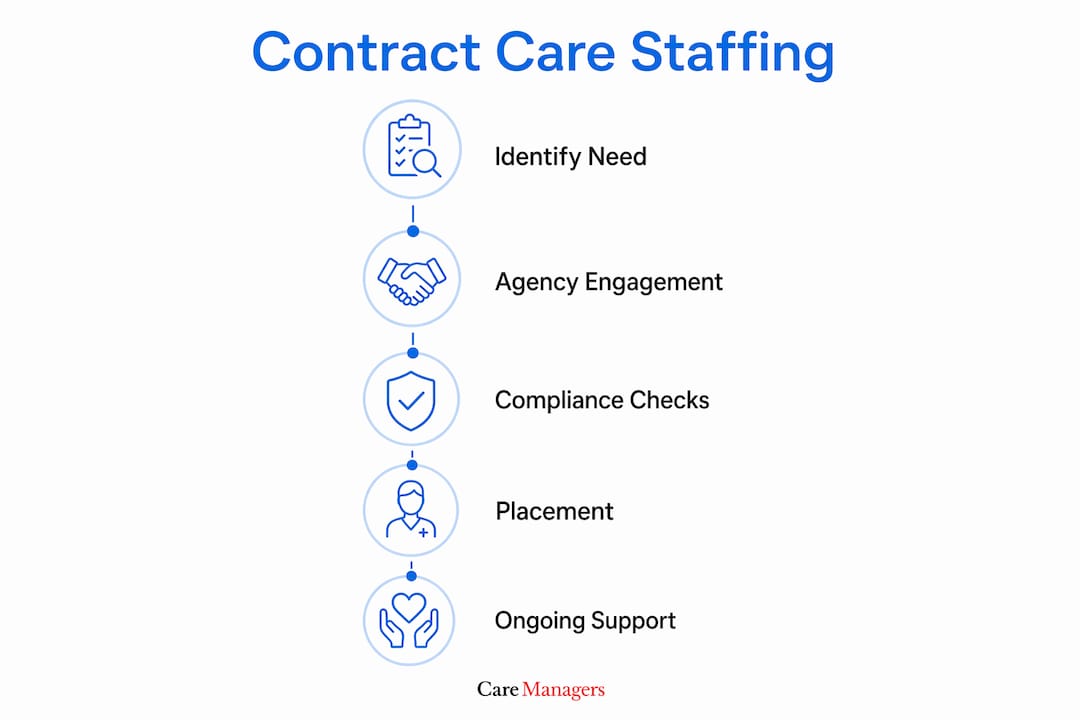
Contract care staffing is the practice of hiring healthcare professionals through regulated agencies on a fixed-term or project basis to fill temporary workforce gaps. Rather than recruiting permanently, a care provider engages an agency, which sources, vets, and places a suitable professional, often within hours for urgent shifts. The arrangement sits between the employer and the worker, with the agency carrying most of the compliance burden.
This model is formally recognised under the Health and Social Care Act 2008, which explicitly includes agency worker supply agreements within its definition of employment in regulated care settings. That legal grounding matters: it means contract staffing is not a workaround but a structured, regulated route to workforce flexibility.
- Contract staffing fills short-term gaps such as maternity cover, seasonal peaks, or specialist project needs
- Agencies handle compliance checks, freeing providers to focus on care delivery
- Workers are engaged for a defined period rather than on open-ended employment terms
- The model differs from permanent hiring in cost structure, lead time, and contractual obligations
Where permanent recruitment typically takes 4–12 weeks, contract placements can be arranged in as little as two hours for urgent cover. That speed is the defining practical advantage.
How do care worker agencies support contract staffing?
Agencies act as regulated intermediaries between healthcare providers and the professionals they need. Their role goes well beyond posting job adverts: they carry out mandatory compliance checks, maintain candidate pools, and provide ongoing clinical oversight once a placement is made.
- DBS enhanced certificates, right-to-work verification, and NMC or HCPC registration checks are completed before any placement
- Agencies monitor professional registrations continuously rather than checking once at onboarding
- Occupational health clearance, vaccination records, and mandatory training evidence are verified as standard
- A dedicated account manager typically handles shift confirmations and urgent gap cover
Healthcare staffing agencies conduct these compliance checks so that care providers meet Care Quality Commission (CQC) ready standards without managing every hiring step internally. That division of responsibility is what makes the model operationally practical for busy care settings.
Over 40% of healthcare professionals in the UK now prioritise flexible contracts and portfolio careers, which means the most experienced clinicians are increasingly choosing agency work over permanent roles. Providers who access this talent pool through a trusted agency gain access to a wider, highly skilled workforce.

Pro Tip: Ask any agency you are considering how clinical oversight works within their organisation. The best agencies have qualified clinical staff assessing candidate suitability beyond a checklist, which matters most in specialist roles such as mental health nursing or theatre work.
What types of roles and contracts does contract care staffing cover?
Contract care staffing spans a broad range of clinical and non-clinical roles, each suited to different service pressures.
- Registered Nurses (RGN, RMN, RSCN): placed for ward cover, community nursing, or specialist unit support
- Healthcare Assistants (HCAs) and Support Workers: the most frequently placed group, covering personal care, observation duties, and ward support
- Allied Health Professionals: physiotherapists, occupational therapists, and radiographers engaged for project-based or maternity cover work
- Locum doctors and specialist clinicians: typically engaged on short, defined contracts where a permanent hire is neither practical nor warranted
Contract arrangements vary just as much as the roles themselves. Temporary bank-style contracts cover single shifts or short blocks. Locum agreements suit highly specialist roles where flexible working is the professional norm. Contract-to-hire arrangements allow a provider to assess a worker before offering a permanent position, reducing the risk of a poor long-term fit.
Pro Tip: Match the contract type to the service need before approaching an agency. A contract-to-hire arrangement suits a role where cultural fit matters long-term; a pure temporary contract suits a known, time-limited gap such as a colleague’s parental leave.

What compliance and legal requirements govern contract care staffing in the UK?
Compliance in contract care staffing is not optional, and the consequences of getting it wrong extend beyond regulatory fines to patient safety. Every placement must meet a defined set of standards before a worker sets foot on site.
- Enhanced DBS certificate (not standard disclosure)
- Verified NMC or HCPC registration, monitored throughout the placement
- Confirmed right to work in the UK
- Occupational health clearance including relevant vaccination records
- Current mandatory and statutory training across all required areas
- At least two verified professional references
NHS England requires trusts to procure agency staff through approved framework agreements such as RM6380, the Health Workforce Solutions Framework delivered through the NHS Workforce Alliance. Working outside these frameworks creates procurement governance risk and complicates audit evidence.
The legal picture is equally layered. Employment status is determined by the reality of the working relationship, not simply by what a contract states. The Agency Workers Regulations 2010 grant agency workers equal treatment rights after 12 weeks in the same role. IR35 rules affect how off-payroll working is taxed, and the responsibility for status determination can fall on the engaging organisation rather than the agency. Taking professional legal advice before signing a staffing contract is not excessive caution; it is standard practice.
Contract care staffing in the UK operates within a framework of CQC standards, NHS procurement rules, and employment law that collectively protect both patients and workers.
How do you choose the right contract care staffing agency?
Choosing a staffing agency is a procurement governance decision, not simply an operational one. The wrong choice creates compliance risk, inconsistent care quality, and potential legal exposure.
- Framework membership: any agency working with NHS organisations must sit within an approved framework such as RM6380. This is the baseline, not a premium feature
- Clinical expertise: a specialist healthcare agency understands the clinical environments it places into; a generalist recruiter with a healthcare division does not
- Transparent rate structures: you should be able to see how rates are calculated and confirm they sit within agreed framework limits
- Communication quality: response times, named contacts, and proactive updates when a shift cannot be filled all affect day-to-day usefulness
- Compliance infrastructure: ask whether the agency has a dedicated compliance team with defined processes, or whether compliance is handled informally
The choice between a Master Vendor and Neutral Vendor model shapes how much control you retain and how costs are managed. A Master Vendor assigns one agency full responsibility for filling vacancies, with fallback to other agencies if needed. A Neutral Vendor outsources recruitment across multiple agencies for greater candidate choice and potential cost savings. Neutral Vendor agreements are often high value and legally complex, so professional procurement advice is worth securing before signing.
Pro Tip: Speak to other NHS organisations or care providers that already use the agency. A tender document will not tell you whether the account manager actually picks up the phone at 6am when you have an urgent gap.
What do UK market trends tell us about contract staffing in 2026?
The UK healthcare staffing market has shifted decisively away from treating agency cover as a last resort. A flexible staffing model combining permanent staff with pre-vetted agency professionals is now the operational standard for well-run facilities, not an emergency measure.
NHS frameworks like RM6380 reflect this shift, moving from transactional shift supply toward integrated, solution-led workforce models that support longer-term planning alongside immediate cover needs.
A widely held assumption is that Bank staffing is always cheaper than agency provision. REC analysis of NHS staffing costs challenges this directly: data obtained via Freedom of Information requests from multiple NHS trusts shows that, at the shift level in high-demand or hard-to-fill roles, Bank staffing is frequently more expensive than compliant, framework-approved agency staff. Costs are driven more by urgency and workforce shortages than by provider type.
- Blended workforce models offer better staff retention and more sustainable service delivery than purely reactive shift-filling
- Agency partnerships protect permanent staff from burnout by absorbing demand spikes
- Integrated workforce planning, rather than ad hoc agency use, produces better patient outcomes over time
Defining contract care staffing clearly
Contract care staffing means engaging healthcare professionals through a regulated agency for a defined period to meet a specific service need. The worker is not a permanent employee of the care provider; the agency remains the employer of record or the intermediary, depending on the contractual structure. The engagement ends when the defined period or project concludes, unless both parties agree to extend or convert to a permanent arrangement.
This is distinct from zero-hours employment, where a worker may have an ongoing relationship with a single employer without guaranteed hours. Contract care staffing typically involves a clearer scope, a defined duration, and agency management of the worker’s compliance status throughout.
The role care worker agencies play in practice
Agencies do not simply match CVs to job descriptions. They maintain live candidate pools, manage compliance renewals, and provide a point of escalation when clinical concerns arise on placement. For a care home or NHS trust managing dozens of shifts weekly, that infrastructure is what makes flexible staffing operationally viable rather than chaotic.
A well-run agency also advises on which staffing model suits a given need, rather than defaulting to the highest-margin option. That advisory function is where specialist healthcare agencies genuinely earn their place.
Why contract staffing benefits healthcare employers
The core benefit is speed without sacrificing compliance. A provider facing an unexpected absence can have a vetted, trained professional on site within hours rather than weeks. Beyond urgent cover, contract staffing lets organisations trial workers before committing to permanent contracts, access specialist skills for time-limited projects, and manage payroll costs more predictably during quieter periods.
For home care providers in particular, the ability to scale staffing up or down in response to client demand, without the fixed overhead of a large permanent workforce, is a meaningful operational advantage.
Types of contract care roles in the UK
The most common contract care roles in the UK span registered nursing, healthcare assistance, allied health professions, and specialist clinical support. Registered nurses cover the widest range of settings, from acute wards to community and domiciliary care. Healthcare Assistants and Support Workers represent the highest volume of placements by number. Allied Health Professionals, including physiotherapists and speech and language therapists, are typically engaged for defined project or maternity cover work.
Specialist roles such as mental health nurses, theatre practitioners, and community nurses require agencies with genuine clinical knowledge of those environments, not just administrative familiarity with the job titles.
Compliance and vetting processes explained
Every agency placement in a regulated care setting must clear a defined compliance checklist before the worker starts. The checklist covers identity verification, right-to-work documentation, professional registration, DBS disclosure, occupational health, training records, and references. Agencies that handle this rigorously protect both the care provider and the worker. Those that treat compliance as a box-ticking exercise create risk for everyone involved.
CQC inspections assess whether providers can evidence the compliance status of every worker on site, including agency staff. Gaps in agency vetting records become the provider’s problem during inspection.
Contract duration and terms: what to expect
Contract durations in care staffing range from a single shift to rolling arrangements lasting several months. Most temporary placements are agreed on a shift-by-shift or weekly basis, with the option to extend. Longer-term contracts, typically covering maternity leave or a fixed project, are usually agreed for three to twelve months with defined review points.
Key terms to scrutinise include notice periods, exclusivity clauses, temporary-to-permanent transfer fees, and how IR35 status is determined. Exit clauses matter particularly in Neutral Vendor arrangements, where the provider needs options if the vendor cannot source sufficient candidates.
How contract care staffing differs from permanent employment
The clearest difference is contractual commitment. A permanent employee has ongoing employment rights from day one, including unfair dismissal protection after two years. A contract worker engaged through an agency has worker rights under the Agency Workers Regulations 2010 but does not hold a contract of employment with the care provider directly.
From a cost perspective, permanent recruitment carries a one-time placement fee, typically 15–20% of salary, plus all ongoing employment costs. Contract staffing carries an hourly rate plus agency margin, with no long-term employment liability for the provider. The right model depends entirely on whether the need is stable and ongoing or time-limited and variable.
Challenges and risks in contract care staffing
The main risks are inconsistency, cost creep, and compliance failure. Frequent rotation of agency staff can disrupt care continuity, particularly for clients with complex needs or dementia. Over-reliance on agency cover without a planned workforce strategy tends to push costs upward over time, especially in high-demand periods when rates rise.
Compliance risk is real when agencies are selected on price alone. An agency that cuts corners on DBS checks or allows lapsed NMC registrations to continue working exposes the provider to CQC enforcement action and potential legal liability.
How contract staffing affects patient care quality
The relationship between contract staffing and care quality is not straightforward. A well-vetted, experienced agency professional can deliver excellent care. The risk arises when high turnover of unfamiliar faces disrupts the continuity that good care depends on, particularly in dementia care or complex home care settings where familiarity and trust between carer and client are central to outcomes.
Providers who use contract staffing as part of a planned blended workforce model, rather than as a reactive gap-fill, tend to see better outcomes. Consistent agency partners who understand the service and its clients deliver more reliably than a rotating pool of unfamiliar workers.
Legal and regulatory considerations for UK contract care staffing
Three legal frameworks shape contract care staffing in the UK. The Agency Workers Regulations 2010 entitle agency workers to the same basic pay and conditions as comparable permanent employees after 12 weeks in the same role. IR35 off-payroll working rules determine how contract workers are taxed, and the responsibility for status determination can sit with the engaging organisation. The Employment Rights Act 1996 defines the difference between employees, workers, and self-employed individuals, and employment status is assessed on the reality of the working relationship, not the label on the contract.
CQC registration requirements mean that regulated providers must be able to evidence the fitness and compliance of every person working in their service, regardless of how they are engaged. That obligation does not transfer to the agency; it remains with the registered provider.
If you are arranging care for someone at home and want to understand how staffing works in practice, Caremanagers provides personalised home care services across South Wales and England, with compassionate and fully vetted staff you can trust.

Key takeaways
Contract care staffing gives UK healthcare providers a regulated, flexible route to filling workforce gaps without the long lead times or fixed commitments of permanent recruitment.
| Point | Details |
|---|---|
| Speed of placement | Contract agency placements can be arranged in as little as two hours for urgent cover. |
| Compliance responsibility | Agencies handle DBS, NMC, and right-to-work checks; CQC compliance obligations remain with the registered provider. |
| Legal framework | Agency Workers Regulations 2010 grant equal treatment rights after 12 weeks in the same role. |
| Cost reality | REC analysis shows Bank staffing is frequently more expensive than framework-approved agency staff at the shift level. |
| Model choice | Master Vendor offers consistency; Neutral Vendor offers candidate choice and potential cost savings across multiple agencies. |
FAQ
What is contract care staffing?
Contract care staffing is the practice of hiring healthcare professionals through a regulated agency for a fixed period to fill temporary or specialist workforce gaps. The agency manages compliance checks and the worker is not a permanent employee of the care provider.
What is a contract of care in healthcare?
A contract of care sets out the terms under which a healthcare professional is engaged, including duration, duties, pay rate, and compliance requirements. In agency staffing, this contract exists between the agency and the worker, with a separate service agreement between the agency and the care provider.
What does it mean to be a contract staff member?
A contract staff member works for a defined period under terms agreed at the start of the engagement, rather than holding open-ended employment. They typically retain worker rights under the Agency Workers Regulations 2010 but do not have a direct employment contract with the care provider.
Who is a contract nurse?
A contract nurse is a registered nurse placed by a staffing agency into a healthcare setting for a temporary or fixed-term period. They hold full NMC registration, meet all compliance requirements, and are deployed to cover gaps such as maternity leave, sickness absence, or seasonal demand increases.
Is contract staffing more expensive than permanent hiring?
Not always. Permanent recruitment carries a one-time placement fee of typically 15–20% of salary plus all ongoing employment costs. Contract staffing carries an hourly rate plus agency margin, and REC analysis shows that in high-demand roles, Bank staffing can cost more per shift than compliant agency provision.