
If you are arranging home care for someone living with dementia, ask your provider for a manualised, one-to-one cognitive stimulation plan, trained staff, a fixed session schedule, and documented review dates before signing any care agreement.
Here is what to request in writing:
- A named cognitive stimulation programme (iCST-style or equivalent), delivered using a structured manual
- Sessions of around 20 to 45 minutes, typically delivered at least twice weekly, with themes personalised to the person’s interests and life history
- Confirmation that the assigned carer has completed recognised dementia care training using the CST or iCST manual
- A written risk assessment covering sensory loss, fatigue, and consent monitoring
- Outcome records: session attendance, engagement rating, mood notes, and a functional aim
- A first review at 6–8 weeks, then quarterly thereafter
When speaking to providers, cite NICE NG97 and Cochrane’s systematic review as the evidence base. Caremanagers can help you put this language into a care plan directly.
Pro Tip: Ask any prospective provider to show you a sample session plan before you commit. If they cannot produce one, that is a red flag.
Table of Contents
- What does UK guidance say about cognitive stimulation?
- What does a structured home session look like?
- How do you include cognitive stimulation in a home care contract?
- How do you adapt activities as dementia progresses?
- How do you measure whether cognitive stimulation is working?
- Key takeaways
- A note from Emm
- Cognitive stimulation as part of your Caremanagers care package
- Useful sources
- FAQ
What does UK guidance say about cognitive stimulation?
The evidence is clear and consistent. Cochrane’s review found that cognitive stimulation probably produces small but meaningful short-term benefits to cognition for people with mild–moderate dementia, with clinically relevant improvements in communication and social interaction. An updated systematic review from the UCL team reinforces that delivery consistency and the social element are critical, whether sessions are delivered in a group or one-to-one.
Cochrane finding: Cognitive stimulation probably produces small short-term cognitive benefits for people with mild–moderate dementia, with clinically relevant gains in communication and social interaction. Benefits are larger with twice-weekly sessions.
NICE NG97 recommends offering structured cognitive activities tailored to the person’s preferences for mild–moderate dementia, and multisensory stimulation for those at moderate–severe stages. These are not optional extras; they are part of recommended dementia management.
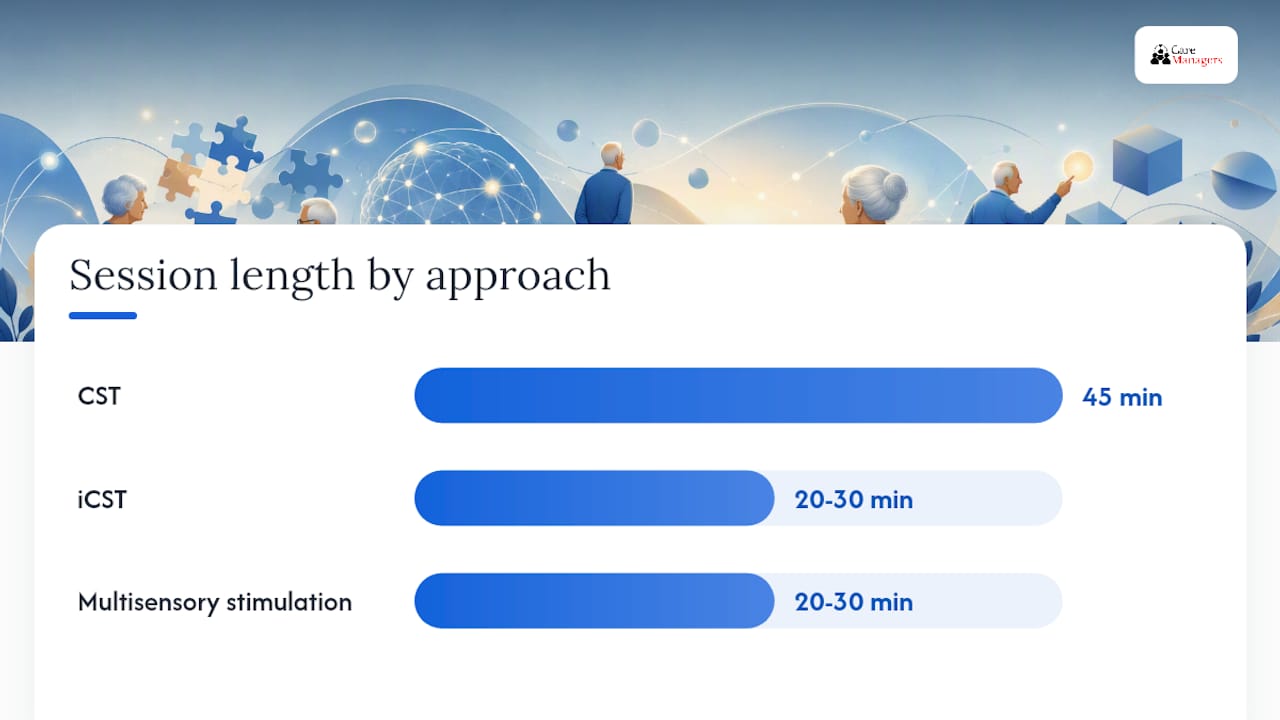
The standard CST model, as described in the NHS England cost-effectiveness summary, runs to 14 sessions of 45 minutes each, delivered twice weekly over seven weeks. A maintenance CST programme of 24 weekly sessions follows for those who benefit. Cost-effectiveness analyses find CST economically favourable when delivered by trained care staff rather than external research teams.
| Approach | Dementia stage | Format | Session length/frequency | Training needed | Evidence strength |
|---|---|---|---|---|---|
| CST | Mild–moderate | Group or one-to-one | 45 min, twice weekly | CST manual, supervised | Strong (Cochrane) |
| iCST | Mild–moderate | One-to-one at home | 20–30 min, at least twice weekly | iCST manual, carer training | Moderate (PLOS Medicine) |
| Multisensory stimulation | Moderate–severe | One-to-one | 20–30 min, as tolerated | Sensory activity training | Emerging (NICE NG97) |
Families should expect small to modest cognitive gains and better social and wellbeing outcomes. Benefits generally appear within a few weeks of consistent delivery.
What does a structured home session look like?
A well-run iCST session at home is short, themed, and follows a clear three-part structure: a warm-up to orient the person, a main activity matched to their preserved abilities, and a calm social close.
Welcome and reality orientation (5 minutes). The carer greets the person by name, mentions the day, date, and weather, and introduces the session theme. This is not a test; it is a gentle anchor.
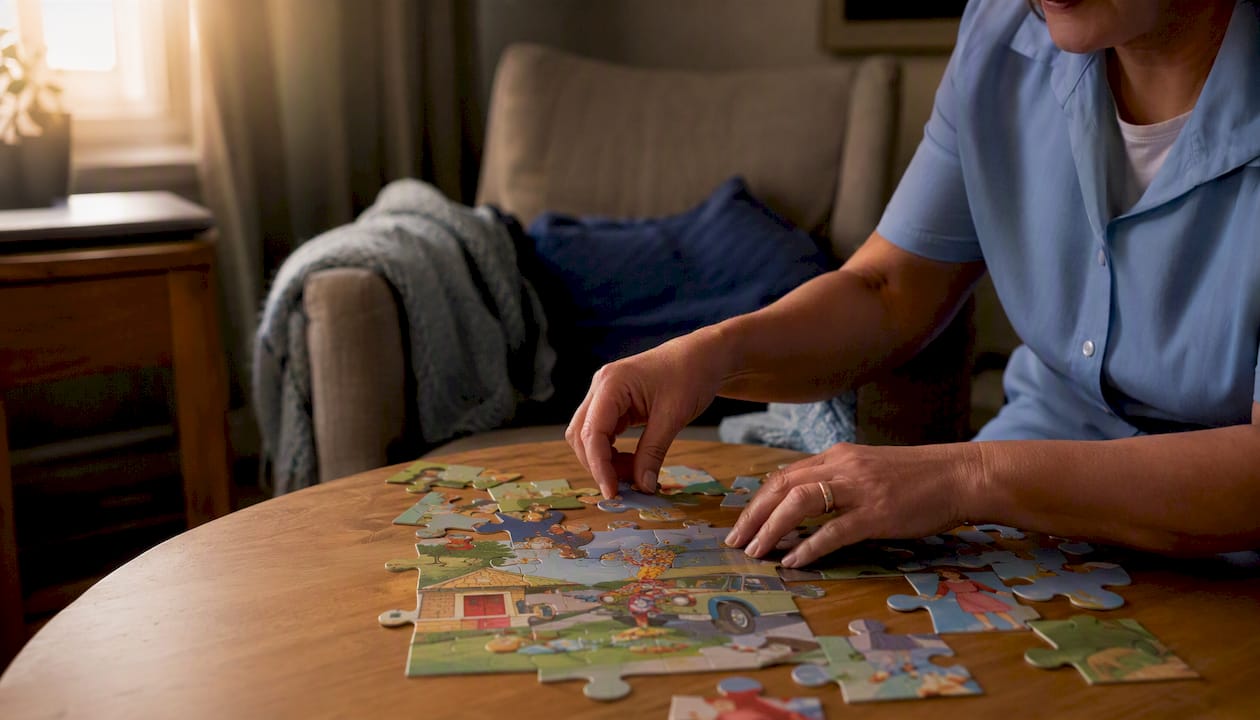
Main cognitive activity (15–20 minutes). The activity matches the session theme and the person’s ability level. Examples include discussing photographs from a personal life history book, a simple word association game using familiar categories, a creative task such as sorting objects by colour or texture, or listening to and discussing music from their youth. The MODEM CST Toolkit describes how the CST manual structures these themes across sessions, with the carer adjusting difficulty using Level A (discussion-based) or Level B (more challenging tasks) as described in the iCST PLOS Medicine research.
Sensory close and social recap (5–10 minutes). A calming sensory activity, such as hand cream with a familiar scent, soft music, or a warm drink, closes the session. The carer briefly recaps what was enjoyed and notes the person’s mood.
Adaptations checklist for carers:
- Reduce multi-step instructions to single steps
- Use larger print, tactile objects, or visual cues instead of verbal prompts
- Shorten the main activity if fatigue appears
- Switch from cognitive tasks to sensory activities when engagement drops
Pro Tip: Ask Caremanagers for a session template you can review before care begins. Seeing the structure in writing helps you understand what your relative will experience and makes it easier to give feedback.
How do you include cognitive stimulation in a home care contract?
Start by requesting that the care plan names the programme, the trained staff member, and the session schedule explicitly. Vague references to ‘activities’ are not sufficient.
You can copy that clause directly into a care agreement or use it as the basis for a conversation with your provider.
For staff training, require written confirmation that the assigned carer has completed the CST or iCST manual training, with observed competency checks and access to regular supervision. The MODEM CST Toolkit and the iCST manual are the recognised training resources in the UK.
Questions to ask any prospective provider:
- Which cognitive stimulation manual do your staff use, and can I see a copy?
- How do you personalise sessions to my relative’s interests and life history?
- What outcomes do you record, and who reviews them?
- How do you adjust the programme if engagement declines?
Red flags to watch for: proposals that mention ‘brain workout activities’ or ‘memory challenges for seniors’ without naming a manual or training standard; no review schedule; no named responsible person for outcome records.
How do you adapt activities as dementia progresses?
When dementia moves into moderate–severe stages, structured cognitive tasks become less appropriate and sensory, simplified activities take over. The NHS guidance on living with dementia and NICE NG97 both support this shift.
Effective sensory activities at this stage include:
- Music from a personal playlist, played softly during a quiet moment
- Hand massage with a familiar-scented lotion
- Tactile boxes filled with objects from the person’s past (fabric swatches, tools, kitchen items)
- Simple scent or taste recognition with familiar foods
- Gentle movement to rhythm, such as clapping or swaying
Safety and dignity considerations matter here. Watch for signs of over-stimulation (withdrawal, agitation), fatigue, or choking risk with taste activities. Consent monitoring is ongoing; a person cannot give advance consent for every session, so carers must read non-verbal cues carefully.
Pro Tip: Keep sessions to 15–20 minutes at this stage. Familiar routines reduce confusion, so repeating the same opening ritual (a favourite song, a warm drink) helps the person feel safe even when memory is significantly impaired.
Social connection remains valuable at every stage. Community activities and group settings can complement home-based work; social clubs for over-60s offer peer contact that home sessions alone cannot replicate.
How do you measure whether cognitive stimulation is working?
Measure both process and outcomes, and set fixed review points from the start.
- Record session attendance and whether the session was completed in full.
- Rate engagement on a simple 1–5 scale after each session (1 = no engagement; 5 = fully engaged throughout).
- Note mood before and after using a brief observational check (calm, agitated, withdrawn, content).
- Track one short functional aim, such as the ability to follow a two-step instruction or sustain a conversation for five minutes.
- Keep carer observational notes: what the person enjoyed, what they found difficult, any adverse reactions.
| Metric | Method | Frequency | Responsible person |
|---|---|---|---|
| Session attendance | Care log | Each session | Named carer |
| Engagement rating (1–5) | Carer observation | Each session | Named carer |
| Mood check | Brief observational note | Each session | Named carer |
| Functional aim progress | Structured observation | Weekly | Named carer + supervisor |
| Formal review | Care plan review meeting | 6–8 weeks, then quarterly | Care manager + family |
Trigger an earlier review if engagement drops below 2 for three consecutive sessions, if the person shows distress during activities, or if there is a noticeable change in their general health or cognition.
Key takeaways
Evidence-based cognitive stimulation at home requires a named manualised programme, trained staff, a fixed session schedule, and documented outcome reviews to deliver reliable benefit.
| Point | Details |
|---|---|
| Use a named programme | Request CST or iCST by name; vague ‘activities’ clauses do not guarantee evidence-based delivery. |
| Session structure matters | Standard CST runs 14 × 45-minute sessions; iCST at home suits 20–30 minutes, at least twice weekly. |
| Match approach to stage | CST and iCST suit mild–moderate dementia; multisensory stimulation suits moderate–severe stages per NICE NG97. |
| Monitor and review | Record attendance, engagement, and mood each session; first formal review at 6–8 weeks, then quarterly. |
| Caremanagers can help | Caremanagers integrates manualised cognitive stimulation into dementia home care packages across South Wales and England. |
A note from Emm
The families I speak with most often arrive at this question after a difficult period: a diagnosis has been confirmed, a care package is being arranged, and someone has suggested ‘activities’ without being specific about what that means. The gap between a carer sitting with someone and a carer delivering a structured, personalised cognitive stimulation session is significant, and it is entirely reasonable to ask for the latter.
What the evidence from Cochrane and the Alzheimer’s Society consistently shows is that the social and relational element of these sessions matters as much as the cognitive task itself. A person who feels heard, engaged, and connected during a session benefits even when the specific memory task is not retained. That is worth commissioning properly.
If you are unsure how to phrase your requirements or want someone to review a care plan before you sign it, Caremanagers is a good place to start that conversation.
Cognitive stimulation as part of your Caremanagers care package
Families arranging dementia support at home through Caremanagers get more than personal care visits. Caremanagers integrates structured cognitive stimulation into home care packages across South Wales and England, with staff trained in the CST and iCST approach, personalised session plans, and documented outcome reviews built into every dementia care agreement.
Whether you need a care plan amended to include cognitive stimulation, a new package arranged from scratch, or a review of an existing agreement, Caremanagers can help. The team also covers hospital discharge care and live-in support, so the same structured approach continues through transitions in care. For a clear picture of dementia care best practices and what to expect from a well-run package, contact Caremanagers to request a care-plan review.
Useful sources
The sources below are the primary references families and providers should consult when commissioning cognitive stimulation at home.
- Can cognitive stimulation benefit people with dementia? | Cochrane
- Dementia: assessment, management and support for people living with dementia and their carers (NICE NG97) — short version
- Cognitive Stimulation Therapy: summary of evidence on cost-effectiveness (NHS England summary PDF)
- Cognitive Stimulation Therapy (CST) — MODEM Dementia Evidence Database / Toolkit
- Individual Cognitive Stimulation Therapy research — PLOS Medicine
- Updated Cochrane systematic review on cognitive stimulation — UCL discovery
- Living with dementia: activities — NHS
- Cognitive stimulation therapy helped dementia — Dementia Connect (Alzheimer’s Society)
Caremanagers can help you interpret these documents and translate their recommendations into specific care-plan language.
This article provides general information about evidence-based cognitive stimulation in home care. It is not a substitute for professional clinical or legal advice. Confirm current guidance with NICE, your GP, or a qualified care professional.
FAQ
What is iCST and how does it differ from group CST?
Individual CST (iCST) is a one-to-one adaptation of group Cognitive Stimulation Therapy, designed for home delivery. It uses the same manualised approach but relies on a trained carer rather than a group facilitator, with sessions typically running 20–30 minutes and delivered at least twice weekly.
How many sessions does a standard CST programme include?
The standard CST model comprises 14 sessions of 45 minutes, delivered twice weekly over seven weeks, followed by an optional maintenance programme of 24 weekly sessions.
Which dementia stages benefit most from cognitive stimulation?
Structured CST and iCST are recommended for mild–moderate dementia; multisensory stimulation is the preferred approach for moderate–severe stages, as set out in NICE NG97.
Can Caremanagers include cognitive stimulation in a home care package?
Yes. Caremanagers builds structured cognitive stimulation into dementia care packages across South Wales and England, with trained staff, personalised session plans, and documented reviews as standard.
How soon should families expect to see benefits?
Small cognitive gains and improvements in communication and social interaction are typically observable within a few weeks of consistent, twice-weekly delivery, based on Cochrane’s pooled trial data.