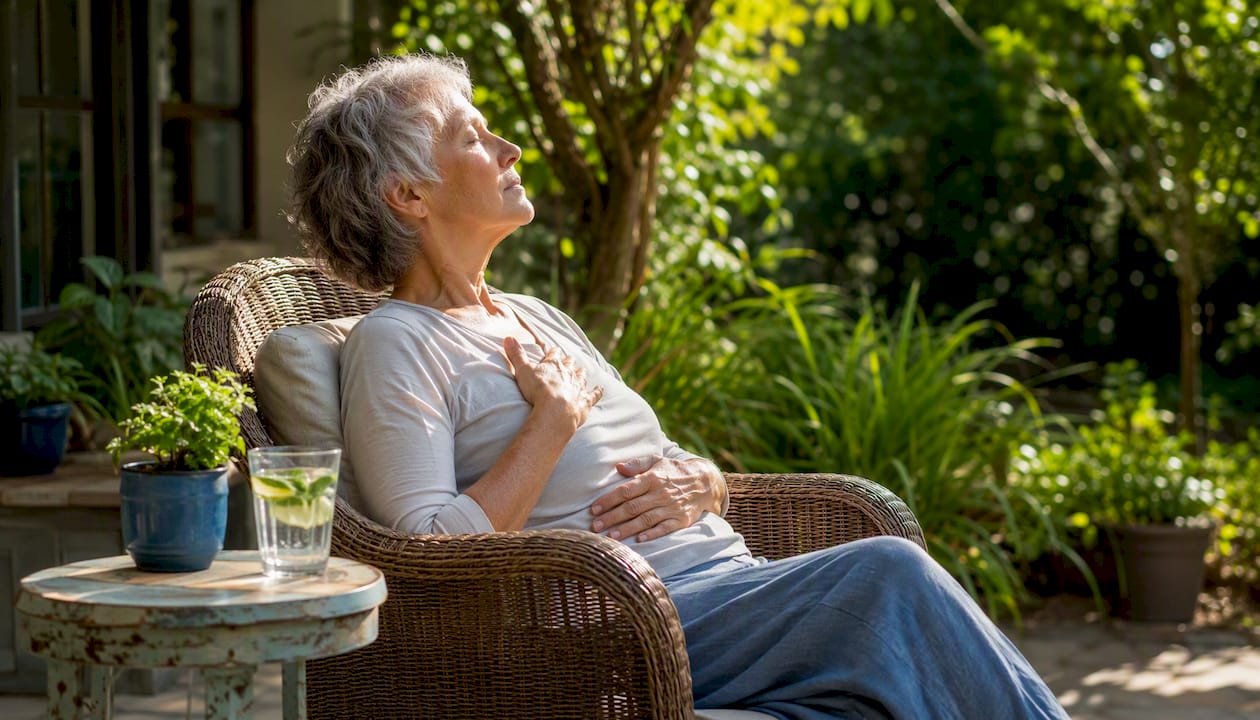
The four techniques that give older adults the fastest, safest results are pursed-lip breathing, diaphragmatic (belly) breathing, paced breathing (including “blow as you go”), and humming or phonation breathing. Start with just two minutes, twice a day, sitting comfortably in a supported chair. That single habit, practised consistently, can ease breathlessness, calm anxiety and make everyday tasks feel less exhausting.
Here is your shortlist to choose from today:
- Pursed-lip breathing — slows the breath and empties the lungs more fully
- Diaphragmatic (belly) breathing — strengthens the main breathing muscle and improves ventilation
- Paced/controlled breathing — synchronises breath with movement to reduce effort
- Humming/phonation breathing — strengthens the muscles that push air out and reduces tension
If you are unsure where to begin, pursed-lip breathing is the easiest to learn in under a minute and works immediately during breathlessness.
Table of Contents
- Why breathing exercises benefit older adults
- Step-by-step breathing exercises seniors can do safely
- Safety rules, red flags and adaptations for older adults
- How carers can help with breathing practice
- A simple starter schedule you can follow from week one
- When to contact a GP, NHS 111 or call 999
- Key takeaways
- Why breathing practice deserves more attention than it usually gets
- How Caremanagers supports breathing practice at home
- Useful UK sources and further reading
- FAQ
Why breathing exercises benefit older adults
Lung capacity naturally declines with age. The muscles around the chest wall stiffen, the diaphragm weakens slightly, and the lungs become less elastic. Breathing exercises for seniors directly counter these changes by training the muscles that matter most.
The benefits are both immediate and cumulative. A single session of controlled breathing slows the respiratory rate, improves the exchange of oxygen and carbon dioxide, and reduces the physical effort of each breath. Over weeks, regular practice builds endurance, clears mucus more effectively, and reduces the breathlessness that makes people avoid activity. Avoiding activity, in turn, leads to deconditioning — a cycle that NHS physiotherapy guidance specifically warns against.
The British Thoracic Society’s Harefield pulmonary rehabilitation booklet recommends that adults with lung or heart conditions aim for 150 minutes of moderate-intensity activity per week — and breathing exercises count as a gentle, accessible starting point toward that target.
“Breathlessness is a normal response to exertion. The key is to keep moving at a level where you can still speak in short sentences — this is the ‘talk test’, and it tells you that you are working safely.”
— WSH NHS Physiotherapy
Beyond the lungs, the benefits extend to mood and daily function. NHS Inform Scotland notes that activities such as Tai Chi and singing — both of which involve controlled breathing — improve balance, emotional wellbeing and respiratory efficiency in older adults with lung conditions. Joining a group activity for seniors that incorporates breathing, such as a community singing group, can make practice feel less like a chore and more like a social occasion.
Step-by-step breathing exercises seniors can do safely
1. Diaphragmatic (belly) breathing
This technique trains the diaphragm — the dome-shaped muscle beneath the lungs — to do more of the work, reducing strain on the neck and shoulder muscles.
- Sit upright in a firm chair with your back supported, or lie on your back with knees bent.
- Place one hand flat on your chest and the other on your stomach, just below the ribcage.
- Breathe in slowly through your nose for a count of 3. The hand on your stomach should rise; the hand on your chest should stay as still as possible.
- Breathe out gently through your mouth for a count of 4–5. Feel your stomach fall.
- Repeat 5–8 times.
Asthma + Lung UK confirms that placing a hand on the stomach is the standard way to check you are engaging the diaphragm rather than the upper chest.
Modification: If sitting upright is uncomfortable, try a semi-reclined position with pillows supporting the back. Lying flat on a bed with a small pillow under the knees works equally well.
Safety note: Stop if you feel light-headed. Take a normal breath and rest for a minute before trying again.
Pro Tip: Hold a small mirror in front of your face while practising. If the mirror fogs evenly with each exhale, your breath is flowing smoothly rather than in short, sharp bursts.
2. Pursed-lip breathing
Pursed-lip breathing slows the breath rate, keeps the airways open slightly longer and helps empty the lungs more fully — particularly useful during exertion or a sudden episode of breathlessness.
- Relax your neck and shoulders.
- Breathe in slowly through your nose for 2 counts.
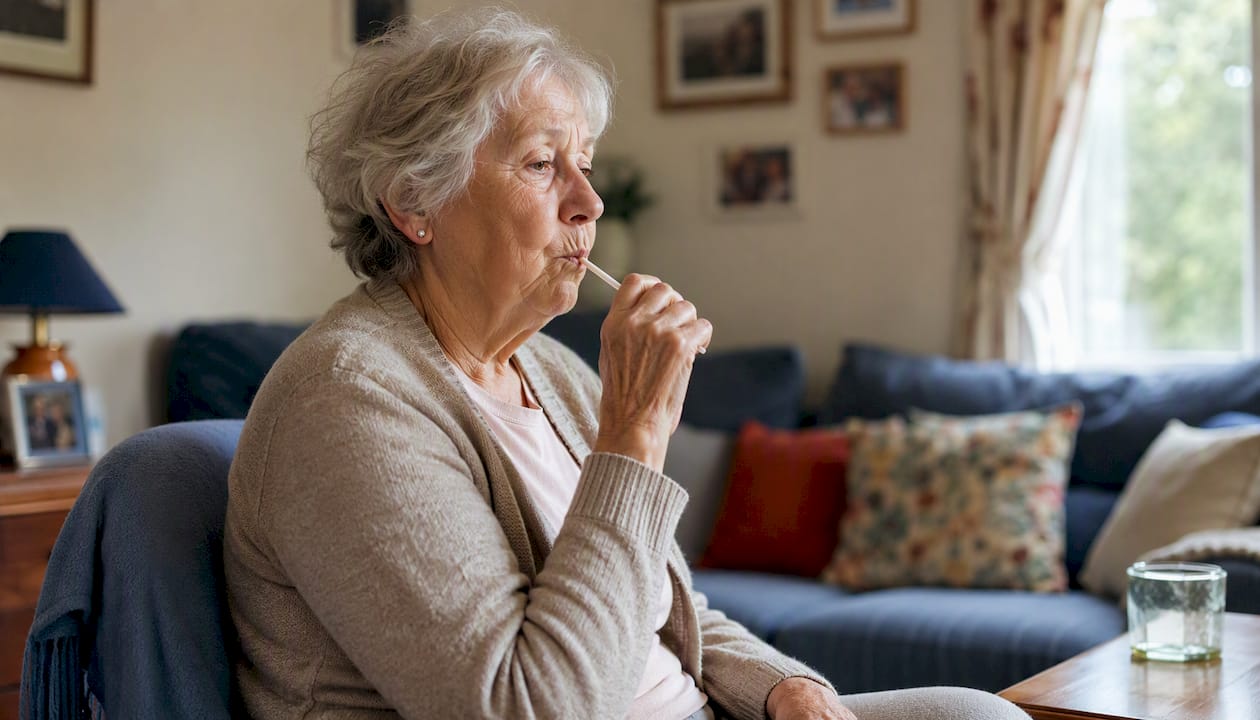
- Pucker your lips as if you are about to whistle or blow out a candle.
- Breathe out gently through pursed lips for 4 counts — roughly twice as long as the inhale.
- Repeat for 5–10 breaths.
Asthma + Lung UK recommends this technique specifically for managing breathlessness during activity and for emptying the lungs more effectively.
Modification for denture wearers or weak lip muscles: Lightly press your lips together around a drinking straw and exhale through the straw instead. This achieves the same resistance without requiring strong lip control.
Safety note: Use this technique whenever you feel breathless during a task — it works within a few breaths and does not require you to stop what you are doing.
3. Paced breathing and “blow as you go”
Paced breathing means matching your breath to your movement so that the effort of a task coincides with the exhale. The British Thoracic Society’s guidance calls this “blow as you go” — and it is one of the most practical elderly breathing techniques for daily life.
- Before a task (standing up, climbing a step, lifting a cup), breathe in.
- As you make the effort — standing, stepping, lifting — breathe out slowly through pursed lips.
- Rest and breathe in again before the next effort.
- For stairs: inhale on the landing, exhale as you take 1–2 steps, pause and repeat.
A simple cadence to remember: inhale for 1–2 counts, exhale for 2–3 counts during the effort phase.
Modification: If stairs feel too much, practise the same pattern while rising from a chair — inhale as you prepare, exhale as you push up.
Safety note: Never hold your breath during effort. Breath-holding raises blood pressure and increases the feeling of breathlessness.
4. Humming and phonation breathing
Humming creates a gentle back-pressure in the airways (similar in principle to pursed-lip breathing) and activates the expiratory muscles. It also has a calming effect on the nervous system, making it a useful relaxation breathing exercise.
- Sit comfortably with your shoulders relaxed.
- Breathe in slowly through your nose for 3 counts.
- On the exhale, hum a single note steadily until your breath runs out naturally.
- Notice the vibration in your chest and throat.
- Repeat 5 times. You can vary the pitch or hum a simple tune.
ESHT NHS guidance on lung health supports singing and phonation as ways to strengthen respiratory muscles and improve mood. Joining a community singing group combines this exercise with social connection — a double benefit for older adults.
Modification: If humming feels strange, simply count aloud on the exhale (“one, two, three…”) — the effect on the expiratory muscles is similar.
Safety note: Keep the hum gentle. Forcing a loud sound can cause dizziness.
Safety rules, red flags and adaptations for older adults
Most breathing exercises are safe for the vast majority of older adults. A few straightforward precautions make practice even safer.
Before each session, check:
- You are seated in a supported chair or lying comfortably — never standing unsupported for the first few attempts.
- You have not just eaten a large meal (wait at least 30 minutes).
- If you use supplemental oxygen, your equipment is set to your prescribed flow rate. Do not alter oxygen settings without clinical advice.
- You feel reasonably well. A mild cold is fine; a fever or acute infection is not.
Stop immediately and rest if you notice:
- Chest pain or tightness
- Dizziness or light-headedness
- Sudden worsening of breathlessness beyond what feels manageable
- New confusion or difficulty speaking normally
“If you have COPD, heart disease, have recently been discharged from hospital, or use supplemental oxygen, speak to your GP or respiratory physiotherapist before starting a new breathing programme. They can tailor the exercises to your specific condition and confirm safe limits.”
— NHS England respiratory disease guidance
Adaptations for mobility aids: Practise seated in a wheelchair or with a walking frame in front of you. Leaning slightly forward with elbows resting on the frame is a recognised “position of ease” that NHS physiotherapy leaflets recommend to stabilise breathing when breathlessness is acute.
For anyone with hearing loss or cognitive difficulties, carers can use visual cues — a gentle hand gesture for “breathe in” and a slow downward wave for “breathe out” — rather than verbal counting alone. Gentle adaptations for older patients are always worth discussing with the clinical team before a new routine begins.
How carers can help with breathing practice
Carers play a central role in making breathing practice consistent and safe. You do not need clinical training — calm, clear prompts and simple observation are enough.
Two short scripts to use:
To introduce a session: “We’re going to do a couple of minutes of gentle breathing together. Sit comfortably, put one hand on your tummy, and just follow my lead.”
To coach during the exercise: “Breathe in slowly through your nose… and now breathe out gently through your mouth. Good. Let’s do that again.”
Counting and monitoring breaths:
A normal resting respiratory rate for independently living older adults is roughly 12–18 breaths per minute. To count: watch the chest or stomach rise and fall, count each rise as one breath, and time for 60 seconds. A rate consistently above 20 at rest warrants a call to the GP.
What to observe and record:
- Breathing rate before and after the session
- Skin colour (any blueness around the lips or fingertips)
- Whether the person can speak in short sentences during practice (the talk test)
- Use of neck or shoulder muscles to breathe (a sign of increased effort)
- Any complaints of chest pain, dizziness or unusual fatigue
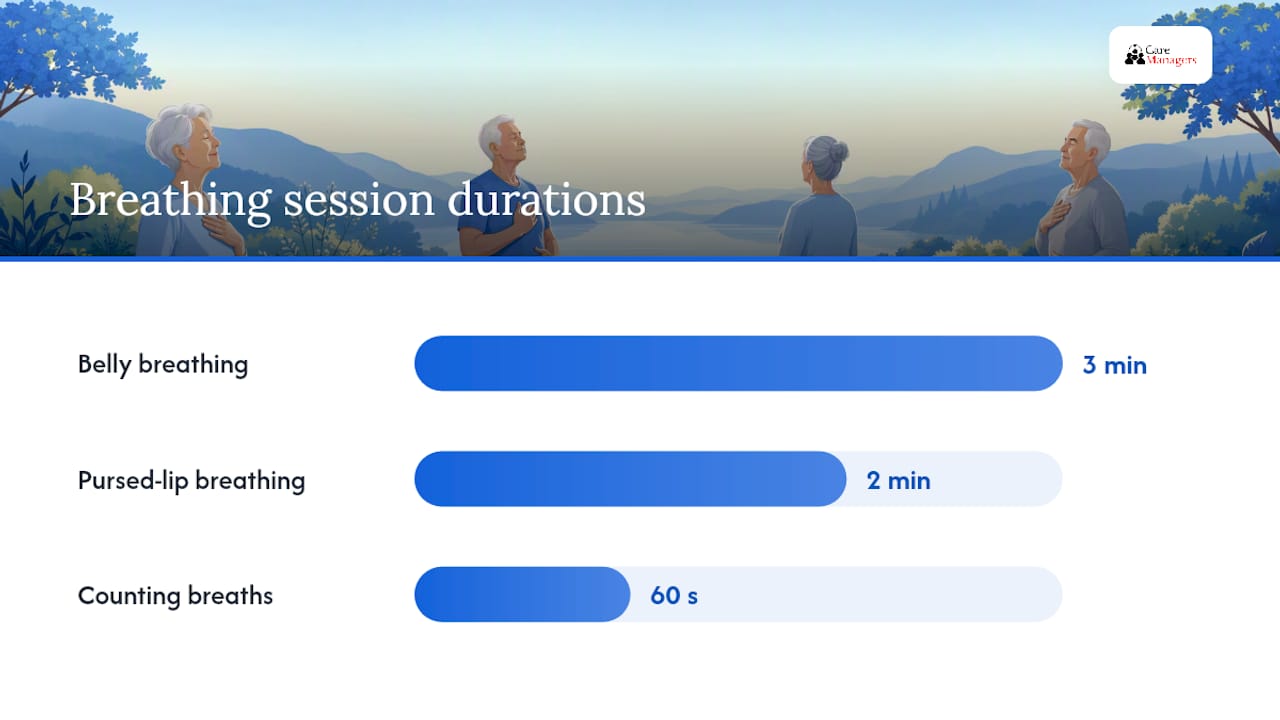
Simple session record template:
| Time | Exercise | Duration | Notes |
|---|---|---|---|
| — | Belly breathing | 3 minutes | Calm, rate 12–18 bpm |
| — | Pursed-lip | 2 minutes | Slight dizziness — stopped early |
Encouragement tips: Praise small wins specifically (“Your tummy moved really well that time”). Keep sessions short and stop before the person feels tired. Pacing and frequent short sets are more effective for older adults than one long session — a principle reinforced by NHS physiotherapy guidance.
A simple starter schedule you can follow from week one
The goal in the first week is simply to build the habit, not to push capacity. Two minutes is genuinely enough to start.
Starter plan:
| Week | Sessions per day | Duration per session | Focus exercise |
|---|---|---|---|
| 1 | 2 | 2 minutes | Belly breathing or pursed-lip |
| 2 | 2 | 3–4 minutes | Add paced breathing during one daily task |
| 3 | 2–3 | 4–5 minutes | Introduce humming; lengthen exhale by 1 count |
| 4+ | 2–3 | 5 minutes | Combine two techniques; add gentle activity |
Weaving breathing into daily tasks:
- Dressing: exhale as you pull on a jumper or fasten buttons.
- Stairs: inhale on the landing, exhale for 1–2 steps, pause and repeat.
- Washing up: use pursed-lip breathing throughout; the rhythm keeps the pace gentle.
- Morning routine: two minutes of belly breathing before getting out of bed sets a calm tone for the day.
Breathlessness during these activities is normal and expected. The talk test — being able to speak in short sentences — confirms you are working at a safe level.
When four weeks of home practice feel comfortable, ask your GP about a referral to pulmonary rehabilitation. Pulmonary rehabilitation typically runs for six to eight weeks with supervised exercise and education, and it is available through the NHS for people with conditions such as COPD, heart failure and post-COVID breathlessness. NHS England’s respiratory policy sets out the referral pathways your GP can use.
When to contact a GP, NHS 111 or call 999
Most breathlessness during gentle breathing practice is normal. Some signs require prompt attention.
Call 999 immediately if you notice:
- Severe breathlessness at rest that is not improving
- Chest pain or pressure
- Blue or grey lips, fingertips or face (cyanosis)
- Collapse or loss of consciousness
- Sudden confusion or inability to speak
Contact NHS 111 or your GP if:
- Breathlessness has worsened noticeably over the past few days without a clear cause
- A new cough, fever or green/yellow phlegm has appeared
- Breathing exercises are causing consistent dizziness or chest discomfort
- The resting breathing rate is regularly above 20 breaths per minute
Requesting a referral: When speaking to a GP about breathing difficulties, it helps to have ready: the person’s resting breathing rate, a note of any recent hospital admissions, current oxygen use, and a brief description of which exercises have been tried. Ask specifically about a referral to a respiratory physiotherapist or a pulmonary rehabilitation programme. Deep breathing guidance from Torbay and South Devon NHS includes step-by-step positions that a physiotherapist can build on during a structured programme.
This article provides general information, not medical advice. Always confirm current guidance with your GP or a qualified respiratory professional.
Key takeaways
Regular breathing exercises for seniors, practised in short daily sessions, improve lung function, reduce breathlessness and support calmer, more confident daily living.
| Point | Details |
|---|---|
| Start small and stay consistent | Two minutes twice daily in week one is enough; build by one to two minutes each week. |
| Normal resting breath rate | A healthy resting rate for older adults is roughly 12–18 breaths per minute; above 20 at rest warrants a GP call. |
| Use the talk test | During any exercise, being able to speak in short sentences confirms you are working at a safe level. |
| Seek clinical advice first | Anyone with COPD, heart disease, recent hospital discharge or oxygen therapy should consult a GP before starting. |
| Caremanagers can help | Caremanagers provides trained home carers across South Wales and England who can support supervised breathing practice as part of a personalised care plan. |
Why breathing practice deserves more attention than it usually gets
Most guides treat breathing exercises as a passive, almost trivial add-on to a care routine. In practice, they are one of the few interventions an older adult can do independently, at home, with no equipment, that produces a measurable change in how they feel within minutes.
What tends to get overlooked is the psychological dimension. Practising controlled breathing when calm — not just during a breathless episode — builds a kind of muscle memory. When breathlessness does arrive, the response becomes automatic rather than panicked. That shift from panic to control is arguably the most meaningful benefit for many older adults, and it is rarely the headline in clinical leaflets.
There is also a social angle that deserves more emphasis. Singing groups, Tai Chi classes and group exercise sessions all involve rhythmic, controlled breathing. They are, in effect, breathing training in disguise — and they carry the added benefit of companionship and connection that solo practice cannot replicate. For seniors who find formal exercises dull or difficult to sustain, a community activity may be the more realistic long-term solution.
The honest caveat is this: breathing exercises are not a substitute for medical treatment. For someone with moderate to severe COPD or heart failure, a structured pulmonary rehabilitation programme under clinical supervision will always deliver more than a home routine alone. The exercises in this guide are a starting point and a daily maintenance tool — not a replacement for the care that a GP or respiratory physiotherapist can provide.
How Caremanagers supports breathing practice at home
For families where a senior needs more than a printed guide, Caremanagers offers trained home carers across South Wales and England who can make breathing practice a reliable part of each day. Carers can coach the exercises described here, monitor breathing rates, recognise early warning signs and adapt sessions for people living with dementia, recovering from a hospital stay, or managing a long-term lung condition.

This is particularly valuable after a hospital discharge, when a structured breathing routine can support recovery but confidence at home is still fragile. Caremanagers’ hospital discharge care packages are designed exactly for this transition — short-term, personalised support that bridges the gap between ward and independent living. For families considering longer-term support, in-home care services can be tailored to include guided breathing sessions alongside personal care, companionship and daily living assistance. Contact Caremanagers to discuss a care plan that fits your family’s needs.
Useful UK sources and further reading
- How can I manage my breathlessness | Asthma + Lung UK
- Importance of exercising with a lung condition | WSH NHS physiotherapy leaflet
- Exercising with COPD | NHS Inform (Scotland)
- Top tips to improve your lung health | ESHT NHS
- Respiratory disease clinical policy | NHS England
- Deep breathing exercise | Torbay and South Devon NHS
FAQ
What is the most effective breathing exercise for older adults?
Pursed-lip breathing is widely recommended as the most immediately effective technique for managing breathlessness, as it slows the breath and helps empty the lungs more fully. Diaphragmatic breathing is the best long-term exercise for strengthening the main breathing muscle.
How many breaths per minute should a 70-year-old have at rest?
A normal resting respiratory rate for independently living older adults is roughly 12–18 breaths per minute. A rate consistently above 20 at rest is worth reporting to a GP.
How often should seniors practise breathing exercises?
Start with two short sessions of two minutes each per day, then build gradually to five to six minutes per session over four weeks. Short, frequent practice is more effective than occasional long sessions.
How can seniors improve their lung capacity at home?
Regular diaphragmatic breathing, pursed-lip breathing and gentle activity such as walking or Tai Chi all support lung function over time. The British Thoracic Society recommends aiming for 150 minutes of moderate activity per week as a broader goal for lung and heart health.
When should a carer call for medical help during breathing practice?
Stop the session and call 999 if the person develops chest pain, blue lips, collapse or severe breathlessness that does not ease with rest. Contact NHS 111 or the GP if breathlessness has worsened over several days, or if the resting breathing rate is regularly above 20 breaths per minute.