
TL;DR:
- Delayed hospital discharges in the UK are mainly caused by systemic issues such as insufficient community capacity and hospital process failures. These delays involve multiple interacting factors, with hospital and social care pressures contributing equally, and cost the NHS billions annually. Early discharge planning, trusted assessor models, and proactive family engagement are proven strategies to reduce avoidable delays and improve patient outcomes.
Delayed hospital discharge in the UK happens primarily because of insufficient community care capacity, hospital-side process failures, high bed occupancy, workforce shortages, and patient or family-level factors that slow the transition home. These causes rarely act alone. Most delayed discharges involve at least two interacting factors, which is why single-service fixes rarely solve the problem. Evidence from NHS England, The Health Foundation, the Nuffield Trust, and the scoping review by Micallef et al. published in BMC Health Services Research all point to the same conclusion: delays are systemic, not incidental. Age UK reports a sharp rise in delayed discharge bed-days since 2021, with the financial and human cost growing year on year.
Scale in numbers: A substantial number of people each day are medically fit to leave hospital but remain in a bed, driving bed-blocking and pressure on emergency care across England.
Table of Contents
- What does ‘delayed discharge’ mean in UK practice?
- How common are discharge delays in the UK, and are they getting worse?
- What are the main causes of delayed discharge?
- Why do these causes persist? The system-level pressures behind delays
- What are the consequences of delayed discharge for patients and the NHS?
- How does NHS reporting capture delayed discharges?
- Which interventions actually reduce discharge delays?
- Practical steps for clinicians, families, and discharge teams
- Correcting the misconception that social care is the only cause
- Key takeaways
- A perspective on what the data misses
- Caremanagers can help you plan a safe, timely discharge
- Useful sources and further reading
- FAQ
What does ‘delayed discharge’ mean in UK practice?
In UK health and social care, a patient is considered to have a delayed discharge when they are clinically ready to leave hospital but cannot do so because of a non-clinical barrier. The GOV.UK hospital discharge guidance defines discharge as the point at which a patient leaves an acute setting and moves to the environment best suited to their ongoing needs, whether that is home with minimal support or a short-term community care package pending longer-term assessment.
NHS reporting captures these delays through a set of reason-code groups. Understanding the categories matters because each one points to a different part of the system that needs action.
- Awaiting care package: The patient needs a funded or arranged package of home care, but the package has not yet been commissioned, assessed, or started. This is one of the most frequently recorded codes.
- Awaiting assessment: A social care, occupational therapy, or continuing healthcare (CHC) assessment has not yet been completed, so the appropriate next setting cannot be confirmed.
- Awaiting care home placement: No suitable residential or nursing home bed is available, or a funding decision is outstanding.
- Awaiting community equipment or home adaptation: Grab rails, hospital beds, stairlifts, or other equipment have not been delivered or installed, making the home unsafe for return.
- Patient or family choice: The patient or family is not yet ready to agree to the proposed discharge destination or care plan.
- Hospital process delays: Internal factors such as pending discharge summaries, pharmacy sign-off, or a final clinical review have not been completed.
- Transport: Suitable transport to the discharge destination has not been arranged.
The distinction between ‘awaiting care package’ and ‘awaiting assessment’ matters practically. A patient coded as awaiting assessment may be resolved quickly once the right professional visits; a patient awaiting a funded care package may face a much longer wait if local authority budgets are constrained. Knowing which code applies tells a discharge coordinator exactly where to direct their energy.
How common are discharge delays in the UK, and are they getting worse?
The scale is significant and has grown sharply since 2021. Age UK’s analysis documents a steep rise in delayed discharge bed-days, with the problem disproportionately affecting older people with complex needs. The financial cost has followed the same trajectory.
Cost to the NHS: The annual cost of delayed discharges rose to a multi-billion-pound figure, a 7.5% increase on the previous year, according to analysis reported in the BMJ.
That figure is built on a bed-day unit cost of around £562, as cited in parliamentary written answers. Multiply that by the roughly 13,000 patients occupying beds unnecessarily each day, and the opportunity cost becomes clear: every delayed day is a bed that cannot be used for someone waiting in A&E or on a surgical list.
Regional variation is real. Some areas, particularly those with well-funded intermediate care and reablement services, consistently record lower delay rates than areas where local authority social care budgets have been cut most severely. NHS England publishes updated dashboards on discharge performance, and Public Health Scotland produces equivalent national data for Scotland. Both are worth checking for the most current figures, as day-to-day volatility and coding differences between trusts mean any single snapshot can be misleading.
One important caveat: coding practices vary across NHS trusts. A delay attributed to ‘patient choice’ in one trust might be coded as ‘awaiting assessment’ in another, depending on local protocols. National totals are reliable as a trend indicator, but granular trust-level comparisons require care.
What are the main causes of delayed discharge?
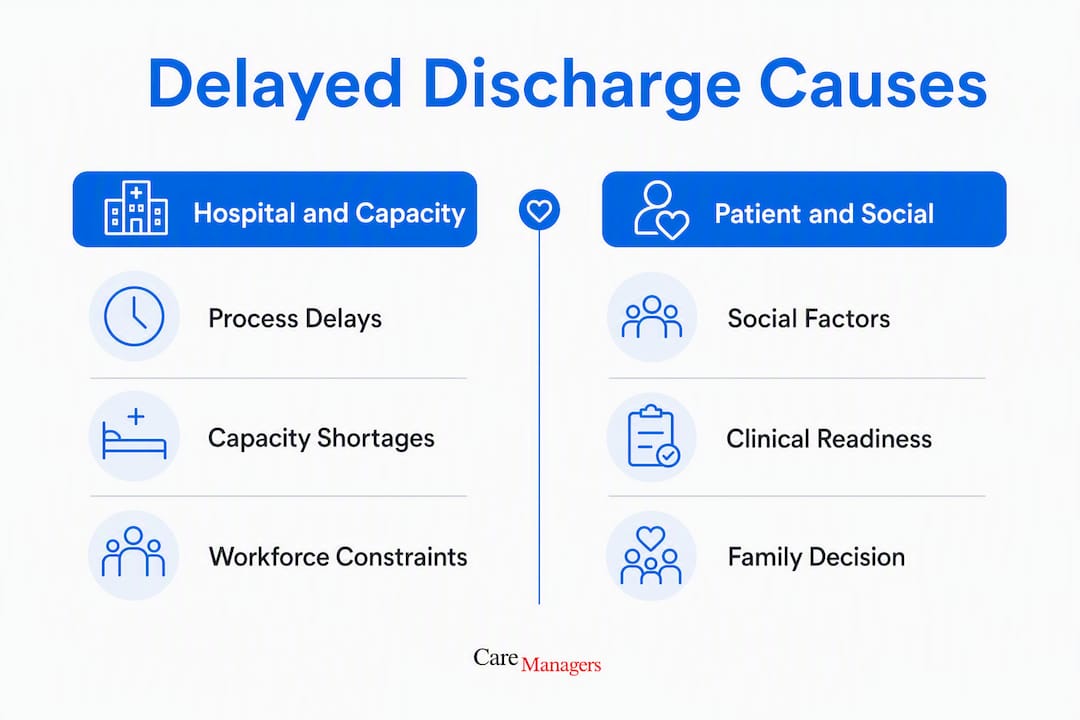
Discharge delays in hospitals rarely have a single cause. Clinical, organisational, and social factors interact, and addressing only one rarely resolves the delay. Here is how each category plays out in practice.
Hospital-internal process causes
These are delays that originate inside the hospital before a patient even reaches a community pathway. Pending therapy or occupational therapy assessments, pharmacy sign-off on complex medication regimes, incomplete discharge summaries, and a final consultant review that has not yet happened all contribute. In busy acute wards, the discharge summary can sit unsigned for hours or days, holding up everything downstream. NHS England’s model discharge pathway specifically addresses daily ward-based practices as a lever for reducing this variation.
Capacity causes
The most frequently cited category. Lack of intermediate care beds, reablement services, community nursing capacity, and available care-home placements creates a bottleneck that no amount of good hospital-side planning can overcome. When a patient is ready to move to a step-down facility and none is available within a reasonable distance, the hospital bed remains occupied by default.

Workforce and operational constraints
Staff shortages affect both hospital and community services. A community occupational therapist who is covering three caseloads cannot complete a home assessment quickly. A care home that cannot recruit enough registered nurses cannot accept a patient with complex nursing needs. Transport, too, is a recurring operational bottleneck: suitable patient transport that is not booked in advance can delay a discharge that is otherwise fully arranged.
Patient-level and social causes
Families sometimes need time to process a diagnosis or care recommendation before agreeing to a discharge plan. Housing issues, such as a home that requires significant adaptation, or the absence of an informal carer who can provide overnight support, are genuine barriers. Continuing Healthcare (CHC) funding disputes add another layer: when eligibility is contested, patients can wait weeks for a decision while occupying an acute bed.

Clinical causes
Some patients are not yet medically ready, even when the primary condition has been treated. Frailty-related complications, slow recovery from surgery, or the emergence of a new clinical problem during the admission can all extend the stay legitimately. The challenge is distinguishing a clinically necessary extension from a delay that has become administrative.
How causes combine
Consider a typical scenario: an 82-year-old admitted following a fall is medically ready for discharge after five days. She lives alone, her home needs a grab rail and a raised toilet seat, and her daughter lives two hours away. The occupational therapist’s assessment confirms she needs a short-term care package. The local authority has a four-day wait for a care coordinator to visit. The community equipment service has a three-day delivery window. The family needs a weekend to discuss options. None of these factors alone would cause a long delay, but together they produce a ten-day wait in an acute bed.
Pro Tip: The single most effective hospital-side action is to start the discharge planning conversation on the day of admission, not the day before planned discharge. Identify the likely discharge destination, flag equipment needs, and contact community services early, before the clinical picture is fully resolved. This one shift in timing prevents the majority of avoidable internal delays.
Why do these causes persist? The system-level pressures behind delays
Individual causes do not explain why discharge delays have grown so consistently. The answer lies in structural pressures that make the system prone to delay even when individual clinicians and social workers are doing their jobs well.
- High bed occupancy: NHS hospitals routinely operate at or above 90% bed occupancy. At that level, there is almost no buffer. A single patient who cannot be discharged on time creates a cascade: the next admission is delayed, the A&E trolley wait lengthens, and the elective list is disrupted. The NHS England delivery plan for urgent and emergency care identifies this as a primary driver of system pressure.
- Health and social care funding fragmentation: NHS care is free at the point of use; social care is means-tested and locally funded. This creates a structural incentive misalignment. The NHS bears the cost of the extra bed-day; the local authority bears the cost of the care package. When local authority budgets are under pressure, assessment timelines lengthen and packages are harder to commission quickly.
- Workforce shortages across the pathway: The shortage of community nurses, occupational therapists, social workers, and home-care workers is not a temporary staffing blip. It reflects years of underinvestment in community services relative to acute care. The Health Foundation notes that hospital-side pressures, including bed occupancy and staffing, are major contributors to delays, not just social care capacity.
- Limited rapid scale-up of community capacity: Even with political will and funding, community services cannot be expanded quickly. Recruiting and training a home-care worker takes months. Building an intermediate care unit takes years. This means short-term demand spikes, such as winter pressures, translate directly into longer delays.
- Inter-agency friction: When hospital discharge teams, local authority social workers, community health teams, and housing services all operate on different IT systems, different referral processes, and different performance frameworks, coordination failures are almost inevitable. A referral that falls between two services can sit unactioned for days.
What are the consequences of delayed discharge for patients and the NHS?
The consequences are serious on both sides of the equation, and they compound the longer the delay continues.
For patients
Hospital-associated deconditioning is one of the most significant and least-discussed harms. Older patients can lose muscle strength, balance, and cognitive function within days of being confined to a hospital bed. A patient who was mobile on admission may need a walking frame by the time they leave, not because of their original condition but because of the enforced inactivity. Hospital delirium is another real risk, particularly for older adults and those living with dementia, and it can have lasting effects on independence and recovery.
Beyond deconditioning, prolonged hospital stays increase exposure to healthcare-associated infections, disrupt sleep and nutrition, and reduce a patient’s sense of agency and dignity. The evidence consistently shows that patients who return home sooner, with appropriate support, recover better than those who remain in hospital beyond clinical necessity.
Bed-day cost: At approximately £562 per bed day, every unnecessary hospital day represents both a direct financial cost and an opportunity cost for a patient who could be recovering at home.
For the NHS
Blocked beds reduce the system’s ability to admit new patients. A&E departments fill with patients waiting for a ward bed, ambulances queue outside hospitals, and elective procedures are cancelled. The £2.7 billion annual cost represents money that could fund community services, preventive care, or additional workforce capacity. The opportunity cost is arguably larger than the direct cost.
How does NHS reporting capture delayed discharges?
Understanding the reporting categories helps clinicians and discharge teams use local data to identify where their specific bottlenecks lie.
| Reason code category | Plain-English meaning | Operational implication |
|---|---|---|
| Awaiting care package | Home care not yet arranged or started | Chase care coordinator; explore self-funded interim option |
| Awaiting assessment (social care) | Social care assessment not yet completed | Escalate to duty social worker; request urgent assessment |
| Awaiting CHC assessment | Continuing Healthcare eligibility not yet determined | Contact CHC team; consider interim funded package |
| Awaiting care home placement | No suitable bed available or funding not confirmed | Explore interim step-down; consider home-first option |
| Awaiting community equipment | Equipment not delivered or home adaptation incomplete | Contact community equipment service; expedite delivery |
| Patient or family choice | Patient/family not yet agreed to discharge plan | Involve discharge liaison; consider family meeting |
| Hospital process delay | Internal paperwork, pharmacy, or clinical review pending | Escalate to ward manager; use criteria-led discharge |
| Transport | Suitable transport not arranged | Book in advance; use patient transport service |
Limitations to bear in mind: Coding practices differ between trusts, and retrospective reclassification is common. A delay initially coded as ‘patient choice’ may be reclassified as ‘awaiting assessment’ once more information is available. NHS England publishes national data with a lag, so real-time local dashboards are more useful for operational decisions. Public Health Scotland produces equivalent data for Scottish health boards.
Which interventions actually reduce discharge delays?
The evidence base for reducing delays has grown substantially over the past decade. Several models have demonstrated consistent results across different health systems.
| Model | Evidence strength | Typical resources needed | Where it fits in the pathway |
|---|---|---|---|
| Discharge to Assess / Home First | Strong (NHS-wide adoption) | Community assessment capacity, reablement staff | Replaces hospital-based assessment; patient goes home first |
| Reablement services | Strong | Reablement workers, OT oversight | Short-term (typically 6 weeks) post-discharge support |
| Discharge liaison hubs | Moderate | Dedicated discharge coordinator team | Single point of coordination across health and social care |
| Frailty teams (in-reach) | Moderate | Geriatrician, frailty nurse, social worker | Identifies and plans for complex patients early in admission |
| Rapid response / community rehab | Moderate | Community nurses, therapists | Prevents admission or supports early discharge |
| Trusted assessor models | Emerging | Cross-sector training, shared protocols | Bypasses redundant reassessments at the community interface |
What works in practice
The Discharge to Assess model, sometimes called Home First, is now the dominant approach in NHS England policy. The principle is straightforward: assess the patient’s longer-term care needs at home, not in hospital. Most patients function better at home than in an acute ward, and their true care needs become clearer once they are in their own environment. NHS England’s model discharge pathway sets out how this should operate as standard practice.
Trusted assessor models address a specific bottleneck: the redundant reassessment that happens when a community worker repeats an assessment already completed by a hospital clinician. Care England identifies late engagement with community partners and the absence of trusted assessor protocols as significant contributors to avoidable delays.
- Criteria-led discharge: — Using pre-agreed clinical criteria to authorise discharge without waiting for a consultant review frees up clinical time and speeds the process. NHS England’s criteria-led discharge guidance provides a practical framework.
A note on generalisability: no single model works everywhere. Local capacity mapping, including what community services actually exist and at what volume, should precede any model adoption. A Discharge to Assess pathway that relies on reablement workers will not function in an area where reablement services are under-resourced.
Practical steps for clinicians, families, and discharge teams
For clinicians and discharge coordinators
- Flag discharge planning needs on the day of admission, including likely destination, equipment requirements, and carer availability.
- Complete a therapy or occupational therapy assessment within 48 hours of admission for patients with complex needs.
- Refer to social care and community services as soon as the likely discharge destination is known, not when the patient is clinically ready.
- Use criteria-led discharge protocols to authorise discharge without waiting for a consultant review where clinically appropriate.
- Contact community equipment services early and confirm delivery dates before the planned discharge date.
- Hold a family meeting within 72 hours for patients with complex social or family factors, involving the discharge liaison nurse or social worker.
- Escalate to the discharge hub or bed manager if a delay exceeds 24 hours beyond the expected discharge date.
For families
- Ask the ward team on day one: “What is the expected discharge date, and what needs to happen before then?”
- Contact your local occupational therapy service or community equipment service directly to ask about home adaptation timelines; families who do this proactively often accelerate the process compared with waiting for hospital-initiated arrangements.
- Explore short-term home care options early, including private arrangements, so you have a plan ready if the NHS package is delayed.
- If your relative is self-funding, a private home-care agreement can often be arranged more quickly than a local authority-funded package, because private providers are not bound by the same statutory commissioning timelines.
- Ask specifically about CHC eligibility if your relative has complex health needs; a CHC assessment can unlock fully funded care, but it takes time, so request it early.
- Prepare the home before discharge: remove trip hazards, arrange a downstairs sleeping area if needed, and confirm that any prescribed equipment has been delivered.
Red flags that need rapid escalation
- A patient has been coded as ‘medically fit for discharge’ for more than 48 hours with no documented action plan.
- A CHC assessment has been requested but no date has been given within five working days.
- Community equipment has not been delivered within the agreed window and no alternative has been arranged.
- The family has not been contacted within 72 hours of a complex discharge being flagged.
Correcting the misconception that social care is the only cause
The most persistent myth about discharge delays is that social care is almost entirely to blame. It is a convenient narrative, partly because social care delays are visible and easy to code, but the evidence does not support it as the dominant explanation.
The Health Foundation is explicit on this point: patients waiting for social care account for less than half of recorded delays in many analyses. Hospital-side pressures, including bed occupancy and staffing constraints, are major contributors. Internal process failures, such as delayed clinical reviews, incomplete discharge summaries, and late pharmacy sign-off, account for a substantial share of delays that never appear in social care statistics.
Care England reinforces this: late engagement with community partners and the absence of trusted assessor models create bottlenecks that are entirely preventable with better cross-sector coordination.
What this means in practice
- Discharge teams should audit their own reason-code data and ask what proportion of delays are hospital-initiated, not just social care-initiated.
- Trusted assessor models, where community staff verify readiness and bypass redundant hospital reassessments, reduce one of the most common interface bottlenecks.
- Families who are self-funding can often move faster through the pathway by securing a private home-care agreement early. Private providers are not bound by the same statutory duty-to-cooperate frameworks as local authorities, which means arrangements can be confirmed in days rather than weeks.
Caremanagers works directly with families and discharge teams across South Wales and England to arrange rapid home-care packages. When a family contacts Caremanagers early in the admission, the team can have a care plan ready before the patient is clinically fit for discharge, removing one of the most common causes of avoidable delay. For families navigating a complex discharge, the hospital discharge care plan guide is a practical starting point.
Key takeaways
Delayed hospital discharge in the UK is driven by a combination of hospital-side process failures, insufficient community capacity, workforce shortages, and social or family factors, with social care accounting for less than half of recorded delays in many analyses.
| Point | Details |
|---|---|
| Social care is not the sole cause | The Health Foundation shows hospital-side pressures account for a significant share of delays, not just social care waits. |
| Scale is substantial | A substantial number of people each day remain in hospital when medically fit, costing the NHS billions annually. |
| Early planning is the most effective lever | Starting discharge planning on the day of admission, not the day before, prevents the majority of avoidable internal delays. |
| Families can act proactively | Contacting community equipment services and exploring short-term care options early often accelerates discharge for self-funders and funded patients alike. |
| Caremanagers supports rapid discharge | Caremanagers arranges hospital discharge care and short-term home support across South Wales and England, helping families have a plan in place before discharge day. |
A perspective on what the data misses
The statistics on delayed discharge are striking, but they tend to flatten a more complicated reality. When you look at the reason codes, the numbers suggest a system problem. When you talk to the families involved, you find something more human: a daughter who needs three days to accept that her mother cannot go back to living alone; a son who has not yet told his father that the family home needs to be adapted; a couple who have been together for sixty years and cannot imagine a care arrangement that separates them.
None of these situations appear in the data as ‘hospital-side failures’. They are coded as ‘patient or family choice’, which makes them sound like a preference rather than a need for support. The implication is that the delay is the family’s fault. That framing is both unfair and unhelpful.
What the evidence from The Health Foundation, Care England, and the Welsh Government guidance actually shows is that delays are most often reduced not by pressure but by earlier, better-quality conversations. When a discharge liaison nurse sits with a family on day two of an admission, explains what the options are, and gives them time to ask questions, the ‘family choice’ delay often disappears. When a community equipment service is contacted on day three rather than day ten, the home is ready when the patient is.
The system tends to treat discharge as an event. Families experience it as a process, often a frightening one. Closing that gap, between the system’s timeline and the family’s readiness, is where the most avoidable delays actually live. It requires more than a checklist. It requires someone who has time to listen, explain, and coordinate. That is not a clinical skill. It is a human one.
Caremanagers can help you plan a safe, timely discharge
When a family member is ready to leave hospital but the right support is not yet in place, every extra day in an acute bed carries a real cost, clinically, financially, and emotionally. Caremanagers specialises in exactly this situation: arranging hospital discharge care at home quickly, so the transition from ward to home is safe and well-supported from day one.

Services include short-term reablement support, live-in care for those who need round-the-clock assistance, and personalised home-care packages for people with dementia or complex needs, all delivered across South Wales and England. Caremanagers can work alongside NHS discharge teams and local authority social workers, or directly with self-funding families who need a care arrangement in place before discharge day.
Funding for discharge care can come from several sources: NHS-funded Continuing Healthcare, local authority social care funding, or self-funding. Caremanagers can help you understand your options, but confirming eligibility for funded care requires assessment by the relevant statutory body. If you are self-funding and need support quickly, Caremanagers can typically have a care plan ready within 24–48 hours of your first contact.
To discuss your situation and request a rapid discharge assessment, visit the home care services page or call the team directly.
Useful sources and further reading
The sources below are the most authoritative starting points for clinicians, families, and policy professionals who want to go deeper.
- Hospital discharge and community support guidance — GOV.UK — The primary national policy framework for England. Sets out the legal and operational basis for discharge, including the Discharge to Assess model and funding responsibilities. Use this to understand what NHS and local authority teams are required to do.
- NHS England model discharge pathway — Operational guidance for hospital and community teams on making timely, clinically-led discharge routine. The most practical NHS document for ward-level implementation.
- Defining delayed discharges of inpatients and their impact — Micallef et al., PMC/NCBI: A peer-reviewed scoping review that maps definitions, causes, and impacts of delayed discharge across multiple health systems. The most academically rigorous source in this list; use it to ground clinical arguments in published evidence.
- Hospital discharge guidance for health and social care staff — Welsh Government: The Welsh equivalent of the GOV.UK guidance, with specific detail on equipment and home adaptation timelines. Directly relevant for teams and families in Wales.
FAQ
What are the most common reasons for delayed discharge?
The most common reasons are awaiting a care package, awaiting a social care or occupational therapy assessment, lack of available care-home placements, and hospital-internal process delays such as incomplete discharge summaries or pending pharmacy sign-off. Patient or family decision-making and missing community equipment are also frequently recorded causes.
Is social care always the main cause of discharge delays?
No. The Health Foundation shows that patients waiting for social care account for less than half of recorded delays in many analyses; hospital-side pressures, including bed occupancy and staffing shortages, are major contributors.
How much do delayed discharges cost the NHS?
The annual cost rose to approximately £2.7 billion, based on a bed-day unit cost commonly cited in analysis. Around 13,000 patients a day are medically fit for discharge but remain in hospital, driving this cost.
How can families help reduce a discharge delay?
Ask about the expected discharge date on day one, contact community equipment services directly to arrange home adaptations early, and explore short-term home-care options, including private arrangements, before the NHS package is confirmed. Families who act proactively often accelerate the process, particularly when self-funding. Caremanagers can arrange a care package quickly for families who need support in place before discharge day.
How can hospitals reduce discharge delays?
The strongest evidence supports starting discharge planning on the day of admission, using Discharge to Assess / Home First models, implementing trusted assessor protocols to avoid redundant reassessments, and appointing a named discharge coordinator for complex patients. NHS England’s criteria-led discharge guidance provides a practical framework for ward-level implementation.