
TL;DR:
- Dignity in care involves respecting a person’s self-respect, privacy, and independence at all times. Legal frameworks require providers to treat individuals equally, protect their privacy, and support community involvement, with specific behaviors and practices observable daily. Families can assess dignity by asking how providers record preferences and respond to individual needs, ensuring proper standards are upheld.
Dignity in care means providing support that protects a person’s self-respect, autonomy, and sense of identity at all times. CQC Regulation 10 under the Health and Social Care Act 2008 makes this a statutory requirement: providers must treat people as equals, protect their privacy, and support their independence and community involvement. If you are a family member arranging care, one of the most useful things you can do right now is ask the provider how they record a person’s preferences, from preferred name to daily routines. That single question tells you a great deal about how seriously they take dignity in practice.
Regulation 10 in brief: Providers must ensure people’s dignity and respect at all times, including privacy when needed, being treated as equals, and support for autonomy and community involvement.
Table of Contents
- What does dignity in care actually mean? The core principles
- What the law and regulators require from care providers
- How dignity shows up in everyday care: examples for staff
- What families and people who use services should expect
- How organisations embed dignity: training, culture, and monitoring
- Dignity in home care: a practice snapshot
- Key takeaways
- Why dignity in care matters more than most providers admit
- Caremanagers: home care that puts dignity first
- Useful sources and further reading
- FAQ
What does dignity in care actually mean? The core principles
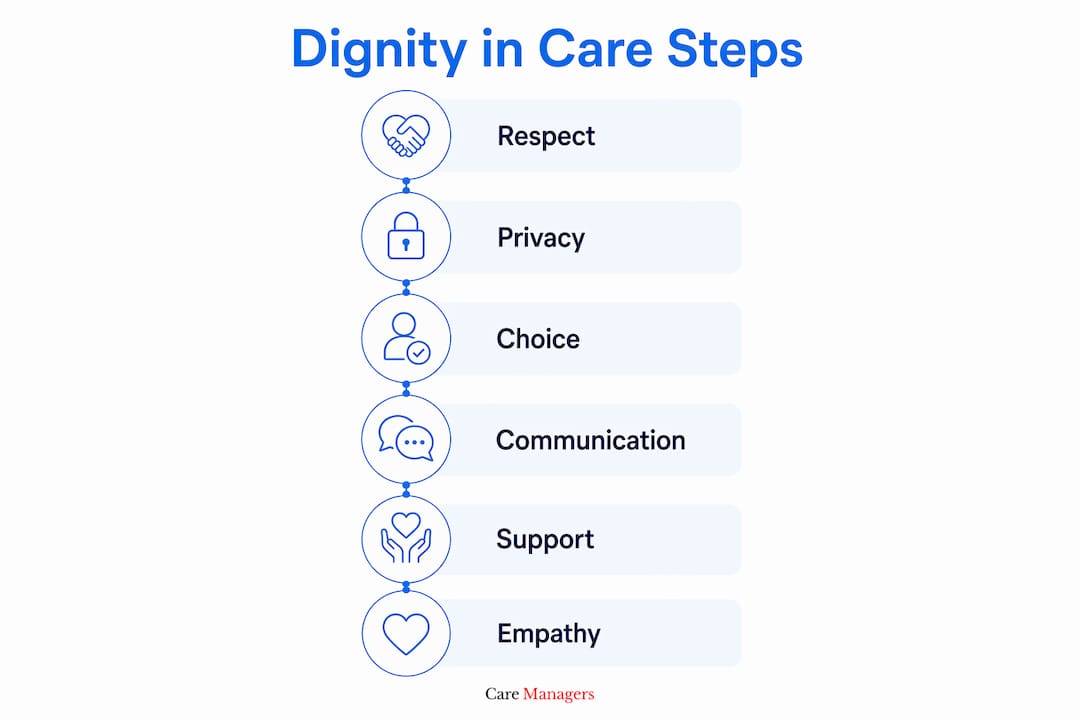
Dignity in care is not an abstract ideal. It is a set of concrete, observable behaviours that inspectors, families, and staff can all recognise. The Social Care Institute for Excellence (SCIE) identifies eight operational factors that together define what dignified care looks like in practice.
Understanding these factors helps you move from a vague sense that something is wrong to a specific, nameable concern you can raise.
The SCIE eight factors that promote dignity in care:
- Choice and control: The person chooses what to wear, what to eat, and how their day is structured. A carer who lays out clothes without asking removes a small but meaningful piece of autonomy.
- Communication: Staff address the person by their preferred name and involve them in decisions about their own care, including medication changes or new routines.
- Nutrition: Mealtimes are unhurried. The person is offered choices, given enough time to eat, and helped when needed rather than rushed.
- Pain management: Discomfort is reported and acted on promptly. Waiting hours to escalate a pain concern is a dignity failure, not just a clinical one.
- Personal hygiene: Intimate care is carried out with consent, explanation, and discretion. The person is never left exposed or embarrassed.
- Practical assistance: Help is offered in a way that supports what the person can still do for themselves, rather than taking over entirely.
- Privacy: Doors are knocked before entering. Conversations about care are not held in corridors or within earshot of others.
- Social inclusion: The person is supported to maintain relationships, take part in activities, and remain connected to their community.
Alongside SCIE’s framework, the Dignity in Care campaign’s 10 Dignity Do’s offer a complementary checklist of staff and workplace behaviours, covering zero tolerance of abuse, supporting independence, and actively listening to the people in care. Providers who use both frameworks in training demonstrate a noticeably more mature approach to embedding dignity across their teams.
It is also worth knowing that dignity is multi-dimensional. Research identifies distinct types, including dignity of personal identity (the right to maintain your sense of self), dignity of moral stature (respect for a person’s own values and beliefs), and dignity of merit (recognition of a person’s history, status, and achievements). A lifelong vegetarian whose dietary beliefs are ignored, or a retired professional who is never addressed by their title, experiences a real loss of dignity even if their physical needs are met.
What the law and regulators require from care providers
Dignity in care is not simply good practice. It is a legal obligation backed by several layers of UK law and regulation.
Regulation 10 of the Health and Social Care Act 2008 (Regulated Activities) Regulations 2014 sets out the specific requirements. Providers must ensure people receive care that:
- Protects their privacy, including when they are asleep, unconscious, or lack capacity
- Treats them as equals regardless of age, disability, or background
- Supports their autonomy and involvement in their local community
Failure to meet Regulation 10 is not a minor administrative matter. CQC can issue improvement notices, impose conditions on registration, or take further enforcement action against providers who cannot demonstrate compliance.
The Human Rights Act 1998 adds a further layer. Article 8 protects the right to private and family life, which directly underpins expectations around privacy, personal relationships, and family contact in care settings. When a provider restricts visiting without good reason, or shares personal information carelessly, they risk breaching both CQC regulations and human rights obligations.
The Care Act 2014 reinforces this through its wellbeing duty. Local authorities and providers must promote individual wellbeing, which the Act explicitly defines to include personal dignity and treating the person with respect.
| Legal or regulatory instrument | What it requires for dignity |
|---|---|
| CQC Regulation 10 (2014) | Privacy, equal treatment, autonomy, community involvement |
| Human Rights Act 1998, Article 8 | Right to private and family life in care settings |
| Care Act 2014, wellbeing duty | Dignity as a component of individual wellbeing |
| Health and Social Care Act 2008 | Statutory basis for CQC regulation of providers |
What inspectors look for: CQC frames dignity as concrete, everyday behaviours rather than policy documents. Inspectors observe how staff address people, whether meals are unhurried, and how quickly pain or distress is responded to.
How dignity shows up in everyday care: examples for staff
Dignity is demonstrated in the small moments of every shift, not in annual reviews or policy statements. CQC guidance is explicit: inspectors look at how someone is addressed, whether their personal history is understood, and how quickly staff respond when a person is in pain or distress.
Practical examples of dignified care in action:
- During intimate care, a carer explains each step before proceeding, asks for consent, and uses a towel to maintain cover. The person is never left undressed while the carer attends to something else.
- At mealtimes, a carer sits at the same level as the person, uses their preferred name, and does not clear the plate until the person has finished. There is no rushing.
- When administering medication, the carer explains what each item is for and checks whether the person has any concerns, rather than simply presenting a pot of tablets.
- During a phone call with a family member, the carer steps away from the person’s room rather than discussing care details in the hallway.
Two brief practice snapshots:
A woman living with early-stage dementia became distressed each morning when staff arrived to help her dress. Once the team learned she had always chosen her own clothes and dressed independently until recently, they changed their approach: they laid out two outfit options the evening before and let her choose in the morning. The distress stopped almost immediately. The change cost nothing except a small shift in routine.

A man receiving post-discharge care at home told his carer he felt embarrassed about needing help with personal hygiene. The carer responded by always knocking, explaining what she was about to do, and chatting about his interests during the process. He later told his daughter he felt “looked after, not managed.”
Pro Tip: At the start of each shift, ask one person in your care: “Is there anything you’d like done differently today?” It takes under a minute and gives you real-time feedback on whether dignity is being preserved. It also signals to the person that their preferences genuinely matter.
What families and people who use services should expect
You have the right to expect dignified care, and you have practical tools to check whether it is being delivered. Knowing what to ask, and what to do if something feels wrong, puts you in a much stronger position.
Questions worth asking any provider:
- How do you record a person’s preferences, including their preferred name, routines, and cultural or religious needs?
- How do staff handle intimate care, and what consent process do they follow?
- What happens if my relative raises a concern or complaint?
- Can I see the provider’s dignity policy and most recent CQC inspection report?
- How are staff trained on dignity and person-centred care?
If something does not feel right, a clear escalation path helps. Start by speaking directly with the care worker or their line manager. If the concern is not resolved, contact the provider’s registered manager in writing. If you remain unsatisfied, you can raise a concern with the CQC directly, or contact your local authority’s adult safeguarding team if you believe someone is at risk of harm.
CQC guidance on visiting and complaints confirms that complaint protections are part of what inspectors assess. You are not putting your relative at risk by speaking up. You are exercising a right that the regulatory framework is designed to protect.

For practical guidance on coordinating family care responsibilities, including how to raise concerns and share information with providers, Caremanagers has a dedicated resource for families navigating these conversations.
How organisations embed dignity: training, culture, and monitoring
Good intentions are not enough. Dignity needs to be built into the systems, supervision, and culture of an organisation so that it holds even under pressure.
Training approaches that make a difference:
- Person-centred care training that focuses on individual histories, preferences, and communication styles
- Cultural competency training, so staff can support people from different backgrounds with genuine understanding
- Scenario-based dignity training, where staff work through real situations rather than reading policy documents
Practical systems that embed dignity:
- A named Dignity Champion within the team, responsible for keeping dignity visible in supervision and team meetings
- A non-punitive complaints process that encourages people to raise concerns without fear
- Supervision and appraisal conversations that include specific questions about dignity, not just task completion
- Regular dignity-focused audits with findings shared with the team
Example audit checklist items:
| Audit area | What to check |
|---|---|
| Privacy in personal care | Are doors closed and consent obtained before intimate care? |
| Care plan evidence | Does each plan record preferred name, routines, and cultural needs? |
| Communication | Are people addressed by their preferred name consistently? |
| Family involvement | Are families informed and involved in care reviews? |
| Complaint records | Are concerns logged and responded to within agreed timescales? |
| Environment | Are private spaces available for personal conversations? |
Pro Tip: Assign your Dignity Champion a standing five-minute slot in every team meeting to share one observation from the week, positive or negative. Over time, this builds a culture where dignity is a normal part of conversation, not a topic reserved for inspections.
Understanding what makes a good carer is closely linked to dignity. Caremanagers outlines the qualities of a good home care worker that families and managers can use as a benchmark when assessing staff.
Dignity in home care: a practice snapshot
Home care presents a particular set of dignity challenges. A person’s home is their own space, and a carer entering it must work within that context, not impose an institutional routine on it.
Consider this situation: an elderly woman receiving daily visits for personal care and meal preparation had always been fiercely independent. She found the early-morning visit time disruptive to her routine and felt she had no say in when carers arrived. Her daughter raised this with the provider, who adjusted the visit to mid-morning and asked the woman which tasks she wanted help with and which she preferred to manage herself. The care plan was updated to reflect her choices.
The outcome was straightforward: she felt more in control, her anxiety reduced, and she began to look forward to the visits rather than dread them. The carer’s role shifted from “doing things to her” to “supporting what she wanted to do.”
Checklist of practices families can ask a home carer to follow:
- Knock and wait before entering any room
- Ask before touching belongings or moving items
- Follow the person’s preferred routine, not the carer’s convenience
- Explain every step during personal care before proceeding
- Use the person’s preferred name at all times
- Keep care-related conversations private, away from neighbours or other household members
- Record any changes in mood, appetite, or comfort and report them promptly
This kind of person-centred approach to care is what separates a provider who talks about dignity from one who actually delivers it.
Key takeaways
Dignity in care is a statutory requirement under CQC Regulation 10, a human rights obligation under Article 8, and a practical standard families can assess by asking specific questions about how preferences are recorded and respected.
| Point | Details |
|---|---|
| Legal basis | CQC Regulation 10 makes dignity a statutory requirement; breaches can lead to enforcement action. |
| Eight operational factors | SCIE’s framework covers choice, communication, nutrition, pain, hygiene, assistance, privacy, and social inclusion. |
| Families can act now | Ask any provider how they record preferences and what their complaints process looks like. |
| Organisations need systems | Dignity Champions, audits, and non-punitive complaints processes embed dignity beyond good intentions. |
| Caremanagers’ approach | Caremanagers delivers person-centred home care across South Wales and England, with staff trained to uphold dignity in every visit. |
Why dignity in care matters more than most providers admit
Dignity in care tends to be discussed as though it were a compliance checkbox. Pass the inspection, tick the box, move on. That framing misses what is actually at stake.
When someone enters care, whether at home or in a residential setting, they are often giving up a degree of control they have exercised their entire adult life. The loss of that control is not a minor inconvenience. For many people, it is one of the most difficult experiences they will face. How a carer knocks on a door, how they address someone, whether they ask before they act: these are not small courtesies. They are the daily evidence that the person still matters, still has preferences worth respecting, and is still the author of their own life.
What I find most telling is that the providers who genuinely embed dignity are not the ones with the longest policy documents. They are the ones where staff can describe, without prompting, what a specific person likes for breakfast and why they prefer to be called by a particular name. That knowledge is only possible when dignity is treated as a relationship, not a regulation.
If you are assessing a provider for a family member, ask a carer what they know about the person’s life before care. The answer will tell you everything.
Caremanagers: home care that puts dignity first
Families across South Wales and England choose Caremanagers’ home care services because the alternative, placing a loved one in residential care, often feels like a loss of independence that does not need to happen. Caremanagers provides personal care, live-in support, dementia care, respite care, and hospital discharge care in the person’s own home, where their routines, belongings, and sense of self remain intact.
Every care plan is built around the individual, recording preferences, routines, and personal history from the first assessment. Staff are trained in person-centred care and work within CQC regulatory expectations, so families can be confident that dignity is not an afterthought. For families choosing home care for an elderly loved one, Caremanagers offers a straightforward starting point: a conversation about what matters most to the person, and a care plan built around the answer. Get in touch to discuss your family’s needs and find out how Caremanagers can help.
Useful sources and further reading
- CQC Regulation 10: Dignity and Respect — The full regulatory text and CQC guidance on what providers must do to meet the dignity standard.
- SCIE: Defining dignity in care — SCIE’s framework explaining the eight factors and the broader concept of dignity in social care.
- Dignity in Care: The 10 Dignity Do’s — A practical ten-point checklist of staff behaviours that protect dignity, used widely in provider training.
- Legislation.gov.uk: Regulation 10 full text — The statutory instrument itself, useful for providers and families who want the precise legal wording.
- Care Act 2014 guidance — Government guidance on the wellbeing duty, including dignity as a component of individual wellbeing.
- CQC: Kindness, compassion and dignity — CQC’s assessment framework guidance explaining what inspectors look for when evaluating dignity in practice.
FAQ
What is dignity in care and why does it matter?
Dignity in care means treating people with respect, protecting their privacy, and supporting their autonomy at all times. It is a statutory requirement under CQC Regulation 10 and a component of the Care Act 2014 wellbeing duty.
What are the eight factors that promote dignity in care?
SCIE’s framework identifies eight factors: choice and control, communication, nutrition, pain management, personal hygiene, practical assistance, privacy, and social inclusion.
What are the different types of dignity relevant to care?
Research identifies several types, including dignity of personal identity (maintaining your sense of self), dignity of moral stature (respect for personal values and beliefs), and dignity of merit (recognition of a person’s history and achievements). Each type can be undermined in different ways in a care setting.
How can families raise a concern about dignity in care?
Start by speaking with the care worker or their line manager, then contact the provider’s registered manager in writing if the concern is not resolved. If you remain unsatisfied, you can raise a concern directly with the CQC or contact your local authority’s adult safeguarding team.
What is a Dignity Champion in a care setting?
A Dignity Champion is a named member of staff responsible for keeping dignity visible within the team, through supervision, audits, and team meetings. Providers who appoint a Dignity Champion and demonstrate regular dignity-focused audits show a more mature approach to embedding dignity in their culture.