
TL;DR:
- Managed care staffing involves a provider fully responsible for recruiting, managing, and vetting carers, ensuring quality and safety. It offers families reliable continuity, rapid mobilization, and clinical oversight, especially after hospital discharge or for dementia support. Caremanagers provides compliant in-home and live-in staffing across South Wales and England, tailored to client needs.
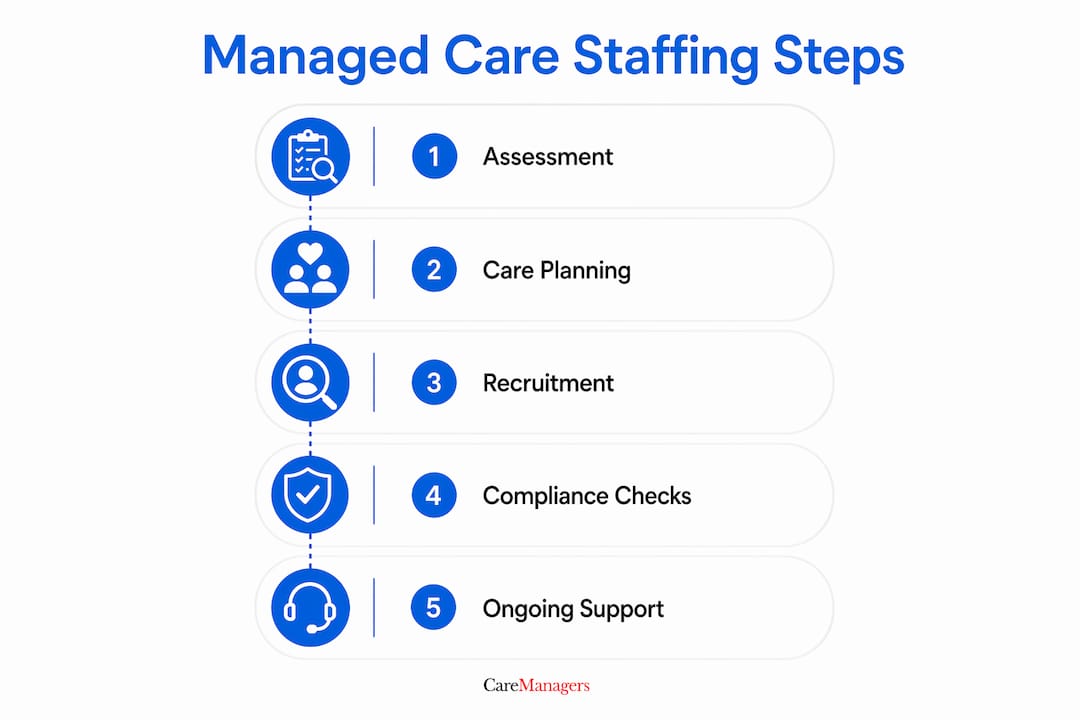
Managed care staffing means a provider takes full responsibility for recruiting, employing, vetting, and managing carers on your behalf, rather than simply introducing someone and stepping back. You get a coordinated service: assessed needs, matched staff, managed rotas, and a named point of contact who handles cover when a carer is unwell. For families in South Wales and England seeking live-in support, dementia care, or help after a hospital discharge, it is usually the most reliable and safest route.
Key things to know at a glance:
- CQC standards apply to managed providers, meaning quality and safety are regulated.
- DBS checks and identity verification are the provider’s responsibility, not yours.
- The NHS Workforce Alliance defines managed staff banks as a formal framework for outsourcing both employment and management of flexible workers.
- Caremanagers provides managed in-home and live-in staffing across South Wales and England, covering hospital discharge, dementia care, respite, and more.
Table of Contents
- How does managed care staffing work in practice?
- What are the real benefits of managed care staffing?
- What compliance and safety checks should you expect in the UK?
- When is managed care staffing the right choice for your family?
- How does pricing usually work for managed care staffing in the UK?
- What questions should you ask a managed care staffing provider?
- How Caremanagers supports families in South Wales and England
- What rights do patients and families have when using managed care staffing?
- Real-world examples of managed care staffing making a difference
- Key takeaways
- Why managed staffing deserves more credit than it usually gets
- Ready to arrange managed care for your family?
- Helpful UK sources for families
- FAQ
How does managed care staffing work in practice?
There are three main models you will encounter.
- Managed staff bank. A pool of pre-vetted workers is held centrally. The provider fills gaps from this bank, managing payroll, compliance checks, and rota cover. The NHS Workforce Alliance framework lists services such as pay rolling, performance management, and ensuring worker compliance to NHS employment check standards.
- Managed service programme (MSP). A single provider acts as your point of contact, coordinating multiple staffing sources, consolidated reporting, and direct sourcing. MSP models combine master vendor and neutral vendor features to improve cost efficiency.
- Hybrid or master/neutral vendor. A master vendor fills vacancies first; if they cannot, the work goes to a wider supplier network. This suits larger organisations but families may encounter it through care agencies working at scale.
| Service model | Who employs staff | Who manages rotas | Who oversees quality |
|---|---|---|---|
| Managed staff bank | Provider or outsourced employer | Provider | Provider/CQC |
| Managed service programme | Provider or sub-suppliers | MSP coordinator | MSP/CQC |
| Introductory agency | Family (self-employed carer) | Family | Family |
| Private hire | Family | Family | Family |
The critical difference from an introductory agency is responsibility. Introductory agencies introduce self-employed carers and then the family manages day-to-day care. A managed provider recruits, trains, and oversees staff, and manages care plans. That distinction matters practically: if your carer is unwell on a Sunday morning, a managed provider finds cover; an introductory agency does not.
What are the real benefits of managed care staffing?
For families, the practical advantages are significant.
- Continuity of named carers. You know who is coming, and so does your relative.
- Managed cover. Sickness, holidays, and emergencies are handled by the provider, not by you making frantic calls.
- Clinical oversight. For complex needs such as dementia or post-surgical recovery, a managed provider can include clinical governance in the care plan.
- Faster mobilisation after hospital discharge. Pre-vetted staff banks mean care can often start within 24–48 hours of a discharge decision.
- Payroll and employer compliance handled. You are not the employer, so you carry no payroll or liability burden.
For organisations, NHS Professionals reports structural cost savings of 5–10% on temporary staffing spend and 100% compliant bank workers screened to NHS Employment Check standards when using managed service provision.
Pro Tip: Ask your provider to assign a primary carer and a small back-up team of two or three familiar faces. Continuity of care improves noticeably when your relative already knows the people covering for holidays.
What compliance and safety checks should you expect in the UK?
Compliance is not optional, and a reputable managed provider will welcome your questions rather than deflect them.
Expect every provider to demonstrate:
- CQC registration or adherence to CQC standards, with a registration number you can verify on the CQC website.
- Enhanced DBS checks for every carer, with records available on request.
- Identity verification and right-to-work checks.
- Documented training and qualifications, including manual handling, medication administration, and condition-specific training (dementia, PEG feeding).
- Indemnity and employers’ liability insurance.
- Safe recruitment records, including references and employment history checks.
- Clear payroll and employment arrangements, so you know who the legal employer is.
Ask providers directly: How are carers revalidated after their initial checks? Who holds the DBS certificates? How is clinical governance managed if a carer raises a concern? The NHS Commercial Solutions framework requires audit processes for worker compliance as a condition of managed staff bank contracts, which gives you a useful benchmark for what good looks like.
Caremanagers publishes detailed guidance on why compliance matters in care staffing if you want to read further before speaking to a provider.

When is managed care staffing the right choice for your family?
Managed care staffing works best where you need rapid, reliable cover combined with clinical oversight and continuity. Here are the most common situations families face.
- Hospital discharge. A managed provider can mobilise a hospital discharge care package quickly, with staff already vetted and ready.
- Progressive dementia. Consistent, named carers who understand routines reduce distress. A managed provider maintains that consistency even when individual carers are unavailable.
- Planned respite. Families who care for a relative at home can arrange a managed respite package with familiar carers, rather than introducing a stranger at short notice.
- Interim cover. If a family’s usual private carer is unwell or leaves, a managed provider bridges the gap without the family having to recruit from scratch.
| Use case | Managed staffing suitability | Typical benefit |
|---|---|---|
| Hospital discharge | High | Rapid mobilisation, clinical handover |
| Dementia support | High | Named carers, routine consistency |
| Planned respite | High | Familiar cover, no family recruitment burden |
| Overnight care | Medium–High | Shift management handled by provider |
| Interim cover | High | Pre-vetted staff available quickly |
How does pricing usually work for managed care staffing in the UK?
Pricing varies by model, but expect a managed-service premium that reflects the end-to-end management you receive.
Common pricing models:
- Hourly rate for visiting care, covering the carer’s pay, travel, and a management margin.
- Weekly live-in fee, which bundles the carer’s pay, accommodation contribution, and management costs into a single figure. You can read more about how live-in care works and what affects the weekly cost.
- Managed service retainer, used more often by organisations than individual families, covering coordination, reporting, and supplier management.
Main cost drivers to understand:
- Staff seniority and qualifications (a registered nurse costs more than a care assistant).
- Shift pattern: overnight and live-in shifts carry a higher rate than daytime visits.
- Enhanced care needs such as dementia, PEG feeding, or catheter care.
- Travel costs, particularly in rural parts of South Wales.
- Payroll and employer costs if the provider employs staff directly.
When comparing quotes, ask for a written breakdown showing: carer pay rate, management fee, travel allowance, contingency arrangements, and notice period terms. Funding options for families are covered in the elderly home care funding guide.
What questions should you ask a managed care staffing provider?
Go into any assessment or sales call with these questions ready.
- Are your carers employed by you, or are they self-employed?
- Who holds the DBS certificates, and can I see them?
- How do you manage rota cover when a carer is unwell?
- Will my relative have a named primary carer?
- What training do carers receive for specific conditions (dementia, post-surgical care)?
- How are incidents reported and escalated?
- What does the written contract cover, and what is the notice period?
- Is there a clear breakdown of fees, including management charges?
Red flags to watch for:
- Inability or reluctance to show DBS records or training certificates.
- Vague answers about contingency cover (“we’ll sort something out”).
- No written service level agreement or unclear payroll responsibility.
- Pressure to sign quickly without a written quote.
How Caremanagers supports families in South Wales and England
Caremanagers provides managed in-home and live-in staffing tailored to families across South Wales and England, with services designed around your relative’s specific needs rather than a standard package.
Services include:
- Hospital discharge packages, arranged quickly to support a safe return home.
- Dementia care, with named carers trained in condition-specific support. See the dementia support at home service page for details.
- Live-in care, with full rota and cover management handled by Caremanagers.
- Respite care, giving family carers a planned break with familiar, vetted staff.
- B2B staffing agreements for healthcare organisations needing managed workforce solutions.
Caremanagers emphasises DBS verification, documented training, and adherence to CQC principles across all placements. Before your first assessment, it helps to have a brief care summary, any recent hospital discharge paperwork, a current medication list, and notes on your relative’s preferred daily routines.
What rights do patients and families have when using managed care staffing?
When a managed provider delivers care in your home, you retain clear rights throughout.
You have the right to see the care plan and to be involved in reviewing it. You can request information about the carers assigned to your relative, including their qualifications and DBS status. If you are unhappy with a carer or with the service, you have the right to raise a formal complaint, and the provider must have a documented complaints procedure. CQC-registered providers are subject to inspection, and you can view their inspection reports publicly on the CQC website.
Families also have the right to withdraw consent for a care arrangement and to seek a second provider without penalty beyond any contractual notice period. If the provider employs the carers, you are not the legal employer and carry no employment liability. That distinction protects you if a dispute arises.
Real-world examples of managed care staffing making a difference
Consider a family in Cardiff whose mother was discharged from hospital after a hip replacement with less than 48 hours’ notice. A managed provider with a pre-vetted staff bank arranged twice-daily visits starting the morning after discharge, with a named carer who attended every visit for the first two weeks. The family did not need to recruit, interview, or manage anyone. That speed and consistency is what managed staffing is designed to deliver.
For families supporting a relative with advancing dementia, the picture is different but the principle holds. A managed live-in arrangement means the same one or two carers are present week after week, learning routines, preferences, and the small details that reduce distress. When one carer takes annual leave, the provider arranges a familiar cover carer rather than sending a stranger. Families report that this continuity reduces anxiety for their relative and for themselves.
Respite care is a third scenario worth noting. A family carer who has been providing daily support for months can arrange a two-week managed respite package, knowing the provider will send vetted, trained carers who have been briefed on their relative’s needs. The break is genuinely restful because the family is not managing the staffing themselves.
Key takeaways
Managed care staffing gives families a single, accountable provider who recruits, employs, vets, and manages carers, covering compliance, rotas, and contingency so you do not have to.
| Point | Details |
|---|---|
| Definition | A managed provider employs or manages carers end-to-end, unlike an introductory agency where the family takes responsibility. |
| Compliance baseline | Expect CQC registration, enhanced DBS checks, documented training, and employers’ liability insurance from any reputable provider. |
| Cost structure | Pricing varies by model; ask for a written breakdown of carer pay, management fee, travel, and notice period before signing. |
| Best use cases | Hospital discharge, dementia support, planned respite, and interim cover are where managed staffing delivers the clearest benefit. |
| Caremanagers | Caremanagers provides managed in-home and live-in staffing across South Wales and England, covering all the above use cases with CQC-aligned compliance. |
Why managed staffing deserves more credit than it usually gets
Most families arrive at managed care staffing after something has gone wrong: a carer hired privately who left suddenly, an introductory agency that offered no cover, or a hospital discharge that caught everyone off guard. The model tends to get chosen by necessity rather than design, which is a shame, because it is genuinely the most protective arrangement for families who cannot or should not be managing a workforce themselves.
The compliance architecture alone is worth the premium. Knowing that DBS checks, training records, and employer liability sit with the provider rather than with you is not a minor administrative convenience. It is the difference between a family that can focus on their relative and one that is fielding calls about payroll and managing employment disputes.
What people underestimate is how much the continuity argument matters over time. A managed provider who assigns named carers and manages cover quietly builds something that is very hard to replicate with ad hoc hiring: familiarity, trust, and a carer who actually knows your relative. That is the real value of the model, and it rarely appears in a price comparison.
Ready to arrange managed care for your family?
Caremanagers offers a straightforward first step: a no-pressure assessment to understand your relative’s needs and match the right managed care package. Whether you need home care services starting this week after a hospital discharge, or you are planning ahead for live-in dementia support, the team covers South Wales and England with fully vetted, managed staff.
To prepare for your first assessment, have the following ready: a brief summary of your relative’s care needs, any recent hospital discharge paperwork or GP letters, a current medication list, and notes on preferred daily routines and any specific preferences. Contact Caremanagers directly through the website to request a written quote and ask for a breakdown of all fees before you commit.
Helpful UK sources for families
- NHS Workforce Alliance Managed Staff Banks framework — explains the formal definition of managed staff banks and the services providers must deliver. Useful for understanding what a compliant managed provider looks like.
- NHS Professionals Managed Service Provision — covers how managed service provision works at NHS trust level, including cost savings and compliance standards. Helpful context for families evaluating provider claims.
- NHS Commercial Solutions Managed Staff Banks — outlines procurement and audit requirements for managed staff bank contracts. A useful benchmark for the compliance standards you should expect.
- Pulse Jobs MSP explainer — plain-language description of how managed service programmes work, including mobilisation speed and reporting.
- Elder: managed vs introductory agency — accessible comparison of managed and introductory models for families considering live-in care.
Always ask any provider for their CQC registration number and request sight of DBS confirmation for the carers assigned to your relative before care begins.
FAQ
What is managed care staffing in simple terms?
Managed care staffing means a provider takes full responsibility for recruiting, employing, vetting, and managing carers on your behalf, including rotas, cover, and compliance checks.
How does managed care staffing differ from an introductory agency?
An introductory agency introduces a self-employed carer and then the family manages everything; a managed provider employs or oversees the carers and handles quality, cover, and compliance directly.
What compliance checks should a managed care staffing provider carry out?
Expect enhanced DBS checks, identity verification, documented training records, CQC registration or adherence to CQC standards, and employers’ liability insurance as a minimum.
How quickly can managed care staffing be arranged after a hospital discharge?
Providers with pre-vetted staff banks can often mobilise care rapidly after a discharge decision, making managed staffing particularly suited to urgent hospital-to-home packages.
Does Caremanagers offer managed care staffing in South Wales and England?
Yes. Caremanagers provides managed in-home and live-in staffing across South Wales and England, covering hospital discharge, dementia care, respite, and live-in packages with CQC-aligned compliance.