
TL;DR:
- Care worker vetting involves verifying identity, criminal history, and right to work before employment. It includes DBS checks, references, professional registration, and risk assessments, especially for roles involving regulated activity with adults. Proper vetting ensures safety, compliance, and minimizes the risk of harm or legal consequences.
Care worker vetting is the set of checks and employer actions that confirm a candidate is safe, lawful, and genuinely suitable to provide personal care to vulnerable adults. In the UK, it is not a single check but a structured process governed by the Disclosure and Barring Service, the Care Quality Commission, and the Health and Social Care Act 2008. Get it right and you protect the people in your care. Get it wrong and you risk harm, regulatory action, and potential criminal liability.
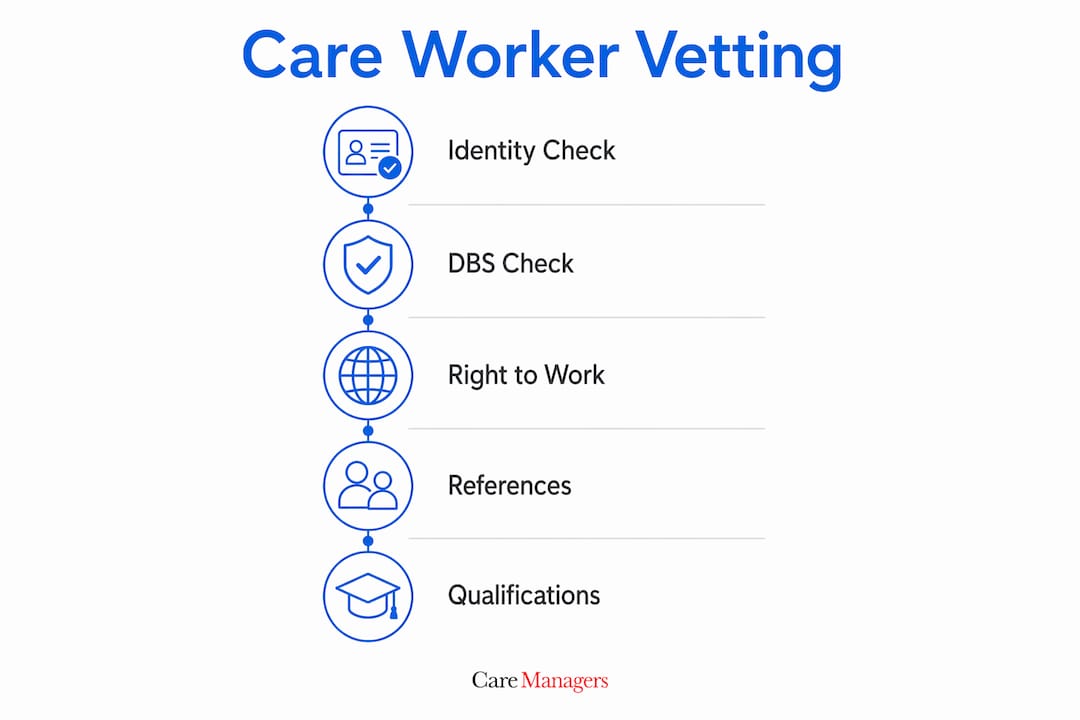
The four elements every employer must address are:
- DBS check at the correct level (Enhanced with Adults’ Barred List for roles involving regulated activity)
- Identity and Right to Work verification, including digital checks where appropriate
- References and employment history, with specific conduct evidence from previous care roles
- Professional registration and qualification checks where the role requires them (for example, NMC registration for nurses)
If you need the short answer: care worker vetting means verifying identity, criminal history, right to work, and character before anyone enters a vulnerable person’s home or care setting.
Table of Contents
- What does care worker vetting actually check?
- When is an enhanced DBS and barred-list check required?
- How do you vet a care worker step by step?
- Why vetting must go beyond box-ticking
- What would make a candidate fail care worker vetting?
- What are your ongoing duties after hiring?
- Your employer checklist for vetting a care worker
- Key takeaways
- Vetting is a safeguarding tool, not a formality
- How Caremanagers supports safe, compliant placements
- Key official sources and further reading
- FAQ
What does care worker vetting actually check?
The care worker screening process covers several distinct areas, each designed to catch a different category of risk.
DBS checks: standard, enhanced, and enhanced with barred list
A Standard DBS check discloses spent and unspent convictions, cautions, reprimands, and warnings. An Enhanced DBS check adds any locally held police intelligence that a chief constable considers relevant. For roles involving regulated activity with adults, such as personal care workers who wash, dress, or prompt medication, the Enhanced check can also include a search of the Adults’ Barred List. That barred-list search is the most critical layer: it tells you whether the DBS has formally barred a person from working in regulated activity.
A conviction does not automatically disqualify a candidate. CQC guidance is clear that employers must assess the relevance and risk of any disclosed information rather than applying a blanket exclusion policy.
Identity and Right to Work checks
You must verify that the person is who they claim to be and that they are legally entitled to work in the UK. Acceptable identity documents include a valid passport, biometric residence permit, or a combination of documents listed in the Home Office guidance. Sector guidance increasingly treats digital Right to Work verification as standard practice, and it can speed up the process considerably without reducing rigour.
References and employment history
Generic character references from friends or family carry almost no weight in a care context. What you need is specific conduct evidence from previous health or social care employers. CQC-ready recruitment files require documented reasons for leaving any role that involved work with vulnerable adults or children. Unexplained gaps in employment history must be explored and recorded.

Professional registrations and qualifications
Where a role requires registration with a professional body, such as the Nursing and Midwifery Council for nurses or the Social Work England register for social workers, you must verify that registration is current and in good standing. For care assistants without a regulated professional title, you should still verify any qualifications claimed on the application form.
Other checks
Depending on the role, you may also need to verify a driving licence (for community care workers who transport clients), check occupational health fitness to work, and confirm immigration status where relevant.
Pro Tip: Always check the DBS eligibility of a role based on the activities the worker will actually perform, not the job title on the contract. A “support worker” who provides personal care is in regulated activity; one who only provides companionship may not be.
When is an enhanced DBS and barred-list check required?
The answer depends on whether the role involves regulated activity with adults, not on what the job is called.
Regulated activity with adults covers personal care provided on a frequent, intensive, or overnight basis. The key activities that trigger eligibility include:
- Washing, bathing, or dressing an adult who needs assistance
- Prompting or administering medication
- Providing personal hygiene support, including continence care
- Providing healthcare by or under the direction of a regulated health professional
- Transporting an adult because of their age, illness, or disability
A care worker who performs any of these activities regularly is in regulated activity and is eligible for an Enhanced DBS check with an Adults’ Barred List search. Frequency matters: the DBS defines “frequently” as regular weekly occurrence, “intensively” as several days over a month, and “overnight” as any period during the early morning hours.
Eligibility is based on what the worker does, not their job title. A volunteer who helps with personal care on a weekly basis is in regulated activity. An administrator who never has unsupervised contact with service users is not.
If you are uncertain whether a specific role qualifies, use the DBS workforce eligibility guidance on GOV.UK or contact the DBS directly. Knowingly requesting a higher-level check than the law permits is unlawful under the Rehabilitation of Offenders Act 1974 (Exceptions) Order 1975.
How do you vet a care worker step by step?
A safe, compliant process follows a clear sequence from the moment you write the job advert to the worker’s first day.
-
Write the advert carefully. State that the role is subject to an Enhanced DBS check and that previous convictions will be considered on a case-by-case basis. This deters unsuitable applicants without unlawfully excluding people with spent convictions.
-
Shortlist using values-based criteria. Before you look at qualifications, ask yourself whether the application shows empathy, reliability, and a safeguarding mindset. Use structured interview questions that probe attitudes: “Tell me about a time you had a concern about a colleague’s behaviour with a client. What did you do?”
-
Verify identity documents at interview. Check original documents in person. For Right to Work, you can use a certified digital identity service provider. Record what you checked, the date, and who verified it.
-
Request the DBS check promptly. Submit the application as soon as a conditional offer is made. If the worker needs to start before the certificate arrives, carry out a risk assessment, document it, and put supervised working arrangements in place. CQC inspectors will expect to see that risk assessment on file.
-
Gather references before the start date. Contact at least two previous employers directly, using a structured template that asks specifically about conduct, reliability, and any safeguarding concerns. Do not accept open references or references submitted by the candidate themselves.
-
Verify professional registrations. Check the relevant register online and print or save a screenshot with the date. NMC and Social Work England registers are publicly searchable.
-
Record everything. Under Regulation 19 and Schedule 3 of the Health and Social Care Act 2008 (Regulated Activities) Regulations 2014, you must hold specific categories of information for every person employed. That includes the DBS certificate number and date, identity documents checked, references received, and any risk assessments completed.
Pro Tip: Keep a recruitment checklist in each staff member’s personnel file and sign it off at each stage. If a CQC inspector asks for evidence of your vetting process, a completed checklist is far more persuasive than a verbal account.
Why vetting must go beyond box-ticking
Skills for Care and CQC guidance is consistent on one point: the importance of vetting care workers lies not in completing a checklist but in using the process to assess values, behaviour, and safeguarding attitudes.
The most common mistakes providers make during inspection include:
- Accepting generic references that say nothing specific about conduct in care roles
- Failing to document why a candidate left a previous care role, particularly where the departure was sudden or unexplained
- Starting staff without a documented risk assessment when a DBS certificate has not yet arrived
- Not probing gaps in employment history during interview
- Holding no record of the identity documents checked or the date they were verified
Making vetting genuinely values-based means training the people who carry out recruitment. Interviewers should understand what safeguarding red flags look like in an application or at interview. Reference templates should ask directly: “Would you re-employ this person in a role involving personal care with vulnerable adults?” A “no” or a non-committal answer to that question is significant, even if the rest of the reference is positive.
Understanding the qualities that make a good home care worker can help you frame interview questions and reference requests around the behaviours that actually matter in practice.
What would make a candidate fail care worker vetting?
Several categories of issue commonly lead to a candidate being rejected or, in serious cases, barred from regulated activity.
- Barred-list entry. If a candidate appears on the Adults’ Barred List, employing them in regulated activity is a criminal offence. There is no discretion here.
- Relevant convictions. Convictions for violence, sexual offences, or serious dishonesty are typically disqualifying for care roles, though employers must assess each case individually rather than applying an automatic exclusion.
- Falsified documents. Presenting a forged passport, fabricated reference, or false qualification certificate is grounds for immediate rejection and may itself be a criminal matter.
- Unexplained employment gaps. Gaps that cannot be accounted for, particularly around periods when the candidate was working in care, warrant careful investigation. They do not automatically disqualify, but they must be explored.
- Poor or absent conduct references. A previous care employer who declines to comment on conduct, or who gives a reference that is deliberately vague, is a significant warning sign.
- Evidence of unsuitable behaviour. References or documented incidents that describe boundary violations, rough handling, financial irregularities, or failure to report concerns are disqualifying in practice, even without a criminal conviction.
- Right to Work failure. If a candidate cannot provide documents that satisfy the Right to Work check, employment is unlawful regardless of how suitable they appear in every other respect.
What are your ongoing duties after hiring?
Vetting does not end on the first day. Employers have continuing legal and regulatory responsibilities that CQC inspectors will check.
- Duty to refer to the DBS. If you dismiss a worker, or they resign when dismissal was likely, because of behaviour that harmed or risked harming a vulnerable adult, you have a legal duty to refer the matter to the DBS. Failure to refer is a criminal offence.
- Regulation 19 record retention. You must maintain the Schedule 3 categories of information for as long as the person is employed and for a reasonable period afterwards. This includes DBS certificate details, identity documents, references, and any risk assessments.
- Professional registration monitoring. For nurses, social workers, and other regulated professionals, check registration status periodically, not just at recruitment. A lapse or suspension mid-employment is a serious risk.
- Periodic re-checks. There is no statutory requirement to repeat a DBS check at fixed intervals for most care roles, but Skills for Care recommends having a policy that triggers reassessment when there is a change in role, a safeguarding concern, or a significant gap in service.
- Supervised working documentation. If a worker starts before their DBS certificate arrives, the risk assessment and supervision arrangements must be documented and kept on file. CQC inspectors expect to see this evidence, not just a verbal assurance that supervision took place.
For organisations managing compliance in care staffing, keeping these records current and accessible is as important as completing the checks in the first place.
Your employer checklist for vetting a care worker
Use this as a ready reference at each stage of recruitment.
Pre-interview
- Confirm the role involves regulated activity and requires an Enhanced DBS with Adults’ Barred List check
- Draft advert wording that references the DBS requirement
- Prepare a structured application form that asks for full employment history with no gaps
At interview
- Verify original identity documents and record what was checked
- Use values-based questions that probe safeguarding attitudes and past conduct
- Ask the candidate to explain any gaps in employment history
Pre-employment checks
- Submit DBS application promptly after conditional offer
- Complete Right to Work check using original documents or an approved digital service
- Contact at least two previous employers directly using a structured reference template
- Verify professional registration where applicable
- If start date precedes DBS certificate: complete and document a risk assessment, put supervised working in place
First week
- Confirm DBS certificate received and reviewed; record certificate number and date
- Confirm all Schedule 3 documentation is on file
- Brief the worker on your safeguarding policy and reporting procedures
- Record caregiver documentation and onboarding steps, following good practice on caregiver documentation
Ongoing
- Set a reminder to check professional registration annually
- Document any supervision notes or conduct concerns as they arise
- Know your duty-to-refer threshold and act on it without delay
For borderline cases, such as a disclosed conviction or an unexplained gap, seek advice from the DBS helpline or a qualified employment lawyer before making a hiring decision.
Key takeaways
Care worker vetting requires an Enhanced DBS check with an Adults’ Barred List search for any role involving regulated activity, combined with Right to Work verification, conduct-specific references, and documented record-keeping under Regulation 19.
| Point | Details |
|---|---|
| Enhanced DBS with barred list | Required for any role involving personal care activities that constitute regulated activity with adults. |
| Right to Work is non-optional | Employment is unlawful without a completed Right to Work check, regardless of other suitability. |
| Conduct references, not character references | References must address specific behaviour in previous care roles, not just general suitability. |
| Document everything for CQC | Regulation 19 and Schedule 3 require specific categories of information to be held on file for every employee. |
| Caremanagers handles compliant vetting | Caremanagers carries out DBS administration, identity checks, and conduct-based screening for placements across South Wales and England. |
Vetting is a safeguarding tool, not a formality
There is a version of care worker vetting that looks thorough on paper but achieves very little in practice. A DBS certificate filed without being read. A reference accepted because it arrived on headed paper. An employment gap noted but never explored. These are the patterns that CQC inspectors find repeatedly, and they are the patterns that precede the most serious safeguarding failures.
What the evidence from Skills for Care and CQC consistently shows is that the providers with the strongest safety records treat vetting as a genuine assessment of character, not a compliance hurdle to clear before someone starts. That means training the people who conduct interviews to recognise evasive answers. It means asking referees the uncomfortable question directly. It means reading a DBS certificate rather than filing it.
If you are reviewing your own vetting procedure, the checklist in this article is a reasonable starting point. But the deeper question is whether the people carrying out your recruitment understand why each check matters, not just that it is required. That understanding is what turns a process into a safeguard.
How Caremanagers supports safe, compliant placements
Families and organisations that need vetted care staff quickly face a real tension: thorough vetting takes time, and the person who needs care cannot always wait. Caremanagers resolves that tension by handling the compliance work directly, so you do not have to manage DBS applications, identity verification, and reference gathering alongside everything else.
For families arranging home care services across South Wales and England, every Caremanagers carer has been through an Enhanced DBS check with Adults’ Barred List search, Right to Work verification, and conduct-specific reference checks before they step through a client’s door. For healthcare organisations, Caremanagers provides staffing solutions with the same compliance standards built in, reducing the risk of a Regulation 19 shortfall at inspection.
Whether you are arranging support after a hospital discharge, setting up live-in care, or sourcing specialist dementia care staff, the vetting has already been done. Contact Caremanagers to discuss your requirements and arrange a placement that meets both your care needs and your compliance obligations.
Key official sources and further reading
These are the primary documents and tools to consult when making vetting decisions.
- The Health and Social Care Act 2008 (Regulated Activities) Regulations 2014, Regulation 19 — the legal basis for fit and proper person requirements, including the Schedule 3 categories of information employers must hold.
- DBS checks guidance for employers — GOV.UK — explains the three levels of DBS check, eligibility rules, and how to submit applications correctly.
- Regulated activity with adults in England and Wales — GOV.UK — the definitive guidance on which activities and roles qualify for an Enhanced check with barred-list access.
- DBS workforce eligibility guidance — GOV.UK — sector-by-sector eligibility guides to help you identify the correct workforce category on the DBS application form.
- DBS checks for adult social care roles — GOV.UK — a focused leaflet covering personal care activities and barred-list eligibility for the adult social care workforce.
- Recruitment and vetting — Skills for Care — practical guidance, templates, and values-based recruitment tools for care providers; the primary source for safer employment practice.
- CQC employment requirements — Regulation 19 FAQs (CQC) — CQC’s own FAQ document explaining what inspectors expect to see in recruitment files and when risk assessments are required.
- Background checks in 2026 — Care England — sector guidance on integrating digital Right to Work and identity checks as standard practice.
FAQ
What would make you fail care worker vetting?
The most common reasons are a barred-list entry (which makes employment in regulated activity a criminal offence), relevant convictions for violence or dishonesty, falsified documents, or a Right to Work failure. Poor or evasive conduct references from previous care employers are also a significant red flag that responsible employers should not overlook.
What do employers check during the vetting process?
A standard care worker screening process covers criminal history via a DBS check, identity and Right to Work documents, employment history including reasons for leaving previous care roles, professional registration where applicable, and conduct-specific references from previous employers.

What are care workers not allowed to do?
Care workers must not perform tasks outside their assessed competence, administer medication without the appropriate training and authorisation, or work in regulated activity if they are on the Adults’ Barred List. They are also prohibited from forming inappropriate personal relationships with clients or accepting gifts beyond a nominal value, as set out in most providers’ codes of conduct.
What is the current vetting process for staff in care?
The current process requires an Enhanced DBS check with an Adults’ Barred List search for roles involving regulated activity, a Right to Work check using original or digitally verified documents, conduct-specific references from at least two previous employers, and documentation of all checks in line with Regulation 19 and Schedule 3 of the Health and Social Care Act 2008 (Regulated Activities) Regulations 2014.
Does a conviction automatically mean someone fails vetting?
No. CQC guidance requires employers to assess the relevance and risk of any disclosed conviction individually rather than applying a blanket exclusion, except where a barred-list entry makes employment in regulated activity unlawful.