
TL;DR:
- Most families in South Wales and England prefer a blended care model with a permanent or live-in carer supported by vetted agency cover. This approach offers continuity that improves quality of life, especially for dementia patients, while providing flexibility for short-term needs or emergencies. Legally, agency staff are hired and managed by the agency, whereas direct employment or provider-managed care involves family or provider handling employment duties and compliance.
For most families in South Wales and England, the best approach is a blended one: a permanent or live-in carer as the core, with vetted agency cover for gaps, emergencies, and short-term needs. This mirrors what sector experts now describe as the most effective staffing strategy for UK care in 2026.
- Permanent or live-in care builds the trust, routine knowledge, and relationship that improve daily quality of life, particularly for people living with dementia.
- Agency or temporary cover gives you speed and flexibility when a regular carer is unwell, when your loved one is discharged from hospital at short notice, or when you need respite.
Pro Tip: When you do use agency cover, ask the provider to send the same named carer each time. Familiarity reduces anxiety for your loved one and keeps handovers smoother.
Table of Contents
- What do ‘agency staffing’ and ‘permanent staffing’ actually mean in UK homecare?
- How do the two models compare across what matters most to families?
- What should families expect to pay, and who is legally responsible?
- How does your staffing choice affect care quality and your loved one’s wellbeing?
- What checks must you confirm before any carer starts?
- What questions should you ask, and what are the red flags?
- How Caremanagers approaches temporary cover and live-in care
- Key takeaways
- A note on why we favour a blended approach
- How to get started with Caremanagers
- Useful sources and further reading
- FAQ
What do ‘agency staffing’ and ‘permanent staffing’ actually mean in UK homecare?
Understanding the difference matters before you sign anything.
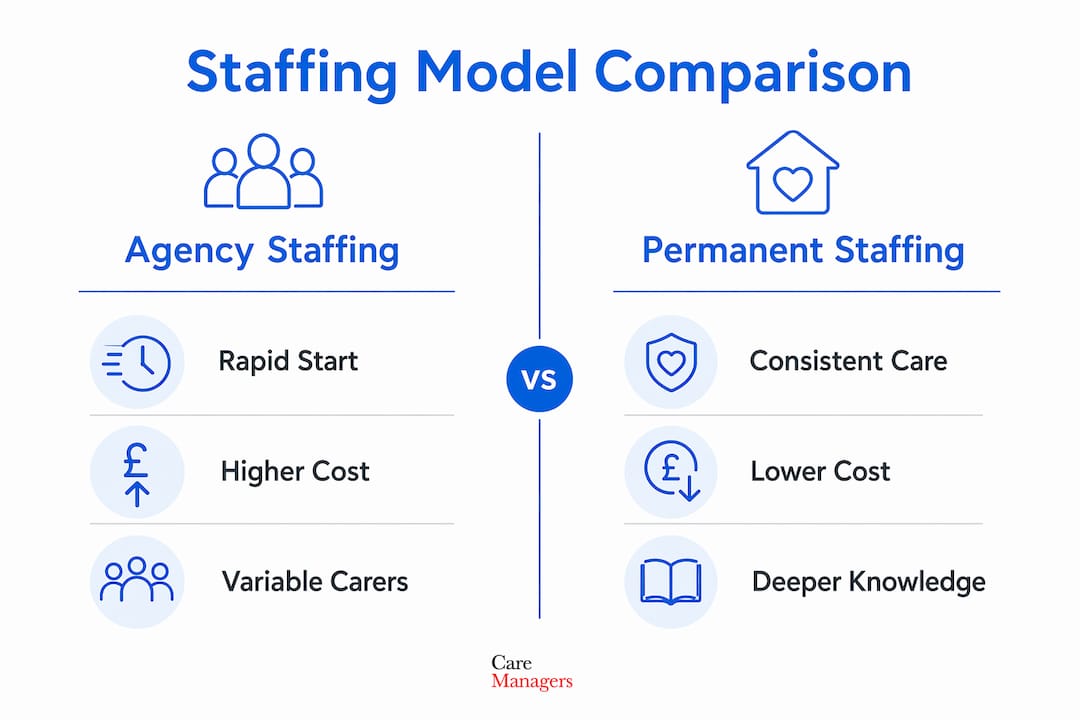
Temporary or agency staffing means a care agency supplies a worker to your home. The agency holds the employment contract, pays the carer’s National Insurance contributions, and handles statutory sick pay. You direct the carer’s day-to-day work, but the legal employer relationship stays with the agency. Under the Agency Workers Regulations 2010, an agency worker placed with you for 12 continuous weeks acquires the right to the same basic terms and conditions as a directly employed worker in the same role. You can read more about what contract care staffing involves and how agencies supply staff.
Permanent staffing and live-in care means either directly employing a carer yourself or engaging a provider who places a dedicated carer in your home on an ongoing basis. The carer learns your loved one’s preferences, routines, and medical history over time. Responsibility for pay, pension contributions, holiday entitlement, and employer National Insurance sits with whoever holds the employment contract.
The practical implications for families:
- Agency model: the agency manages pay, NI, sick pay, and DBS renewal; you pay an hourly rate that includes the agency’s margin.
- Direct employment: you become the employer and carry all legal obligations, including pension auto-enrolment and statutory sick pay.
- Provider-managed live-in care: a care company like Caremanagers holds the employment relationship and manages compliance, leaving you with a single contract and a named coordinator.
How do the two models compare across what matters most to families?
| Dimension | Agency / temporary cover | Permanent / live-in care |
|---|---|---|
| Flexibility | High — cover arranged at short notice | Lower — changes require notice periods |
| Continuity | Variable — different carers each visit | Strong — same carer builds deep knowledge |
| Total cost (typical) | Hourly rate including agency margin | Weekly fee or employed salary plus employer costs |
| Vetting and training | Agency holds DBS and training records | Provider or family manages checks and induction |
| Management and supervision | Agency coordinates rotas | Provider coordinator or family manages directly |
| Speed to start | Often within 24–48 hours | Permanent recruitment typically takes around 12 weeks |
| Contract and cancellation | Usually flexible, shorter notice | Longer notice periods; formal care agreements |
Pros of agency cover: rapid response, no long-term commitment, useful for short-term home care after hospital discharge or respite.

Cons of agency cover: different carers each visit, less personalised knowledge, higher hourly cost over time.
Pros of permanent or live-in care: consistent relationship, deeper knowledge of routines, better outcomes for dementia care, often lower total weekly cost for full-time needs.
Cons of permanent or live-in care: slower to arrange, less flexible for short-term gaps, employer liabilities if you hire directly.
When to choose which:
- Post-hospital discharge or short-term respite: agency cover is usually the faster, lower-commitment option.
- Long-term dementia support or complex live-in needs: a permanent or live-in arrangement almost always serves your loved one better.
- Ongoing care with occasional gaps: a blended model, with a permanent carer supported by named agency cover, gives you the best of both.
What should families expect to pay, and who is legally responsible?
Pricing in homecare is rarely straightforward, so it helps to know what you are actually comparing.
Agency hourly rates include the carer’s wage plus the agency’s margin. This covers the agency’s employer costs: National Insurance, holiday pay, and statutory sick pay. Under GOV.UK guidance on agency staff, the agency pays NICs and SSP for their workers, which is why the headline rate is higher than an employed carer’s hourly wage.
Live-in care fees are typically charged as a weekly package. This usually covers the carer’s accommodation, meals, and a rest period, plus the provider’s management and coordination costs.
A simple worked example (illustrative, not a quote):
| Care type | Typical weekly cost range | What is included |
|---|---|---|
| Agency visiting care (e.g. 4 visits/day) | — | Hourly rate with agency margin; no employer liability for family |
| Provider-managed live-in care | — | Carer’s wage, accommodation, coordination, employer costs managed by provider |
| Direct employment (live-in) | Lower gross wage, but family pays employer NI, pension, holiday pay | Family carries all employer obligations |
Employer liabilities families must account for if they hire directly:
- Employer National Insurance contributions
- Statutory sick pay when the carer is unwell
- Holiday entitlement (at least 5.6 weeks per year)
- Workplace pension auto-enrolment
- DBS renewal and ongoing training costs
The Homecare Association’s 2025 workforce report notes that commissioning practices often fragment hours and drive zero-hours patterns, which can affect cost predictability. Always ask for a written, line-item breakdown before agreeing to any arrangement.
Pro Tip: Request a written cost schedule that separates the carer’s rate, the agency or provider margin, travel costs, sleep-in supplements, and any bank holiday surcharges. Vague pricing is a red flag.
How does your staffing choice affect care quality and your loved one’s wellbeing?
The evidence here is clear. Research from the StaRQ mixed methods study finds that quality of care varies substantially and is strongly influenced by workforce stability and the ability of staff to build deep knowledge of the people they support. Improving care quality usually depends on staff stability and managerial consistency rather than simply increasing headcount.
For people living with dementia, this matters most. Long-term knowledge of preferences, routines, and triggers is something agency staff cannot replicate on short placements. A carer who knows your mother takes her medication with warm milk, dislikes being rushed in the morning, and responds well to a particular piece of music is providing something qualitatively different from a carer meeting her for the first time. Caremanagers’ dementia care guidance reflects this directly.
Practical steps to protect continuity when agency cover is unavoidable:
- Keep a detailed, up-to-date care notes document that any carer can read before their first visit.
- Request joint handovers between the outgoing and incoming carer where possible.
- Ask the provider for ongoing training and development records for any agency carer sent to your home.
- Ask your provider about rota management and how they match carers to client preferences.
What checks must you confirm before any carer starts?
Insist on seeing DBS clearance, right-to-work evidence, relevant training records, and proof of induction before any carer enters your home. This applies whether you are using an agency or a permanent provider.
Your pre-start checklist:
- Enhanced DBS certificate — must be current and relevant to the care role.
- Right-to-work documentation — the provider or agency must have verified this.
- Two references — at least one from a previous care employer.
- Moving and handling training — mandatory for personal care roles.
- Safeguarding training — adults and, where relevant, children.
- Dementia awareness training — where your loved one has a diagnosis.
- Employer liability insurance — confirm the agency or provider holds this.
- CQC or CIW registration — providers in England must be registered with the Care Quality Commission; those in Wales with Care Inspectorate Wales. CQC Regulation 18 requires providers to deploy suitably qualified, competent, and experienced staff at all times.
Understanding why compliance matters in care staffing helps you ask the right questions and spot providers who cut corners.
Pro Tip: Ask for a named staffing coordinator as your single point of contact. This person should be able to tell you, at any time, which carer is scheduled, what their training status is, and how to escalate a concern.
What questions should you ask, and what are the red flags?
Start with your top two priorities: does your loved one need continuity above all else, or is speed and flexibility the immediate need? That answer should guide every conversation with a provider.
Questions to ask any provider or agency:
- Can you guarantee a named, regular carer for ongoing visits?
- What is your typical turnaround time for emergency or same-day cover?
- Can I see the DBS certificate and training records before the carer starts?
- What are your cancellation terms, and how much notice do I need to give?
- Who is my named point of contact, and how do I escalate a concern out of hours?
- Are your carers employed by you, or are they self-employed or supplied through a third party?
- What does your induction programme cover, and how is ongoing training managed?
Red flags to stop and question:
- No DBS evidence available before the carer’s first visit.
- No named contact for escalation or complaints.
- Vague or verbal-only pricing with no written breakdown.
- Refusal to provide references or training records.
- Pressure to sign a long contract before you have seen a care plan.
If a provider cannot answer these questions clearly, ask for written confirmation or look for a different provider. Families managing multiple carers and transitions will find practical guidance on coordinating elderly care responsibilities useful here.
How Caremanagers approaches temporary cover and live-in care
Caremanagers recommends a permanent or live-in core arrangement where the need is ongoing, supported by vetted agency cover coordinated through a named staffing coordinator. This blended model reflects both the evidence on continuity and the practical reality that gaps will always occur.
Key features families can expect from Caremanagers:
- CQC-aligned practices across all services in England, with equivalent CIW standards in Wales.
- DBS and training management handled by the Caremanagers team, not passed to the family.
- Named staffing coordinator as a single point of contact for rotas, cover, and escalation.
- Hospital discharge packages arranged quickly, often within 24 hours of referral.
- Dementia expertise built into care planning and carer matching.
- Transparent pricing with written cost breakdowns provided before care starts.
- Rapid temporary cover for respite, emergencies, and post-discharge needs across South Wales and England.
Caremanagers offers live-in care arrangements and hospital discharge care packages across South Wales and England. Contact the team to request an initial assessment and receive a written care plan and cost estimate before any care begins.
Key takeaways
For most families, a blended model anchored by permanent or live-in care, with vetted agency cover for gaps, delivers the best balance of continuity, safety, and flexibility in UK homecare.
| Point | Details |
|---|---|
| Blended model is best | Permanent or live-in care for continuity, agency cover for gaps and emergencies. |
| Continuity improves outcomes | Staff stability and managerial consistency are the strongest drivers of care quality, especially for dementia. |
| Confirm checks before day one | Always see DBS, right-to-work, training records, and induction proof before a carer starts. |
| Understand total cost | Agency rates include employer costs; direct employment adds NI, pension, and sick pay obligations to the family. |
| Caremanagers covers both | Caremanagers provides permanent live-in care and rapid temporary cover across South Wales and England, with a named coordinator throughout. |
A note on why we favour a blended approach
The families we speak with most often are not choosing between agency and permanent care in the abstract. They are trying to keep someone they love safe, comfortable, and known. That is why a rigid either/or answer rarely serves them well. A permanent carer who knows your loved one’s routines is irreplaceable; a reliable agency partner who can step in at 7am when that carer is unwell is equally so. At Caremanagers, we build both into every care plan from the start, so families are never left making urgent decisions without support. If you would like a personalised assessment, the team is ready to help.
How to get started with Caremanagers
Caremanagers offers families in South Wales and England a single, straightforward route to both temporary cover and longer-term live-in care, without the complexity of managing multiple agencies or employer obligations yourself.
Whether you need home care services arranged urgently after a hospital discharge or want to explore a longer-term live-in placement, the process starts with one call or online enquiry. A named coordinator will guide you through options, costs, and next steps.
Recommended next steps for families:
- Request an initial assessment call with a named Caremanagers coordinator.
- Ask for a written evidence pack covering DBS, training records, and insurance for any proposed carer.
- Request a written cost estimate with a line-item breakdown before care begins.
- Ask about named carer options for both permanent and temporary placements.
- Confirm the cancellation and review terms in writing before signing any agreement.
Families considering live-in care can find detailed guidance at the live-in care guide for families. For hospital discharge situations, the hospital discharge care page explains how quickly care can be arranged and what to expect on the first day.
Useful sources and further reading
- Agency Workers Regulations 2010: GOV.UK guidance — explains the legal framework governing temporary agency workers, including the 12-week equal treatment rule and who holds employer responsibilities.
- GOV.UK: Contract types and employer responsibilities — agency staff — covers NI, SSP, and equal treatment obligations for hirers using agency workers.
- CQC Regulation 18: Staffing — sets out what registered providers in England must do to deploy suitably qualified and trained staff.
- StaRQ mixed methods study (NCBI) — research linking staff stability and managerial continuity to better care quality outcomes; supports the continuity arguments in this article.
- Homecare Association: Voices of Homecare Workforce Report 2025 — sector data on commissioning pressures, zero-hours patterns, and provider behaviour; supports the cost and contract sections.
- Nurses Group: Agency vs Permanent Staff for Care Homes 2026 — industry commentary on blended staffing strategy, recruitment timelines, and vacancy pressures.
- Regicare: Domiciliary Care Staffing Guide — practical guidance on safer recruitment, rota management, and CQC-aligned staffing practices for homecare providers.
FAQ
What is the main difference between a healthcare temp agency and permanent staffing?
A temp agency supplies carers under their own employment contract, handling pay and NI, while permanent staffing means a carer is placed on an ongoing basis with deeper knowledge of your loved one’s routines and needs.
How quickly can agency care start compared to a permanent placement?
Agency cover can often be arranged within 24–48 hours; permanent recruitment typically takes around 12 weeks due to advertising, DBS checks, references, and induction.
Who is responsible for DBS checks when using a healthcare agency?
The agency holds and manages DBS certificates for their workers; when you use a provider like Caremanagers, DBS and training compliance are managed by the provider, not the family.
Is a blended staffing model better than choosing one option?
Yes, for most families. Research supports permanent staff for continuity and relationship-building, with agency cover filling gaps, as the most effective approach for sustained care quality.
What should I always check before a carer starts in my home?
Always confirm an enhanced DBS certificate, right-to-work documentation, two references, and up-to-date training records covering moving and handling, safeguarding, and dementia awareness where relevant.