
Discharge from a mental health hospital means the formal process of leaving inpatient care, either because you chose to be there as an informal patient or because a legal detention under the Mental Health Act 1983 has ended. Whether you are a patient, a family member, or a carer trying to make sense of what happens next, three things matter most right now.
You have the right to be involved in your discharge plan. GOV.UK statutory guidance is clear: planning should start on admission and must include you and any carers you choose. If you were detained under certain sections of the Mental Health Act (such as section 3), you may be entitled to Section 117 aftercare, which is free and has no time limit. If you disagree with a detention or a discharge decision, you have real legal routes to challenge it, including a hospital managers’ review and an application to the First-Tier Tribunal (Mental Health).
Three things to do right now if you or someone you care about is facing discharge:
- Ask the ward team for a written copy of the discharge plan.
- If you are detained, request an Independent Mental Health Advocate (IMHA) through the hospital. This is a free, confidential service.
- Ask directly whether Section 117 aftercare applies to your situation, and get the answer in writing.
Table of Contents
- What are the different types of discharge and who decides?
- What is Section 117 aftercare and are you entitled to it?
- When does discharge planning start and what should your plan include?
- How do you challenge a detention or dispute a discharge decision?
- What happens on the day of discharge and in the first two weeks?
- How specialist homecare can support the transition home
- Key takeaways
- What good discharge support actually looks like
- Caremanagers: hospital discharge homecare across South Wales and England
- Useful sources and where to get help
- FAQ
What are the different types of discharge and who decides?
Not every discharge from a mental health hospital works the same way. The route out depends on why you were admitted in the first place.
Informal and voluntary discharge
Most people admitted to mental health wards are there voluntarily, referred to as informal patients. If you are an informal patient, you generally have the right to leave when you choose, though staff may raise clinical concerns and, in some circumstances, use holding powers under section 5 of the Mental Health Act to prevent you leaving while an assessment takes place. Your responsible clinician (RC) will typically confirm that you are ready to go and arrange a care plan for the community.
Discharge under the Mental Health Act
If you were detained (sometimes called “sectioned”), the process is more structured. The most common detention sections are:
- Section 2: Admission for assessment, lasting up to 28 days.
- Section 3: Admission for treatment, lasting up to six months and renewable.
- Section 37: Hospital order made by a court.
Under section 23 of the Mental Health Act, a patient liable to be detained shall cease to be so if a written discharge order is made. That order can come from several sources.
Who can authorise discharge?
Rethink Mental Illness sets out the main decision-makers clearly:
- Hospital Managers: — A panel of lay members appointed by the hospital trust. They can hold a review and order discharge independently of the RC.
Community Treatment Orders
A Community Treatment Order (CTO) is not a discharge in the conventional sense. It allows a patient to live in the community while remaining subject to certain conditions and the possibility of recall to hospital. The RC and an approved mental health professional must agree to the CTO. If you are on a CTO, you can apply to the tribunal to have it discharged.
Statistic callout: NHS England data shows that over 40% of discharge delays relate to a lack of available housing at the point of discharge. Housing and social care bottlenecks are the single most common reason a patient who is clinically ready to leave stays on the ward longer than necessary.
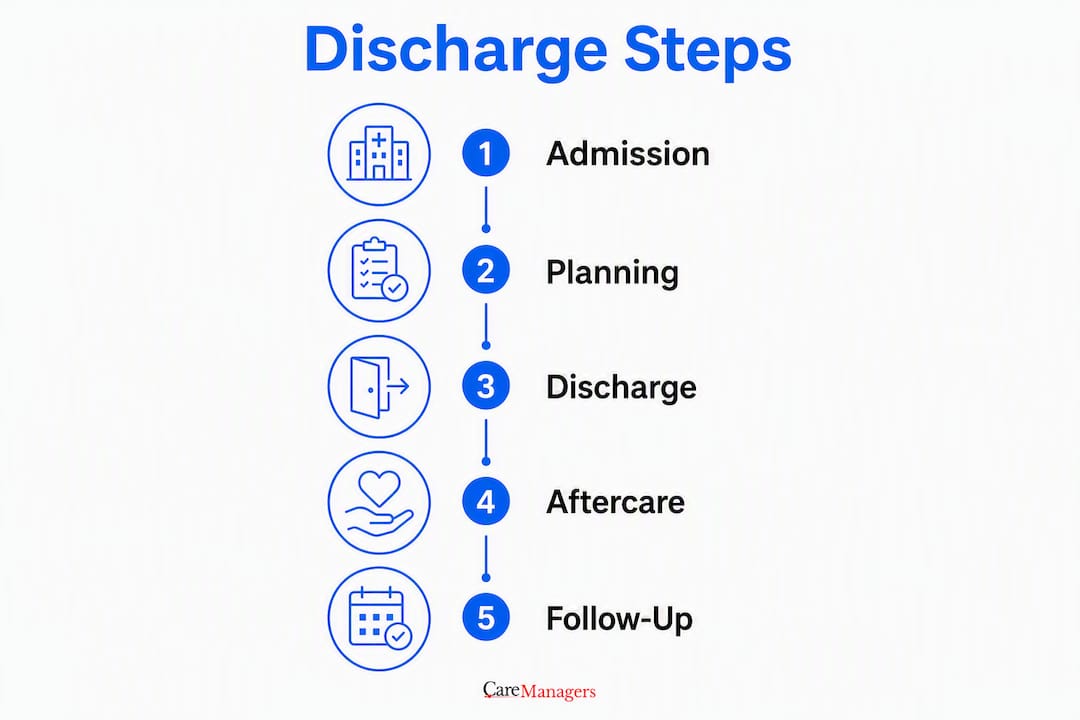
The typical flow runs from admission, to an expected date of discharge (EDD) being set, through multi-disciplinary team sign-off, to the RC or tribunal confirming discharge. Each decision-maker sits at a different point in that sequence, and knowing which one applies to your situation tells you exactly where to direct your questions.
What is Section 117 aftercare and are you entitled to it?
Section 117 of the Mental Health Act creates a legal duty on the local authority and the relevant Integrated Care Board (ICB) to provide free aftercare to people who have been detained under certain sections. This is one of the most important rights in the entire discharge process, and it is frequently misunderstood or not raised at all.
Who is eligible?
NHS guidance on mental health aftercare confirms that Section 117 applies to people who have been detained under sections 3, 37, 45A, 47, or 48 of the Mental Health Act. It does not apply to those admitted informally or under section 2. Crucially, there is no statutory time limit on Section 117 aftercare. It continues until both the local authority and the ICB are satisfied that you no longer need it, and that decision must follow a formal reassessment.
What can Section 117 aftercare include?
The range of support is broader than many people realise. Common elements include:
- Community mental health support and therapy.
- Medication and prescription costs.
- Supported accommodation or assistance with housing.
- Personal budgets to fund care arrangements.
- Social care support, including help with daily living.
- Carer support where it is part of the aftercare plan.
Both the health and social care elements are free under Section 117. The local authority cannot charge for services provided under this duty, even if those services would normally be means-tested.
What to do if Section 117 is disputed or withdrawn
If a social worker or care coordinator suggests ending your Section 117 support, there must be a documented reassessment first. A sudden withdrawal without any paperwork is a red flag that the statutory process is not being followed. Challenge it in writing, ask for the reassessment in writing, and contact your IMHA or a mental health solicitor if the response is unclear. The duty does not simply lapse because time has passed or because your condition has improved.
Pro Tip: Ask your care coordinator to confirm in writing which section you were detained under and whether Section 117 applies to you. Get this confirmed before you leave the ward, not after.
When does discharge planning start and what should your plan include?
Discharge planning should begin on the day of admission, or even before if the admission is planned. This is not good practice guidance; it is a statutory expectation set out in GOV.UK’s discharge from mental health inpatient settings guidance, which requires multi-agency cooperation and full involvement of the patient and chosen carers from the outset.
Two key operational concepts shape the timeline:
- Expected Date of Discharge (EDD): Set early in the admission, reviewed regularly, and used to coordinate housing, social care, and community services.
- Clinically Ready for Discharge (CRFD): The point at which the clinical team confirms the patient no longer needs inpatient care. Families should treat both the EDD and CRFD as working estimates and flag housing or social care needs as early as possible, because procurement delays of multiple weeks are common once clinical readiness is confirmed.
What a complete discharge plan should contain
A good discharge plan covers more than medication and a follow-up appointment. Use this as a checklist to assess whether your plan is complete:
- Care plan: — Written summary of your ongoing mental health needs and how they will be met in the community.
Timeline milestones
| Milestone | Expected timeframe |
|---|---|
| EDD set | At or shortly after admission |
| CRFD confirmed | When clinical criteria for discharge are met |
| Discharge plan finalised | Before the day of discharge |
| First community follow-up | Within 72 hours of discharge |
| CMHT review | Within two weeks of discharge |
| Section 117 aftercare plan agreed | Before or on the day of discharge |
NHS England’s inpatient mental health improvement guide recommends the 72-hour follow-up as a minimum standard. Delays in community follow-up are most likely when housing has not been confirmed or when social care funding is still being arranged.
NHS bodies, local authorities, and ICBs all have duties to cooperate in discharge planning under sections 72 and 82 of the NHS Act 2006. If any party is not engaging, that is a statutory failure you can raise formally.
Pro Tip: Keep a dated written record of every planning meeting, including who attended and what was agreed. If the plan changes, ask for the updated version in writing. This record is your evidence if any element of the plan is not delivered.
How do you challenge a detention or dispute a discharge decision?
If you believe a detention is unlawful, or if you disagree with a discharge decision (for example, you feel you are being discharged too soon without adequate support), you have several formal routes available.
Step-by-step options for review and appeal
-
Request a hospital managers’ review. This is often the fastest route. A panel of lay managers, independent of the clinical team, reviews the grounds for detention and can order discharge. A managers’ review is less formal than a tribunal and can be arranged relatively quickly. Consider this as a first step before applying to the tribunal.
-
Apply to the First-Tier Tribunal (Mental Health). The tribunal is an independent judicial body. For section 2, you can apply within the first 14 days of detention. For section 3, you can apply once in each period of detention and once in each period of renewal. The tribunal has the power to discharge you absolutely or conditionally.
-
Involve the Nearest Relative. The Nearest Relative (a defined legal role, not simply next of kin) can give 72 hours’ written notice to the hospital managers to discharge someone detained under section 2 or section 3. The RC can block this on safety grounds, but the Nearest Relative can then apply to the county court to have a different person appointed as Nearest Relative if they believe the block is unjustified.
-
Request an Independent Mental Health Advocate (IMHA). Hospitals are required to offer IMHA access to all detained patients. An IMHA can help you understand your rights, attend meetings with you, and support you through a managers’ review or tribunal application. This is free and confidential.
-
Contact a mental health solicitor. Legal aid is available for Mental Health Act tribunal cases. A solicitor can prepare your case, gather evidence, and represent you at the hearing.
-
Raise a complaint with the Care Quality Commission (CQC). If you believe your rights under the Mental Health Act are not being upheld, the CQC regulates mental health services and can investigate.
-
Contact the local authority adult social care team. If the dispute relates to aftercare, housing, or social care funding, the local authority has statutory duties and a formal complaints process.
If you believe detention is unlawful and need urgent action
- Write to the hospital managers requesting an urgent review today.
- Ask the ward staff to contact the duty IMHA immediately.
- Ask a family member or the Nearest Relative to contact a mental health solicitor.
- If you are not sure who your Nearest Relative is legally, ask the IMHA or solicitor to clarify this, as the definition under the Mental Health Act follows a specific hierarchy.
A hospital managers’ review is often faster and less adversarial than a tribunal. Requesting one early does not prevent you from also applying to the tribunal, and both can run in parallel if needed.
What happens on the day of discharge and in the first two weeks?
The day of discharge can feel abrupt, even when it has been planned carefully. Knowing what to expect makes it easier to manage.

What the ward team should provide
Before you leave, staff should give you:
- A supply of medication (usually enough for seven days, sometimes more) with clear written instructions.
- A discharge letter or summary addressed to your GP.
- A written copy of your care plan and crisis plan.
- Contact numbers for your community mental health team, crisis line, and key worker.
- Confirmation of your first follow-up appointment.
- Transport arrangements, if these were agreed in the discharge plan.
If any of these are missing, ask before you leave. It is far easier to resolve gaps on the ward than to chase them from home.
The first 72 hours
The period immediately after discharge is when the risk of crisis is highest. Your community mental health team should make contact within 72 hours, as recommended by NHS England. If you have not heard from them by then, contact the team directly using the number on your discharge letter. If you cannot reach anyone and you feel unsafe, use the crisis line number or call 111 and select the mental health option.
Check that your GP has received the discharge summary. If you take regular medication, book a GP appointment within the first week to confirm ongoing prescriptions and referrals.
The first two weeks
Within two weeks, you should have had at least one face-to-face or telephone review with your CMHT. Your Section 117 aftercare plan, if applicable, should already be in place. If housing or social care support was promised in the discharge plan and has not materialised, raise this with your care coordinator and, if needed, the local authority adult social care team in writing.
Pro Tip: Keep all discharge paperwork in one folder, including medication lists, care plan, crisis plan, and contact numbers. Take a photo of each document on your phone as a backup. If you are supporting a family member through discharge, ask the ward team to include you in the handover conversation, with the patient’s consent.
For families wanting a fuller picture of what the first weeks look like in practice, the hospital to home care guide from Caremanagers covers the settling-in period in detail.
How specialist homecare can support the transition home
For many people, leaving a mental health ward and returning home is not simply a matter of picking up where they left off. The gap between inpatient support and community care can feel wide, particularly in the first days. This is where short-term hospital discharge homecare can make a practical difference.

What discharge homecare services provide
A specialist homecare provider can step in quickly to fill the gap between hospital and full community support. Services typically include:
- Personal care assistance (washing, dressing, medication prompts) during the settling-in period.
- Live-in support for those who need someone present around the clock in the early days.
- Companionship and monitoring to reduce the risk of crisis or readmission.
- Practical help with daily tasks, meals, and household routines while confidence rebuilds.
- Liaison with the community mental health team and GP on the family’s behalf.
This kind of support can be written into a Section 117 aftercare plan, funded by the local authority or ICB where applicable, or arranged privately. The key is speed: a good provider can often have someone in place within 24 to 48 hours of discharge.
How to arrange care quickly
The process is straightforward. A care provider will need a copy of the discharge letter or summary, details of the care plan, and confirmation of any Section 117 or local authority funding arrangements. A brief telephone assessment is usually enough to agree the initial package. For families who want to understand the full pathway before discharge day, the hospital discharge care plan guide for families from Caremanagers walks through each step.
A real-world example of what coordinated care looks like
A family in South Wales contacted Caremanagers two days before their relative’s planned discharge from a mental health ward. The patient had been detained under section 3 and was entitled to Section 117 aftercare, but the community mental health team’s first visit was not scheduled for five days. Caremanagers arranged a live-in carer to be in place on discharge day, covering medication prompts, daily routines, and overnight support. The CMHT visit took place as planned, and the patient remained at home without readmission. The care package was later incorporated into the formal Section 117 aftercare plan, with funding shared between the ICB and the local authority.
For families considering this kind of support, how hospital discharge care works explains the practical steps in plain English.
Key takeaways
Discharge from a mental health hospital in England is governed by clear legal duties: patients have the right to be involved in planning, to free Section 117 aftercare where eligible, and to independent review of any detention.
| Point | Details |
|---|---|
| Discharge planning starts on admission | GOV.UK statutory guidance requires planning to begin at admission, with regular reviews involving the patient and carers. |
| Section 117 aftercare has no time limit | Free aftercare for those detained under qualifying sections continues until a formal reassessment confirms it is no longer needed. |
| Multiple routes exist to challenge detention | Hospital managers’ review, First-Tier Tribunal, Nearest Relative powers, and IMHA support are all available to detained patients. |
| First community follow-up within 72 hours | NHS England recommends contact from the community mental health team within 72 hours of discharge. |
| Caremanagers can bridge the gap | Caremanagers arranges short-term homecare across South Wales and England, often within 24 to 48 hours of discharge, fitting into Section 117 plans where applicable. |
What good discharge support actually looks like
There is a gap between what the guidance says should happen and what families actually experience on discharge day. The statutory framework is genuinely strong: clear duties, defined timelines, free aftercare rights, and multiple routes to challenge decisions. The difficulty is that these rights only work if someone knows to ask for them.
What strikes me most, having seen families navigate this process, is how often the most important conversations happen too late. Section 117 eligibility is raised at the discharge meeting rather than at admission. The Nearest Relative’s legal powers are never mentioned. The crisis plan is handed over as a photocopied sheet with no explanation. The 72-hour follow-up happens on day five because the community team’s diary was full.
The guidance is not the problem. The problem is that patients and families are rarely told, clearly and early, what they are entitled to. A family who knows to ask for the discharge plan in writing on day one, who requests an IMHA at the first sign of disagreement, and who flags housing needs before the CRFD is confirmed will almost always have a smoother transition than one who waits to be told. That is not a criticism of clinical teams, many of whom are working under real pressure. It is simply the reality that self-advocacy, or having someone advocate for you, changes outcomes.
The emotional weight of returning home after inpatient care is also underestimated. The ward provides structure, monitoring, and a kind of safety that disappears the moment the front door closes. Good discharge support acknowledges that, and good homecare in the first days is not just about medication prompts. It is about having a calm, consistent presence while the person finds their footing again.
Caremanagers: hospital discharge homecare across South Wales and England
Returning home after a mental health admission is a significant moment, and the first days matter more than most people expect. Caremanagers specialises in short-term hospital discharge homecare that can be arranged quickly, often within 24 to 48 hours of a confirmed discharge date, without the delays that come with local authority procurement alone.
Where Section 117 aftercare funding is in place, Caremanagers can work alongside the ICB and local authority to deliver the care element of the aftercare plan. For families funding privately, or where local authority support is still being arranged, a short-term package can be put in place immediately to prevent any gap in support. The first call takes around 20 minutes: a care coordinator will ask about the discharge plan, current needs, and any specific preferences, then confirm what can be arranged and when.
To find out what is available in your area or to arrange a care package ahead of discharge, visit the Caremanagers home care services page or call the team directly. You do not need to wait until discharge day to make that call.
Useful sources and where to get help
The following sources are authoritative starting points for patients, families, and carers navigating the discharge process in England.
Statutory guidance and law:
- Discharge from mental health inpatient settings (GOV.UK): The primary statutory guidance covering discharge planning duties, multi-agency cooperation, and patient involvement
- Mental Health Act overview (NHS): Plain-English explanation of the Act, detention, and patient rights
- Inpatient mental health improvement guide (NHS England): Operational guidance covering EDD, CRFD, and the 72-hour follow-up standard
Section 117 aftercare:
Charity guidance and advocacy:
Immediate contacts:
- Caremanagers: For short-term homecare and hospital discharge support across South Wales and England. See the hospital discharge care guide for families for practical next steps.
For families wanting to understand the full range of mental health services available in the community, the types of mental health services family guide provides a useful overview of what community support can look like after discharge.
FAQ
What does discharge from a mental health hospital mean?
Discharge means you are formally leaving inpatient mental health care, either as an informal patient choosing to leave or because a legal detention under the Mental Health Act has ended through a clinical, managerial, or tribunal decision.
Who decides when you are discharged under the Mental Health Act?
Your Responsible Clinician makes the most common discharge decision, but hospital managers, the First-Tier Tribunal (Mental Health), and in some cases the Nearest Relative can also authorise discharge under sections 2, 3, or 37.
What is Section 117 aftercare and who is entitled to it?
Section 117 aftercare is a free, legally enforceable right to health and social care support after discharge for people detained under qualifying sections, including section 3. It has no statutory time limit and cannot be withdrawn without a formal reassessment.
How quickly should the community mental health team contact you after discharge?
NHS England recommends first community follow-up within 72 hours of discharge. If you have not been contacted within that window, call the team directly using the number on your discharge letter.
Can you challenge a decision to detain or discharge you?
Yes. You can request a hospital managers’ review, apply to the First-Tier Tribunal (Mental Health), involve your Nearest Relative, or request an Independent Mental Health Advocate (IMHA), all of which are free and available to detained patients.