
TL;DR:
- Dementia care training improves residents’ lives, staff confidence, and reduces pressure on health systems. Well-structured programs lasting at least eight hours and based on the Dementia Training Standards Framework produce measurable, lasting benefits.
Dementia care training matters because it directly improves the quality of life for people living with dementia, builds staff confidence, and reduces pressure on the wider health system. When training is well designed and mapped to national standards, the benefits are measurable and lasting.
- Person-centred engagement: trained staff communicate more effectively, plan activities around individual interests, and move away from task-focused routines.
- Reduced reliance on antipsychotics and restraints: best-practice training is directly linked to fewer chemical and physical interventions in care settings.
- Staff retention and confidence: organisations that invest in dementia capability see stronger staff engagement and lower turnover.
The Dementia Training Standards Framework (published by NHS England and Health Education England) and the Alzheimer’s Society’s Because We’re Human Too report are the two most authoritative references for anyone commissioning, delivering, or evaluating dementia training in the UK.
Table of Contents
- Why does dementia training matter for people living with dementia?
- What does the evidence show about the impact of dementia training?
- What is the UK Dementia Training Standards Framework and who needs which tier?
- What should good dementia training cover?
- How do organisations benefit, and what do CQC and commissioners expect?
- How do you choose or commission dementia training that actually works?
- What Caremanagers has learned from delivering dementia care at home
- Key takeaways
- A realistic view of what training can and cannot do
- Useful UK sources and next steps
- FAQ
Why does dementia training matter for people living with dementia?
The most direct argument for investing in training is what happens to the person receiving care. When staff understand dementia as more than a memory condition, they respond differently. They recognise that a person who becomes agitated at mealtimes may be communicating discomfort, not simply being difficult. That shift in understanding changes everything about how care is delivered.
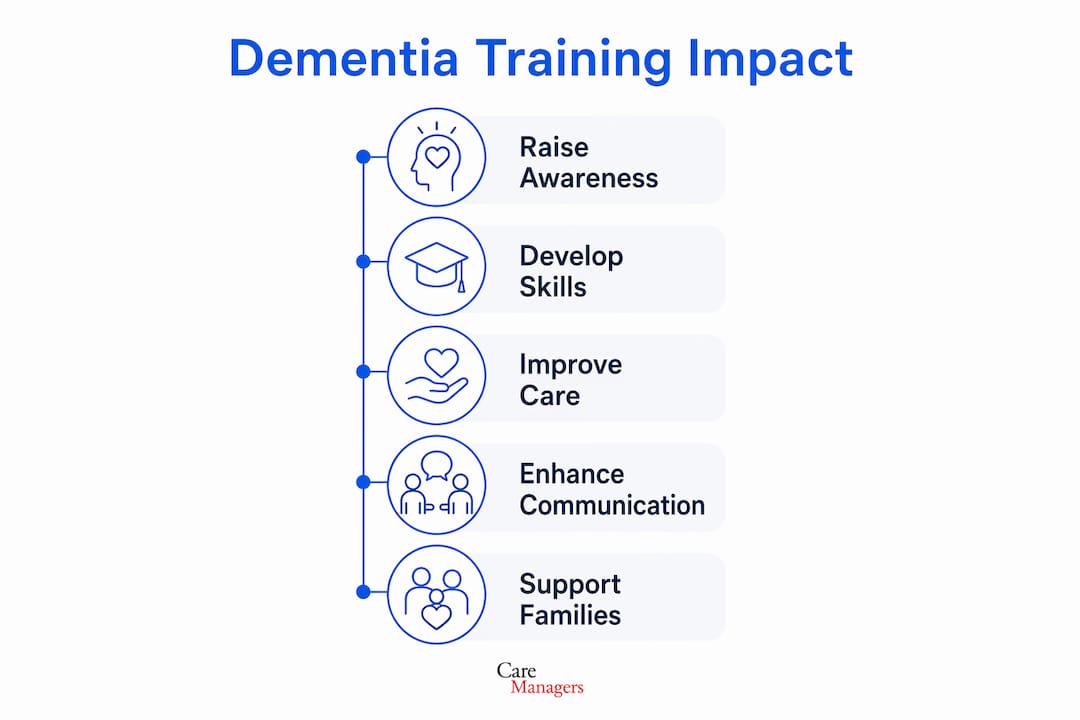
Person-centred training interventions such as WHELD are associated with improved activity levels, better staff-resident interactions, and measurable gains in wellbeing. Families notice it too: visits feel calmer, their relative seems more settled, and conversations with staff are more meaningful.
Fewer avoidable admissions is another concrete outcome. When care staff can identify and respond to unmet needs early, the person is less likely to reach a crisis point that ends in a hospital admission or an emergency GP call. The Alzheimer’s Society’s modelling suggests that scaling best-practice training nationally could generate system savings through reduced avoidable hospital and GP visits. For families, that means fewer frightening disruptions and a more stable experience of care at home.
Statistic to note: A significant proportion of social care staff in England are recorded as having undertaken condition-specific dementia training. That gap represents a significant proportion of the people living with dementia who are being supported by staff without adequate preparation.
What does the evidence show about the impact of dementia training?
The evidence base has grown considerably over the past decade, and the direction of travel is consistent: well-designed training produces real improvements in care quality, staff behaviour, and system outcomes.

The Alzheimer’s Society’s Because We’re Human Too report draws together findings from multiple evaluated programmes, including WHELD, to show that best-practice dementia training can considerably improve people’s quality of life, increase staff job satisfaction, and lead to savings across the health and care system. The WHELD programme, in particular, demonstrated improvements in resident engagement and communication in care homes when staff received structured, person-centred training.
A national audit published in BMC Health Services Research found that effective programmes typically last at least eight hours and use active learning methods. Sessions of 90 minutes or longer, with practical follow-up, consistently outperform shorter awareness-only inputs. A review published in BMJ Open reinforced this: passive, brief awareness sessions have limited impact on staff attitudes, and attitude change is what drives compassionate practice over time.
What the research confirms: training produces basic but positive impacts on staff-reported confidence, knowledge, and attitudes to person-centred care regardless of topic or length. The gains are larger and more durable when programmes are interactive, facilitated by skilled trainers, and followed up in practice.
The limits of the evidence are worth acknowledging. Most studies rely on self-reported outcomes, and measuring practice change in real care settings is genuinely difficult. That said, the consistency of findings across multiple methodologies gives commissioners and providers a solid basis for action.
What is the UK Dementia Training Standards Framework and who needs which tier?
The Dementia Training Standards Framework, developed by Health Education England and NHS England, maps learning outcomes to staff roles across health and social care. It defines three tiers, each designed for a different level of contact with people living with dementia.
| Tier | Who it is for | Expected competency |
|---|---|---|
| Tier 1 | All staff with any contact with people living with dementia (including non-clinical, reception, domestic) | Basic dementia awareness; understanding impact on the person; knowing when and how to refer |
| Tier 2 | Staff who regularly provide direct care or support to people living with dementia | Person-centred care planning; communication approaches; understanding behaviour; pharmacology basics; safeguarding; end-of-life care |
| Tier 3 | Leaders, specialists, and those who design or deliver training | Advanced clinical knowledge; service leadership; training facilitation; quality improvement |
Tier 1 is the floor, not the ceiling. Every member of staff in a care setting should hold it. Tier 2 is where the real clinical and relational competencies sit, and it is also where the biggest gaps currently exist. A Leeds Beckett and Alzheimer’s Society analysis found that fewer than 40% of Tier 2 and Tier 3 learning outcomes are covered by many training packages currently in use. The Framework has also been updated to include food, drink, and oral health as specific learning areas, reflecting the practical daily-living challenges that dementia presents.
What should good dementia training cover?
The curriculum matters, but so does how it is taught. A course that covers the right topics through passive slide presentations will rarely change how a carer behaves on a Tuesday afternoon when a resident is distressed.
Core curriculum topics for Tier 2 training:
- Person-centred care planning and life history work
- Understanding behaviour as communication and responding to unmet needs
- Effective communication approaches, including non-verbal and adapted language
- Pharmacology basics: what antipsychotics do, their risks, and alternatives
- Safeguarding: recognising abuse and poor practice in dementia care
- End-of-life care and advance care planning
- Practical daily-living support: nutrition, oral health, activity, and mobility
Learning methods that produce lasting change:
- Interactive group sessions with case discussion and scenario work
- Simulation and role play to practise communication approaches
- Programmes totalling at least eight hours, spread across sessions rather than delivered in a single day
- Practical follow-up coaching in the care setting, not just classroom time
Pro Tip: Design training to challenge attitudes, not just add knowledge. Staff who hold stigmatising views about dementia will not change their practice simply by learning more facts. Build in structured reflection, peer discussion, and real case examples that invite carers to examine their own assumptions.
How do organisations benefit, and what do CQC and commissioners expect?
The regulatory case for investing in dementia training is straightforward. CQC Regulation 18 requires providers to ensure staff receive appropriate support and training to carry out their duties. Inspectors look for evidence that training is mapped to staff roles, that it is current, and that it translates into practice. A well-documented training programme aligned to the Dementia Training Standards Framework gives providers a clear, defensible record.
Beyond compliance, the organisational benefits are real. Organisations that invest in dementia capability typically see improved staff engagement, stronger relationships with commissioners, and potential reductions in turnover. Staff who feel equipped to do their job well are more likely to stay.
What inspectors and commissioners commonly look for:
- Evidence that all direct care staff hold at least Tier 1 awareness training.
- Tier 2 training for staff providing regular dementia support, with records of completion.
- Training mapped explicitly to the Dementia Training Standards Framework.
- Supervision and coaching structures that reinforce training in practice.
- Outcome data: reduced incidents, fewer avoidable admissions, resident wellbeing measures.
Coverage gap: Skills for Care audit data shows only 29–38% of social care staff in England have undertaken condition-specific dementia training. For commissioners, that figure is a prompt to include training requirements in contracts and to ask providers how they verify competence, not just attendance.
The Skills for Care workforce strategy, published in July 2024, recommends that all care staff undertake training mapped to the Dementia Training Standards Framework. That recommendation, combined with CQC expectations, makes the case for commissioners to treat framework-mapped training as a baseline requirement rather than an optional quality marker.
How do you choose or commission dementia training that actually works?
Choosing the right training is where good intentions often stall. The market includes everything from two-hour e-learning modules to multi-day accredited programmes, and the quality varies enormously.
Questions to ask any training provider:
- Which tiers of the Dementia Training Standards Framework does this programme map to?
- What is the total contact time, and does it meet the eight-hour minimum for Tier 2?
- How is the training delivered — face-to-face, blended, or fully digital?
- What is the facilitator’s background and experience in dementia care?
- Is there any post-training support, coaching, or follow-up in the care setting?
- How is competence assessed, and what evidence does the provider supply?
Red flags to watch for:
- A single session of two hours or less presented as sufficient for Tier 2 competency.
- No practical component or follow-up beyond the classroom.
- No explicit mapping to the Dementia Training Standards Framework.
- Facilitators with no direct dementia care experience.
- Certificates of attendance with no assessment of learning or practice change.
On delivery mode: face-to-face training with skilled facilitation consistently produces the strongest attitude change. Blended approaches, combining digital pre-learning with facilitated group sessions, can work well for dispersed teams. Fully digital e-learning alone rarely changes practice, though it can be useful for Tier 1 awareness. For guidance on choosing a specialist dementia carer, the same principles apply: look for evidence of structured, framework-mapped training rather than generic care certificates.
What Caremanagers has learned from delivering dementia care at home
At Caremanagers, the most consistent lesson from supporting people with dementia at home is that training only becomes real when it is practised in context. A carer who has completed a strong Tier 2 programme still needs time, mentoring, and space to apply what they have learned in the specific rhythms of someone’s home.
Consider a situation where a person living with mid-stage dementia becomes increasingly distressed during personal care each morning. A trained carer, drawing on their understanding of behaviour as communication, identifies that the distress is linked to the sequence of tasks rather than the tasks themselves. By adjusting the order and pace, and by using familiar music as a cue, the morning routine becomes manageable. That kind of adaptation does not come from a certificate. It comes from training that has been reinforced through supervision and coaching on the job.
Caremanagers builds protected training time into staff schedules and uses experienced senior carers as practice mentors. Outcome measures, including reduced incidents and family feedback, are reviewed quarterly. Families looking for guidance on what well-trained home care looks like in practice can find more detail in the Caremanagers dementia care best practices guide.
Key takeaways
Dementia care training that is mapped to the Dementia Training Standards Framework, lasts at least eight hours, and uses interactive methods produces measurable improvements in care quality, staff confidence, and system outcomes.
| Point | Details |
|---|---|
| Map staff to the right tier | All direct care staff need at least Tier 1; those providing regular dementia support need Tier 2. |
| Minimum eight hours for Tier 2 | Short awareness sessions do not produce lasting attitude or practice change. |
| Require framework mapping | Ask any provider to show how their programme maps to the Dementia Training Standards Framework. |
| Protect time for follow-up | Classroom training without on-the-job coaching rarely changes day-to-day practice. |
| Measure outcomes, not just attendance | Track incidents, wellbeing indicators, and family feedback to evidence practice change. |
A realistic view of what training can and cannot do
Change in dementia care practice does not happen overnight. In the first three months after a well-designed training programme, you will typically see shifts in staff confidence and small but meaningful changes in how individuals approach communication and daily routines. The deeper changes, fewer incidents, more consistent person-centred planning, and measurable improvements in wellbeing, tend to emerge over six months or more, and only when training is supported by supervision and organisational commitment.
The systemic barriers are real. Funding for training is inconsistent, protected time is hard to find in stretched care settings, and there is still no statutory requirement across England, Wales, or Northern Ireland for all care staff to undertake dementia-specific training. That absence of a legal mandate creates wide variation in coverage and quality. Pragmatically, the most effective local response is to treat the Dementia Training Standards Framework as your minimum standard, build training requirements into contracts and job descriptions, and use peer mentoring to sustain learning between formal sessions.
Useful UK sources and next steps
Where you go first depends on your role.
- Commissioners and providers: start with the Dementia Training Standards Framework on the NHS England/HEE website. It includes mapping tools and implementation guidance.
- Organisations reviewing their current provision: the Alzheimer’s Society’s Because We’re Human Too report and the Leeds Beckett/Alzheimer’s Society Training Gap analysis together give you the strongest evidence base for making the case internally.
- Family carers: the Alzheimer’s Society’s training and information resources are written for non-professionals and are freely accessible. Caremanagers’ guide on what dementia care means for families is a practical starting point for understanding what to expect from trained home carers.
- NHS and academic resources: the NHS Learning Hub and the Royal College of Psychiatrists’ National Audit of Dementia provide further evidence and benchmarking tools.
If you are considering trained home care support for someone living with dementia, Caremanagers provides specialist dementia home care across South Wales and England. Every carer is trained to the Dementia Training Standards Framework and supported through ongoing supervision and mentoring.
This article provides general information about dementia care training in the UK. It is not a substitute for professional advice. Please consult the Dementia Training Standards Framework, CQC guidance, or a qualified health and social care professional for guidance specific to your organisation or situation.
FAQ
Why is dementia training important for care staff?
Dementia training equips care staff with the knowledge, communication skills, and attitudes needed to deliver person-centred support. Without it, staff are more likely to misinterpret behaviour, rely on inappropriate interventions, and feel less confident in their role.
What are the three tiers of the Dementia Training Standards Framework?
Tier 1 covers basic awareness for all staff, Tier 2 covers core skills for those providing regular direct care, and Tier 3 covers advanced knowledge and leadership for specialists and training facilitators.
What are the 4 R’s of dementia care?
The 4 R’s are not a formally defined UK framework within the Dementia Training Standards Framework; definitions vary across providers. Many training programmes use principles of Recognise, Respond, Record, and Refer as a practical guide for care staff, but you should confirm the specific framework your training provider uses.
Why is training important in care more broadly?
Training gives care staff the skills to respond safely and compassionately to complex needs, meet regulatory requirements under CQC Regulation 18, and deliver consistent, high-quality support. In dementia care specifically, training is linked to reduced antipsychotic use, fewer avoidable admissions, and better wellbeing outcomes for the people being supported.
How long should dementia training be to make a real difference?
Effective Tier 2 dementia training typically totals at least eight hours and uses interactive, facilitated methods rather than passive e-learning alone. Shorter sessions can build basic awareness but are unlikely to produce lasting changes in staff attitudes or day-to-day practice.