
Table of Contents
- What Does a Tailored Home Care Plan Actually Mean?
- The Real Benefits of Tailored Home Care Plans for Seniors
- What Is a Care Needs Assessment?
- How to Create a Personalised Care Plan That Works
- CQC Standards for Home Care Planning: What They Mean for You
- Cost-Effectiveness Compared to Residential Care
- Planning the Transition from Hospital to Home
- Conclusion: Building a Care Plan Around the Person, Not the Other Way Round
- Frequently Asked Questions
Last Updated: September 8, 2026
When a senior can no longer manage daily tasks alone, many families first consider residential care. Yet the benefits of tailored home care plans for seniors go far beyond convenience; they address the emotional, psychological, and practical needs that a one-size-fits-all setting cannot. At Care Managers, we believe a well-structured plan allows older adults to remain the authors of their own lives.
A tailored home care plan is a documented, living agreement between the client, their family, and a care provider. It outlines specific needs, preferences, and goals, and is reviewed as circumstances change. The most important benefit is straightforward: care that bends to the individual, not the other way round.
What Does a Tailored Home Care Plan Actually Mean?
A tailored home care plan is a personalised document that details exactly how support will be delivered in a person’s own home. It moves beyond a generic list of tasks to cover how and when care is provided, ensuring consistency with the individual’s daily routines, cultural practices, and personal preferences.
The plan typically specifies medication schedules, mobility assistance, meal preparation aligned with dietary needs, and the level of social interaction the person enjoys. It also records communication preferences for family members. This detail ensures care feels like help from a trusted companion, rather than an intrusion from a stranger.
The Real Benefits of Tailored Home Care Plans for Seniors
The advantages of this approach touch every part of a person’s life. The most significant benefits include remaining in a familiar environment, retaining independence and dignity, and receiving genuine one-to-one attention. Each of these contributes directly to a better quality of life and, often, to slower functional decline.
Remaining in a Familiar Environment
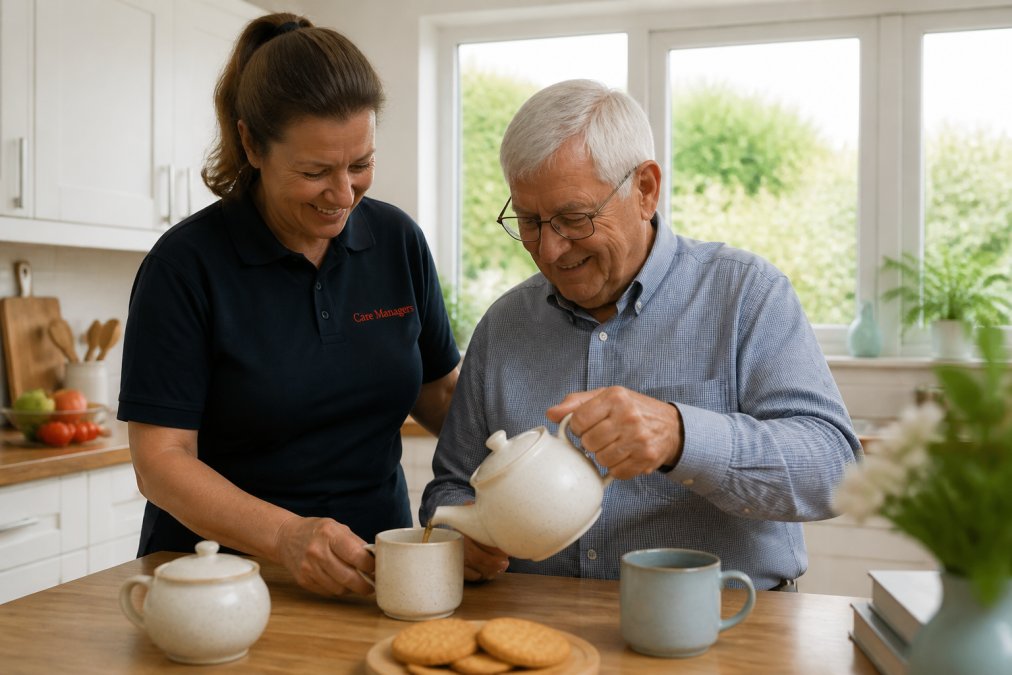
Staying at home preserves the sensory anchors of a lifetime: the layout of the kitchen, the neighbours, the garden, and familiar walls. For a person living with dementia, this familiarity can significantly reduce confusion and agitation. The stress of relocating to an unfamiliar building is entirely avoided.
This continuity supports better sleep, steadier moods, and a greater sense of security. A home safety audit, conducted during initial planning, can address trip hazards and access issues so the environment supports independence rather than limiting it.
Maintaining Independence and Dignity
A common fear among older adults is that accepting help signals a loss of control. A tailored plan works against this by focusing on what the person can do, with support filling only the gaps. The plan might enable a client to dress while a carer prepares breakfast, preserving autonomy in one area while receiving help in another.
Dignity is protected through consistent, respectful practice: knocking before entering, asking before assisting, and honouring preferences on everything from bath times to clothing choices. Carer consistency is vital, as a familiar face is far more likely to be trusted with intimate tasks.
One-to-One Attention and Companionship
Unlike a residential setting where staff divide their time among many residents, home care offers undivided attention for each visit. This allows carers to notice subtle changes in health, mood, or mobility that might otherwise be missed. It also provides genuine companionship, directly combating social isolation.
This interaction is not merely polite conversation; it is a protective factor for mental well-being. For families, knowing their loved one has a consistent companion looking out for them offers immense reassurance.
What Is a Care Needs Assessment?
A care needs assessment is the foundational step in creating any effective home care arrangement. It is a detailed conversation between the client, their family, and a care professional to understand physical, emotional, and cognitive support requirements. It explores daily routines, health conditions, mobility, and personal goals.
The assessment covers medical history, medication regimens, dietary requirements, and cognitive support needs. It also considers the home environment and the capacity of family members to provide informal care. The output forms the basis of the bespoke care plans that follow.
How to Create a Personalised Care Plan That Works
Creating an effective plan is a collaborative process involving the senior, their family, and the care provider. The first step is the care needs assessment, followed by a home safety audit. From there, the plan is drafted to cover all aspects of daily living.
- Define the schedule: Specify visit times, durations, and which carer will be assigned.
- Detail task lists: Outline exact duties, from medication management to personal care.
- Record preferences: Include meal choices, hobbies, and communication styles.
- Set review dates: Agree on a schedule for the formal care plan review.
The plan is only as good as its execution. A common mistake is treating it as a static document rather than a dynamic guide. Regular reviews, prompted by changes in health or family circumstances, keep care aligned with current needs.
CQC Standards for Home Care Planning: What They Mean for You
Understanding the Care Quality Commission (CQC) framework is the most practical checklist families have for evaluating a home care provider. The CQC inspects services against five key questions: Are they safe, effective, caring, responsive, and well-led? A tailored home care plan is the primary evidence a provider uses to demonstrate these standards.
Using CQC Ratings as a Due Diligence Tool
A provider’s overall rating is a useful starting point, but the real insight lies in the full inspection report. These public reports contain specific findings about how a provider assesses needs and handles complaints. Look for direct mentions of how care plans are personalised and how often they are reviewed.
The ‘Well-Led’ Question and the Review Process
The CQC’s ‘well-led’ question examines leadership and management. Providers are expected to have robust systems for gathering feedback and, crucially, acting on it. A provider that scores well here will have a transparent, documented process for adjusting a care plan following a change in condition or a family concern.
Call us for Free Assessment Today →
Questions to Ask a Provider Based on CQC Standards
Instead of asking ‘Are you CQC registered?’, which every legitimate provider is, use the framework to ask sharper questions:
- On Safety: “How does your care plan document specific risk assessments for my relative’s mobility or medication, and how do you ensure carers follow them?”
- On Effectiveness: “How do you measure the outcomes of your care, and how is that data used to update the care plan?”
- On Responsiveness: “Can you walk me through the last time you changed a client’s care plan in response to feedback or a change in their health?”
- On Well-Led: “How do you supervise and support your carers to ensure they are delivering the plan as written, and how do you handle concerns raised by families?”
A provider’s willingness to answer these questions in detail, without defensiveness, is a strong indicator of their commitment. When a provider openly discusses its last inspection and improvement plans, it demonstrates that the tailored care plan is a living document, not a box-ticking exercise.
Cost-Effectiveness Compared to Residential Care
Navigating the complex funding landscape is a real financial challenge. A tailored home care plan can provide documented evidence of need that funding authorities may require.
Local Authority Funding: The Means Test and the Care Act 2014
Under the Care Act 2014, local authorities have a legal duty to assess anyone who appears to need care and support. This assessment is free and separate from any financial assessment. If eligible needs are found, the local authority conducts a means test to determine who pays.
- If assets (including savings and property, if the person owns it and lives alone) are below £23,250 in England: The local authority will contribute towards the cost of care. The exact contribution depends on income and savings.
- If assets are above £23,250: The person is likely to be a ‘self-funder’ and will pay for the full cost of their care.
The local authority has a duty to meet eligible needs, regardless of whether the person is a self-funder. Families should request a copy of the ‘Personal Budget’, the amount calculated to meet eligible needs. This figure is a benchmark against which to compare provider quotes.
NHS Continuing Healthcare (CHC)
For individuals with significant, complex, and ongoing health needs, NHS Continuing Healthcare (CHC) is a fully funded package arranged solely by the NHS. It is not means-tested.
The assessment is a two-stage process: a checklist screening followed by a full multidisciplinary assessment using the Decision Support Tool, which looks at 12 care domains. A tailored home care plan provides the detailed, evidence-based picture of needs the team will consider. Many charities offer free guidance on preparing for a CHC assessment.
Local Authority Grants and Discretionary Payments
Beyond the core funding streams, local authorities have discretionary powers to provide grants for specific purposes. These can include:
- Disabled Facilities Grants (DFGs): These are mandatory grants from the local council to help pay for adaptations to the home, such as stairlifts, level-access showers, or ramps. The grant is means-tested, but certain assets may be disregarded, meaning some older homeowners may qualify for support.
- Local Welfare Assistance Schemes: Some councils offer small, one-off payments to help with immediate needs, such as a new bed or a fridge, to prevent a hospital admission or support a discharge.
Long-Term Budget Planning: A Practical Framework
Once funding is established, the focus shifts to long-term sustainability. Care needs typically increase over time, so a plan that works today may be insufficient in 12 months. A practical framework includes:
- Establish the baseline: Calculate the current weekly cost of the tailored care plan.
- Project forward: Assume a modest annual increase in care hours (e.g., an extra hour per visit or an additional visit per week) and an annual inflationary uplift on the hourly rate.
- Identify the funding gap: Subtract any local authority contribution or CHC funding from the projected cost to determine the personal contribution required.
- Explore financial products: For self-funders, exploring various financial products may help cover care costs, potentially offering protection against future care expenses.
Navigating this system is complex, but a tailored care plan is the common thread. It is the evidence base for the needs assessment, the specification for the personal budget, and the document demonstrating the cost-effectiveness of home care versus a residential placement.
Planning the Transition from Hospital to Home
The discharge process from hospital is often rushed, leaving families to arrange care under pressure. A well-managed transition is critical to preventing readmission. A tailored plan for hospital discharge care begins before the patient leaves the ward.
Technology can make a tangible difference here. Medication dispensers with alarms, mobile call systems, and digital updates provide extra safety during the initial weeks at home. A structured plan ensures the home is prepared, medication is ordered, and a carer is waiting to welcome the patient.
Conclusion: Building a Care Plan Around the Person, Not the Other Way Round
The true measure of a tailored home care plan is whether the senior feels they are still in charge of their own life. The benefits are clear: sustained independence, preserved dignity, and the comfort of home, all supported by a plan that adapts to the person.
At Care Managers, our approach is built on this principle. We offer home care, live-in care, and supported living services that are designed around individual routines and preferences. Our team provides ongoing quality assurance and reliable communication, ensuring that families are never left chasing for updates. If you are exploring options for a loved one, we invite you to book a call with our team to discuss how a personalised plan could support your family.
Frequently Asked Questions
Why is a personalised care plan essential for home support?
A personalised care plan is essential because it moves care from a generic list of tasks to a schedule built around one person’s routines, preferences and health needs. For seniors, that means medication at the right time, meals they actually enjoy, and support that respects how they like to live. It also gives families confidence that nothing important is missed. A good plan is reviewed regularly and updated as needs change, which keeps the care safe, consistent and genuinely person-centred rather than a one-size-fits-all service.
How does a care plan change as a person’s needs evolve?
Care plans are not fixed documents. They should be reviewed regularly, and formally reassessed whenever health changes, such as after a hospital stay, a fall or a new diagnosis like dementia. During a review, the carer, the care manager and the family look at what is working and what is not, then adjust tasks, times and goals. For example, someone who once needed help with shopping might later need help with bathing and medication. A tailored plan flexes with those changes, so the senior gets the right level of support without losing more independence than necessary.
What is included in a professional home care assessment?
A professional home care assessment, often called a care needs assessment, covers the person’s physical health, mobility, medication, personal care needs and cognitive support. It also looks at the home environment for safety issues, daily routines, diet, social connections and what matters most to the individual. The assessor will ask about preferences, hobbies and how the person wants to spend their day. This information forms the basis of the tailored care plan. In England, the local council can also carry out a needs assessment to determine eligibility for support.
What role does the Care Quality Commission play in care planning?
The Care Quality Commission (CQC) is the independent regulator of health and social care services in England. It sets the standards that home care providers must meet. When it comes to care planning, the CQC requires providers to deliver person-centred care that is based on a thorough assessment of each individual’s needs and preferences. The plan must be reviewed and updated regularly, and the provider must respect the person’s dignity, privacy and independence. Choosing a CQC-registered provider gives you confidence that their care planning follows these regulated standards.