
Table of Contents
- What Is Private Home Care for the Elderly?
- Types of Private Home Care Services
- Specialist Care Options for Complex Needs
- How to Find Private Home Care for Overnight Support
- Key Questions to Ask Home Care Agencies
- Costs and Funding Options
- What to Look for in a Quality Care Provider
- Conclusion
Last Updated: August 19, 2026
What Is Private Home Care for the Elderly?
Private home care for the elderly is professional support delivered in someone’s own home, enabling older adults to maintain independence, dignity, and familiar routines whilst receiving the help they need. Rather than moving to a residential facility, individuals remain in their own environment with trained carers providing assistance tailored to their specific requirements.
This differs fundamentally from residential care. Home care preserves autonomy; your loved one decides when to wake, what to eat, and how to spend their day, with professional support woven around their preferences rather than institutional schedules. According to NHS guidance on social care, many older people prefer to age in place, and outcomes for wellbeing and health often improve when support is available at home.
The scope of private home care for the elderly ranges from companionship and light housekeeping to complex medical support, including personal hygiene, medication management, specialist dementia support, and overnight care. Care Managers delivers tailored care plans across South Wales and England that adapt to changing needs, with options including faith-based support for families with specific cultural or religious requirements.
The key advantage is continuity. When the same carer visits regularly or lives in, your relative builds trust and routine without learning new faces or repeating their medical history to strangers. This consistency matters enormously, particularly for people with cognitive decline or anxiety around change.
Private home care keeps older people in their own homes with professional support tailored to their needs, preserving independence, dignity, and familiar routines that institutional care cannot replicate.
Types of Private Home Care Services
Private home care comes in several distinct models, each suited to different circumstances and levels of need.
Visiting Care
Visiting care, also called domiciliary care, involves carers calling at set times, typically 30 minutes to two hours per visit. This model suits people who need help with specific tasks but can manage independently between visits. A typical arrangement might include morning support with washing and dressing, midday medication reminders, and an evening meal preparation visit. Carers assist with personal hygiene, continence support, meal preparation, medication management, and light housekeeping.
The advantage is flexibility and cost-efficiency. Your relative remains in their own home with routines intact. The disadvantage is gaps between visits; if someone falls at 3 p.m. and the next visit isn’t until 5 p.m., there’s a risk. For people with dementia or significant mobility issues, this model works best alongside family involvement or additional safeguards.
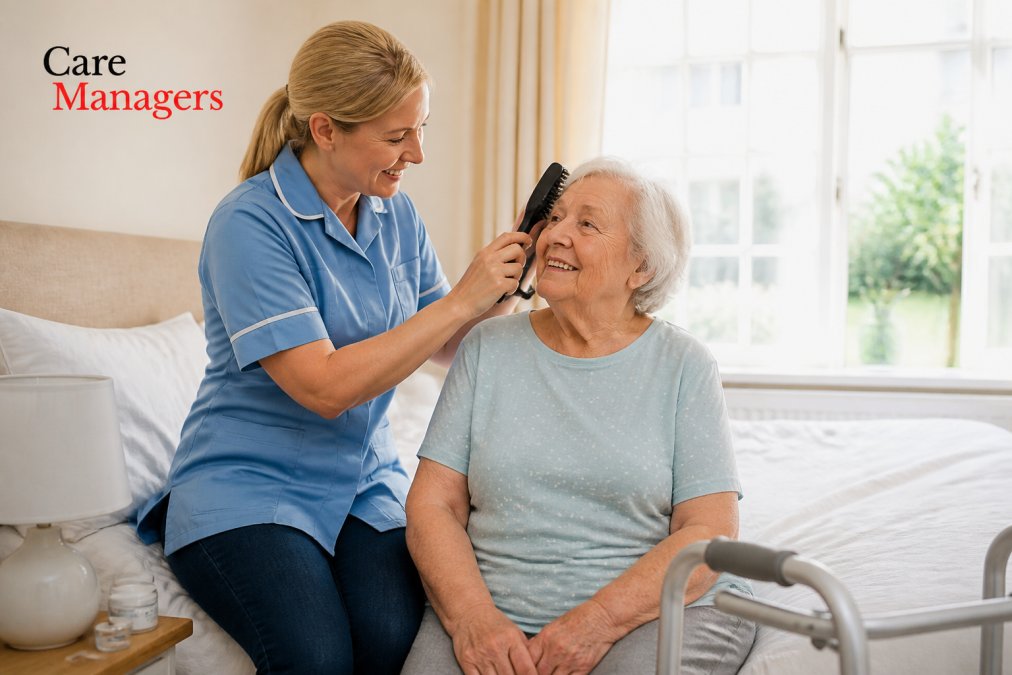
Live-in Care
Live-in care means a carer resides in the home, providing 24-hour support. This model suits people with complex needs, those recovering from hospital discharge, or individuals who need constant supervision. A live-in carer has a bedroom in the home and manages all personal care, medication, meal preparation, and household tasks. Importantly, live-in care includes night-time support; if your relative needs help at 2 a.m., assistance is there immediately.
The emotional benefit is profound. Many families report that their relative’s anxiety drops significantly when they know someone is present. For people with dementia who experience sundowning, live-in care provides reassurance and structured support during difficult hours. Care Managers offers live-in care with carers matched to individual needs, including specialist support for dementia and Parkinson’s disease, with continuity that builds understanding of subtle health or behavioural changes.
Overnight and Respite Care
Overnight care involves a carer staying in the home during night hours only, typically 10 p.m. to 8 a.m., to manage nighttime needs and provide emergency response. This suits people who can manage daytime independently but need support at night.
Respite care is temporary, usually a few days or weeks, to give family carers a break. Without respite, family carers often face burnout; regular respite, even a week every few months, significantly improves family caregiver wellbeing and reduces the risk of breakdown in care arrangements.
Specialist Care Options for Complex Needs
Some older people have conditions requiring expertise beyond standard personal care. Specialist care options exist for dementia, Parkinson’s disease, stroke recovery, end-of-life care, and acquired brain injury.
Dementia care requires different skills than general elderly care. Carers need training in communication techniques for people with cognitive decline, understanding of behavioural changes, and patience with repetition and confusion. Specialist dementia carers recognise that aggressive behaviour often signals unmet needs, pain, hunger, confusion, or toileting, rather than malice, and they respond accordingly.
Parkinson’s disease care demands understanding of medication timing, mobility support (falls risk is high), and the emotional impact of progressive disability. Carers trained in Parkinson’s support understand freezing episodes, swallowing difficulties, and the importance of maintaining activity and independence.
Stroke recovery often requires help with speech and language rehabilitation, physiotherapy exercises, and managing post-stroke depression. Acquired brain injury can leave people with complex cognitive, physical, and behavioural needs requiring specialist understanding.
Care Managers provides specialist care for dementia, Parkinson’s, and other complex conditions.
Specialist conditions require trained carers. Placing an untrained carer with someone with dementia or Parkinson’s often leads to poor outcomes, distress, and carer turnover. Always confirm that your care provider has specific training and experience in your relative’s condition.
How to Find Private Home Care for Overnight Support
Finding the right care provider requires systematic assessment and careful vetting.
Step 1: Assess care needs. Write down what help is required: personal care (washing, dressing, toileting), medication management, meal preparation, mobility support, companionship, and specialist care needs. Include frequency, times of day, and whether overnight or 24-hour support is necessary. This clarity prevents mismatches and helps providers quote accurately.
Step 2: Decide between agency and self-employment. Regulated care agencies like Care Managers employ carers directly and handle employment, vetting, insurance, and replacement if a carer is unavailable. Self-employed carers are often cheaper but shift employment responsibility to you. Both models work; the choice depends on your capacity to manage employment and your budget.
Step 3: Check regulatory status. In the UK, home care is regulated by the Care Quality Commission. Ask prospective providers for their CQC rating. A rating of ‘Good’ or ‘Outstanding’ indicates proper oversight, training, and safeguarding.
Step 4: Request references and check vetting. Ask how long carers have worked with the provider, whether they’ve had Disclosure and Barring Service (DBS) checks, and whether the provider conducts competency assessments. Request contact details of current clients and speak to them directly about their experience.
Step 5: Trial period. Arrange a trial, typically one week, with a proposed carer before committing long-term. This allows your relative to assess compatibility and gives the carer opportunity to understand routines and preferences. medical alert systems.
Step 6: Establish communication. Confirm how you’ll receive updates, daily logs, phone calls, and messaging. Clarify expectations upfront. Care Managers emphasises reliable communication as a core benefit, recognising that families need confidence their relative is safe and well.

Key Questions to Ask Home Care Agencies
Before committing to any provider, ask these questions directly. Their answers reveal whether they understand your needs and operate professionally.
About the carer:
Call us for Free Assessment Today →
- How long has this carer worked with you?
- What training and qualifications do they have? (Ask specifically about dementia training, moving and handling, first aid, and any specialist training relevant to your relative’s condition.)
- Have they had a DBS check?
- What happens if they’re ill or on holiday; how is continuity maintained?
About safeguarding:
- What’s your safeguarding policy? How do you respond to concerns?
- How do you vet carers beyond DBS checks?
- What insurance do you carry?
- How do you monitor quality; do you observe carers, collect feedback, conduct spot checks?
About care planning:
- How do you assess needs initially?
- Will you develop a written care plan tailored to my relative’s preferences?
- How often do you review the plan?
- Who do I contact if needs change?
About communication:
- How will I receive updates on my relative’s wellbeing?
- Who do I contact if I have concerns?
- What’s your response time for urgent issues?
- Will the same carer visit consistently, or will there be changes?
About costs:
- What’s included in your fee? (Ask about mileage, cancellations, bank holidays, emergency call-outs.)
- What’s your notice period if I need to pause or end care?
- Do you offer flexibility; can I reduce hours if needed?
About experience:
- How many clients do you support with my relative’s specific condition?
- Can you provide references from families with similar needs?
- What’s your staff turnover rate? (High turnover indicates problems.)
Agencies that answer these questions clearly and confidently are more likely to deliver reliable care. Those that are vague, defensive, or unwilling to discuss safeguarding warrant caution.
Write down the answers and compare providers side by side. Red flags include: reluctance to discuss vetting, inability to guarantee carer continuity, no written care plan, poor communication systems, and high staff turnover.
Costs and Funding Options
Private home care costs vary significantly based on location, type of support, and provider. Visiting care typically costs more per hour in London and the South East than in Wales or the Midlands. Overnight care costs less per hour than daytime care because the carer is sleeping. Live-in care is often quoted as a weekly rate and may be more cost-effective than multiple daily visits for people needing substantial support.
Funding sources:
- Self-funding: Paying privately from savings or pension
- Local authority funding: Councils assess needs and may fund care if you meet eligibility criteria. Contact your local authority social services to request a care assessment.
- NHS continuing healthcare: If your relative has significant health needs, they may qualify for NHS-funded care. Eligibility is strict, but if awarded, it covers care costs fully.
- Combination funding: Many people receive partial council funding and top up with private fees.
For detailed information on eligibility and how to apply, consult the Government’s guidance on adult social care funding. Councils have a legal duty to assess care needs, so if you’re uncertain whether your relative qualifies, request an assessment; it’s free and carries no obligation.
Councils fund social care (personal care, meals, companionship) but not healthcare. If your relative needs nursing care, wound dressing, medication administration by injection, or catheter care, that’s healthcare and may be funded by the NHS even if personal care is privately funded.
What to Look for in a Quality Care Provider
Quality varies enormously between providers. Regulatory ratings help, but direct experience matters most.
Consistency of carer. The single strongest predictor of care quality and client satisfaction is whether the same carer visits regularly. Continuity builds trust, understanding, and routine. Providers with high staff turnover deliver inconsistent care. Ask directly: "Will my relative have the same carer, or will there be changes?"
Person-centred approach. Quality providers don’t impose a schedule; they adapt to the person. If your relative prefers to shower in the evening rather than morning, a quality provider accommodates this. Poor providers follow a checklist regardless of preference.
Responsiveness to change. Older people’s needs shift. A quality provider reviews care regularly, listens when families report concerns, and adapts quickly. If a carer isn’t working out, a quality provider replaces them without defensiveness.
Specialist training. If your relative has dementia, Parkinson’s, or another condition requiring specialist knowledge, confirm the provider has trained carers available.
Safeguarding culture. Quality providers take safeguarding seriously, with clear policies, staff training, and prompt action on concerns. Poor providers minimise concerns or blame the client or family.
Communication. Quality providers keep families informed through daily logs, flagging concerns, and responding to messages promptly. Poor providers communicate minimally, leaving families anxious.
Realistic about limitations. Quality providers are honest about what they can and can’t do. If your relative needs nursing care, a personal care provider will recommend you seek NHS involvement.
Care Managers exemplifies these qualities: tailored care plans adapted to individual routines and preferences, ongoing quality assurance, reliable communication, and specialist care options for complex conditions. These directly address the frustrations families repeatedly report when care arrangements fail.
Finding private home care for the elderly requires clarity about needs, careful assessment of providers, and ongoing oversight. The right care provider becomes a trusted partner, enabling your relative to live safely and independently at home whilst giving you genuine peace of mind. At Care Managers, we understand that every family’s situation is unique. Our tailored care plans, specialist support for conditions like dementia and Parkinson’s, and commitment to reliable communication ensure that your loved one receives consistent, dignified care aligned with their preferences and routines. Book a call with our team to discuss how we can support your family.
Frequently Asked Questions
How much does private home care for the elderly cost?
Private home care costs vary significantly depending on the type of care, your location, and the provider. Visiting care typically charges hourly rates, whilst live-in care is usually priced weekly. Factors affecting cost include the level of care needed, whether specialist support is required (such as dementia care), and whether you hire through an agency or independently. For current pricing and a personalised quote, contact care providers directly or request an assessment of your loved one's needs.
What is the difference between agency-managed and independent private care?
Agency-managed care means the care provider employs and manages carers, handling payroll, vetting, and replacements if someone is unavailable. You pay the agency directly. Independent care involves hiring a self-employed carer directly, giving you more control over selection and potentially lower costs, but you become the employer and manage scheduling, payments, and backup arrangements yourself. Agency care offers peace of mind and professional oversight; independent care offers flexibility and often lower fees.
How do I assess the quality of a home care agency?
Check the Care Quality Commission (CQC) ratings on their website, look for 'Good' or 'Outstanding' ratings. Ask the agency about carer vetting procedures, training, and how they handle continuity of care. Request references from current clients and ask specific questions about their experience. Verify the agency's experience with your loved one's particular needs, whether that's dementia support, mobility assistance, or medication management. Trust your instincts during initial consultations about whether the provider listens to your concerns and responds thoughtfully.
What types of support can a private carer provide at home?
Private carers can assist with personal care (washing, dressing, toileting), meal preparation, medication reminders, mobility support, companionship, and household tasks. Some provide specialist care for conditions like dementia or Parkinson's disease. More complex needs may require nurse-led care for health monitoring and clinical oversight. The specific support available depends on the carer's qualifications and the care plan tailored to your loved one's individual needs and daily living activities.
Is private home care regulated in the UK?
Yes, home care agencies are regulated by the Care Quality Commission (CQC). Regulated providers must meet standards for safety, quality, and person-centred care. You can check any agency's CQC rating and inspection reports on the CQC website. However, if you hire a self-employed carer independently, they may not be CQC-regulated. It's important to verify a provider's registration status and understand what safeguards are in place to protect your loved one.
This article was written using GrandRanker