
Staff retention determines whether a care service is safe, consistent and financially sustainable. When care workers stay, service users keep the same face at the door, families trust the routine, and managers spend less time firefighting rota gaps. Skills for Care, the Care Quality Commission and the Local Government Association all point to the same conclusion: retention is not a soft HR metric. It is a direct driver of care quality and organisational survival.
The consequences of getting it wrong show up fast, in two distinct ways.
- Operationally: agency spend climbs, managers lose hours to recruitment instead of supervision, and intake capacity shrinks just when demand is highest.
- In care quality: missed visits, rushed calls and unfamiliar faces erode the therapeutic relationship that underpins good domiciliary and residential care.
Pro Tip: Pull your last 12 months of leaver data today and sort it by tenure. If most departures happen within the first 12 weeks, your problem is induction, not pay.
Key Takeaways
Staff retention protects care quality and safety by preserving continuity, cutting missed care, and lowering the recruitment and agency costs that strain service budgets.
| Point | Details |
|---|---|
| Continuity drives safety | High turnover is linked to missed care and safety risks such as medication errors, per the Royal College of Nursing. |
| Turnover carries a real price | A single resignation can cost around £17,000 in recruitment and lost output, based on Cordis Bright’s analysis. |
| Fix controllable drivers first | Predictable rosters and protected supervision address issues managers can influence, unlike commissioning-driven pay constraints. |
| Measure before you intervene | Track turnover rate, tenure cohort retention, and agency hours monthly against the 24.2% sector benchmark. |
| Staffing partners ease the pressure | Caremanagers supplies trained, consistent care staff and induction support to help services stabilise rotas while longer-term fixes take hold. |
Table of Contents
- How turnover damages care quality, safety and continuity
- The real cost of turnover: money, time and capacity
- Why care workers leave: the primary, evidence-backed drivers
- What good retention delivers for people, teams and services
- How to measure retention and diagnose risk in your service
- Practical, evidence-backed actions managers can prioritise to improve retention
- The limits managers face: commissioning, contract design and the wider system
- What we’ve seen work in practice
- How a staffing partner can support your retention plan
- Sources
- FAQ
How turnover damages care quality, safety and continuity
Turnover doesn’t just cost money. It breaks the chain of knowledge that keeps people safe. A care worker who has supported someone for two years knows their swallowing risk, their medication timing quirks, and the early signs of a bad day. A replacement, however well trained, starts from zero.
The Royal College of Nursing has documented how staffing instability disrupts consistency of care and is linked to missed care and safety risks, including medication errors and inadequate surveillance of deteriorating conditions. This is not a marginal effect confined to large hospital wards. It plays out just as sharply in a two person domiciliary team covering a rural patch, where one resignation can mean every remaining call gets rushed to cover the gap.
Safe staffing is fundamental to care quality. Staff shortages and turnover increase the likelihood of missed care such as medication errors and poor surveillance, according to the Royal College of Nursing.
Skills for Care puts the adult social care turnover rate at 24.2% for 2023/24, a figure worth holding in your head as you read the rest of this section. Roughly a quarter of the workforce changed employer within a single year. That scale of movement makes continuity the exception in some services rather than the norm.
In homecare specifically, the therapeutic relationship is the whole point of the service. Each new worker needs time to learn a client’s preferences, routines and risks, and that learning curve resets every time someone leaves. A family expecting the same two carers on rotation, and instead getting a different agency worker every fortnight, experiences that as a broken promise, not an administrative hiccup. Our own guide on why home care matters for families covers this from the family’s side of the relationship, and the two perspectives reinforce each other: continuity is the product, not a nice extra.
A short illustrative example. Picture a residential dementia unit that loses three care assistants in a single quarter. Each departure means a new worker learning which residents resist personal care in the morning, which ones need prompts to eat, and which behavioural changes signal pain rather than agitation. Multiply that learning curve across three simultaneous replacements and the unit effectively runs blind for weeks, even with excellent care plans on paper. Dignity in care, as we’ve written elsewhere, depends heavily on staff who know the person, not just the plan.
Inconsistent staffing also shows up directly in CQC inspection outcomes. Inspectors ask service users and families about consistency of carers as a matter of course, and a service that cannot answer with confidence tends to score lower on both safety and responsiveness. The CQC’s own workforce reporting links recruitment and retention pressure to reduced capacity and heavier reliance on agency staff, which in turn undermines the very consistency inspectors are checking for.
The real cost of turnover: money, time and capacity
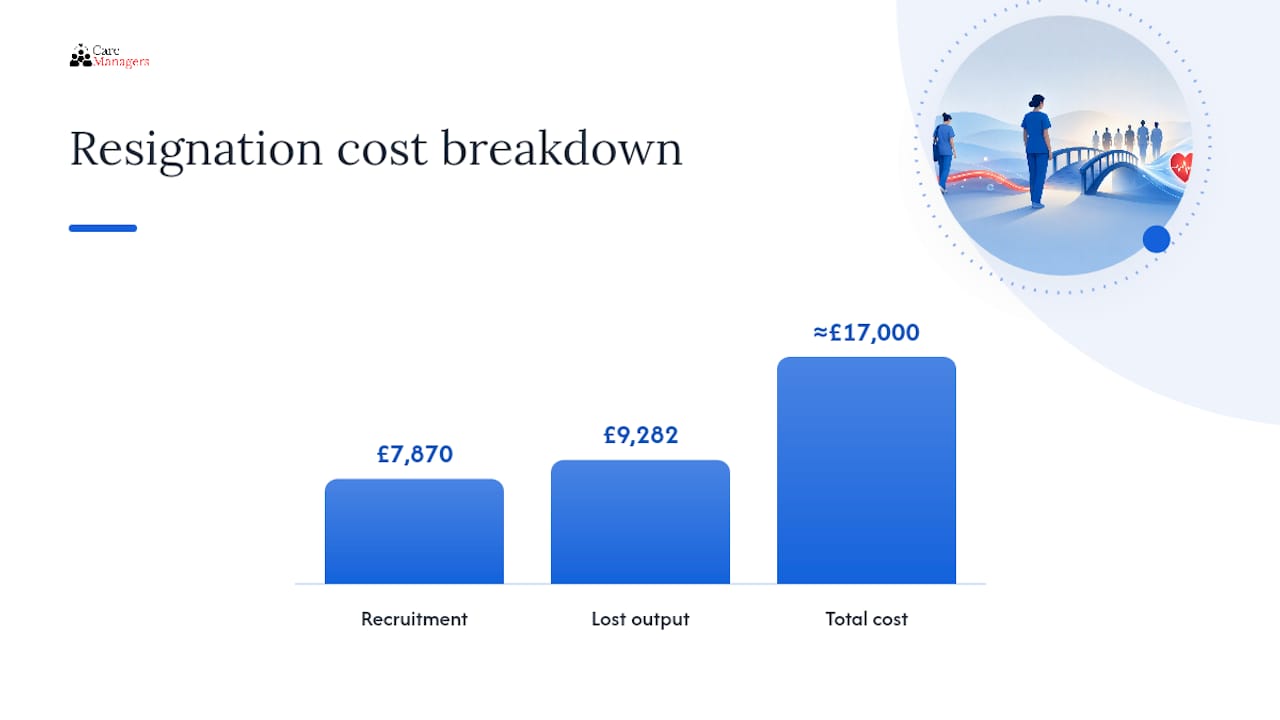
Every resignation costs more than the price of a job advert. Economic analysis from Cordis Bright puts the median recruitment cost at roughly £7,870 per hire, with lost output during the vacancy and induction period adding a further £9,282. Add those together and a single resignation can cost a provider close to £17,000 once you account for advertising, interviewing, DBS checks, induction shifts, and the productivity dip while a new worker gets up to speed.
Run that figure across a realistic turnover rate and the scale becomes clear.
| Scenario | Estimated cost impact |
|---|---|
| One resignation (recruitment + lost output) | Approximately £17,000, based on Cordis Bright’s median figures |
| Service at 24.2% turnover | Roughly 7 leavers a year, implying substantial combined recruitment and lost output costs |
| Same service reducing turnover by a third | A meaningful reduction in annual recruitment and cover spend, freeing budget for pay or training |
Those numbers only capture direct recruitment costs. They don’t include agency premiums, which typically run well above the hourly rate of a permanent worker, or the manager hours spent screening CVs and running induction sessions instead of doing supervision, quality checks or business development. A registered manager who spends three days a month recruiting is a manager who isn’t reviewing care plans or building relationships with commissioners.
- Agency reliance rises sharply once permanent headcount drops below safe staffing levels, and the CQC links this pattern directly to reduced service capacity.
- Manager time diverted to recruitment is time not spent on supervision, safeguarding oversight or business growth.
- Persistent vacancies limit how many new clients or beds a service can safely accept, capping revenue at exactly the moment demand is strongest.
The business case writes itself once the numbers are on the table. A service that cuts turnover from 24% to 16% doesn’t just save recruitment fees. It reclaims intake capacity, reduces agency dependency, and gives managers the breathing room to reinvest savings into pay or training, which further reinforces retention. It’s a virtuous cycle that starts by treating turnover as a cost line, not an inevitability.
Why care workers leave: the primary, evidence-backed drivers
Most resignations in care trace back to a small, recognisable set of causes. Knowing which one dominates in your service is the difference between fixing the actual problem and rolling out a generic wellbeing initiative that misses the point entirely.
- Pay outside the sector. The Gov found most providers report recruitment and retention as challenging, with better pay elsewhere cited repeatedly as the reason staff leave.
- Insecure contracts and unpredictable hours, particularly zero-hours arrangements that make it hard for staff to plan childcare, second jobs or their own finances.
- Unmanageable workload and poor rostering, where back-to-back calls with no travel time or unfilled shifts pushed onto remaining staff create burnout fast.
- Limited training and career pathways, leaving care assistants with no visible route to senior carer, team leader or nursing associate roles.
- Weak line management and culture, where staff feel unsupported, unheard, or micromanaged rather than trusted.
The Local Government Association frames retention as depending on six interconnected conditions, including supportive leadership, manageable workloads and staff feeling genuinely heard, rather than any single lever a manager can pull in isolation.
It helps to separate what you can control from what you can’t. Pay bands are often set by commissioning contracts you don’t negotiate directly. Rostering quality, supervision consistency and how valued a worker feels day to day, however, sit almost entirely within a manager’s remit. That distinction matters when you’re deciding where to spend limited time and budget.
Pro Tip: Run a two-question staff pulse survey this month: “What would make you consider leaving in the next six months?” and “What’s one thing that would make today easier?” Cross-reference the answers against your last ten exit interviews. The overlap tells you exactly which driver to tackle first.
What good retention delivers for people, teams and services
Retention pays back on every front that matters to a care service. Continuity strengthens the therapeutic relationship, cuts the frequency of missed or rushed visits, and reduces the agency spend that eats into margins during a bad month.
- Fewer new faces means fewer near-misses caused by unfamiliarity with a person’s risks, preferences or medication routine.
- Lower agency reliance frees budget that would otherwise go on premium hourly rates for cover staff.
- Recruitment and induction costs fall in proportion to how many fewer vacancies you’re filling each year.
- Staff who stay build genuine expertise, which shows up in more confident, higher-quality care delivery across the team.
Services with lower turnover are associated with higher CQC scores, according to sector analysis summarised by Staffordshire County Council’s retention support pack, which draws on Skills for Care data to link workforce stability directly to quality ratings. That correlation makes intuitive sense once you consider what inspectors are actually assessing: consistency, safety and whether people feel known by the staff supporting them.
Retention also feeds staff wellbeing in a way that’s easy to overlook. Workers who see genuine progression routes, whether into senior carer roles or specialist areas like dementia care, report stronger professional identity and lower burnout. That, in turn, makes them more likely to stay, which completes the loop back to better care.

How to measure retention and diagnose risk in your service
You can’t fix what you haven’t measured. Most services already hold the data they need in payroll and rota systems, but few managers convert it into the handful of metrics that actually flag risk early.
- Turnover rate: total leavers over 12 months divided by average headcount, multiplied by 100. Compare against the sector’s 24.2% benchmark to see where you stand.
- Retention rate by tenure cohort: what proportion of staff hired 12 months ago are still with you? A sharp drop-off inside the first three months points to induction failures rather than pay.
- Vacancy rate: unfilled posts as a percentage of your total establishment, tracked monthly rather than as an annual snapshot.
- Agency hours as a share of total care hours: a rising trend here is often the earliest warning sign of a retention problem, appearing months before turnover figures catch up.
- Time-to-hire: days from advertising a post to a new starter’s first shift. Longer times mean longer periods of unsafe understaffing.
- Internal promotion rate: the proportion of senior or specialist roles filled from within, a rough proxy for whether staff can see a future in your service.
For a rapid diagnostic, run exit interviews on every leaver rather than a sample, cross-check the themes against a short staff pulse survey, review caseload or call-time data for signs of overload, and check onboarding completion rates for new starters. As a rough threshold, sustained turnover above the sector’s 24.2% average, combined with rising agency hours, is a reasonable signal that continuity and safety are being meaningfully affected, not just administrative inconvenience.
Practical, evidence-backed actions managers can prioritise to improve retention
Fix rostering and supervision before you touch anything else. Pay matters enormously, but most managers can’t move pay bands overnight, whereas predictable rotas and protected one-to-ones are within reach this month. Get the controllable factors right first, then build the case for the harder structural changes.
Immediate actions (within weeks):
- Build predictable rosters with genuine notice periods, rather than last-minute shift-filling that punishes the staff who always say yes.
- Redesign induction as a structured cohort programme rather than a single shadow shift, since systematic review evidence points to supportive induction as one of the more promising, if under-evaluated, retention interventions.
- Protect supervision slots in the rota so they can’t be cancelled when cover is tight, a practice the Local Government Association links to materially better retention outcomes.
- Introduce simple, consistent recognition, whether that’s acknowledging good practice in team meetings or flagging strong feedback from families directly to the worker involved.
Medium-term actions (within two to three months):
- Build visible career pathways, including apprenticeship routes into senior carer or specialist roles. Partner organisations such as Meallmore offer useful models for structuring entry-level progression that other providers can adapt.
- Review pay against local competitors outside the sector, even where full parity isn’t achievable, since the gov.uk workforce survey identifies pay gaps with other sectors as the most commonly cited reason staff leave.
- Roll out values-based recruitment so new hires are selected for fit with the role, not just availability, an approach the systematic review associates with stronger long-term retention.
- Use a designated care staffing coordinator role to own rostering quality and supervision scheduling, rather than leaving it to whoever has a spare hour.
Longer-term and system-level work:
- Open a structured dialogue with commissioners about contract length and rates, using your own costed turnover figures as evidence.
- Explore whether flexible staffing arrangements can absorb short-term gaps without destabilising your permanent team’s rota.
- Build a multi-component retention plan spanning recruitment, induction, development and culture together, since research syntheses consistently show that single interventions rarely move the needle on their own.
Consider two low-risk pilots to test what works before committing to a full rollout: a cohort induction package for your next intake of new starters, and a fixed, protected supervision slot for one team over a single quarter. Measure retention and agency hours before and after each pilot so you have real numbers when you take the case further.
Pro Tip: Put retention metrics on the same monthly dashboard as safeguarding and incident data. When turnover sits next to safety figures in a manager’s weekly review, it stops being an afterthought and starts driving decisions.
The limits managers face: commissioning, contract design and the wider system
Some retention problems simply cannot be solved from inside a service. Council contract rates, often set years in advance and rarely adjusted for real wage inflation, put a hard ceiling on what a provider can pay without running at a loss. Short contract terms discourage investment in training, since providers have little confidence they’ll retain the contract long enough to see a return.
Research from Edge Hill University points to commissioning models and contract length as structural constraints on a provider’s ability to invest in retention, and notes that providers who manage to reframe staff as long-term assets, rather than a variable cost, tend to perform better over time even within these constraints. That reframing is easier said than done when a contract could be re-tendered in 18 months.
Zero-hours contracts compound the problem. They give commissioners flexibility on paper, but they push the instability straight onto the workforce, making it harder for staff to plan their lives around a job that offers no guaranteed income.
A short “case for change” template helps when you’re negotiating with commissioners or internal procurement:
- State your current turnover rate against the sector benchmark, with the associated recruitment and agency cost.
- Show the capacity lost to vacancies, expressed as care hours or client places you could accept if fully staffed.
- Propose a specific rate or contract-length change tied to a measurable retention target over 12 months.
Pro Tip: Commissioners respond to numbers, not sentiment. Bring your costed turnover figure and your lost intake capacity to every contract review, even when it isn’t formally on the agenda.
What we’ve seen work in practice
The services that turn retention around rarely do it with one dramatic change. It’s usually a sequence of small, unglamorous fixes: a rota rebuilt around real travel times, supervision that survives a busy week instead of being the first thing cancelled, and an induction programme that gives new starters four weeks of shadowing instead of one shift and a badge.
What’s underappreciated is the order these changes happen in. Fixing culture before fixing the rota rarely works, because no amount of recognition compensates for a worker who hasn’t had a lunch break in three weeks. Get the practical, controllable basics right first, and the harder conversations about pay and career pathways land on much more receptive ground.
Pro Tip: Sequence your changes: roster and supervision first, recognition and culture second, pay and career pathways third. Trying to do all three at once dilutes the impact of each.
How a staffing partner can support your retention plan
Consistent, well-trained staff are the foundation of every retention fix described above, and building that consistency internally takes time most managers don’t have to spare. Caremanagers works with care providers across South Wales and England to supply reliable, dementia-trained care staff and structured induction support, so your permanent team isn’t stretched thin covering gaps.

A staffing partner can free manager time in several concrete ways:
- Managed recruitment that screens for values and role fit before candidates ever reach your interview stage.
- Temporary cover that maintains continuity, using consistent staff rather than rotating unfamiliar faces through vulnerable clients.
- Training packages, including dementia care and hospital discharge support, that raise skill levels without pulling your own staff off the rota to deliver them.
If workforce pressure is limiting your capacity to take on new clients or plan sustainable rotas, explore our home care services page and get in touch for an initial consultation to talk through where the gaps in your current staffing model sit.
Sources
For deeper detail behind the figures and recommendations in this article, these sources are worth your time:
- What good looks like in the retention of regulated professionals | Local Government Association
- Gov
- Retaining Healthcare Workers: A Systematic Review of Strategies for Sustaining Power in the Workplace (PMC)
FAQ
Why is staff retention so important in care?
Retention protects the continuity, safety and personalisation that define good care. High turnover is linked to missed care and safety incidents, according to the Royal College of Nursing, while stable teams support stronger therapeutic relationships and lower operational costs.
What are the main factors influencing employee loyalty in care?
Pay compared with other sectors, secure and predictable contracts, manageable workloads, and supportive supervision consistently emerge as the strongest drivers, based on the gov.uk workforce survey and Local Government Association findings. Career progression and feeling genuinely heard by management also matter significantly.
What turnover rate signals a serious retention problem?
Sustained turnover above the sector’s 24.2% average, especially when paired with rising agency hours, is a reasonable signal that continuity and safety are under meaningful strain rather than facing normal staff movement.
How can a staffing partner help improve retention?
A partner like Caremanagers can supply consistent, trained cover during gaps so permanent staff aren’t overloaded, reducing the burnout that often triggers resignations, while structured induction and dementia training support raise skill and confidence across the wider team.
What should managers measure first to diagnose retention issues?
Start with turnover rate, retention by tenure cohort, and agency hours as a share of total care hours. These three metrics, drawn from routine payroll and rota data, reveal most retention problems before they show up in CQC feedback.