
Families arranging care for an elderly relative face a system that is genuinely complex, but the core funding pathways are clearer than they might first appear. The main sources of financial support for elderly home care in the UK are:
- Local council funding — available after a care needs assessment and means-tested financial assessment, subject to capital limits of £23,250 (upper) and £14,250 (lower) for 2026/27 in England
- Self-funding — required when savings exceed the upper capital limit; typical hourly rates run £15–£30, with live-in care with costs that can vary significantly depending on level of care and location
- Attendance Allowance and Personal Independence Payment (PIP) — non-means-tested benefits that can contribute to care costs regardless of savings
- NHS Continuing Healthcare (CHC) — fully funded NHS care for those with a primary health need, with no means test applied
- Equity release, deferred payments, and immediate needs annuities — financial tools to release money when savings are tied up in property
- Charitable and voluntary organisation grants — supplementary support from organisations such as Age UK and local charities
Understanding which of these applies to your situation, and in what order to pursue them, is what this guide covers.
Table of Contents
- How does local council funding for home care actually work?
- What does self-funding elderly home care actually cost?
- What benefits and NHS support can help pay for home care?
- How do you navigate assessments and choose the right care provider?
- Caremanagers: personal home care support across South Wales and England
- Key takeaways
- FAQ
How does local council funding for home care actually work?
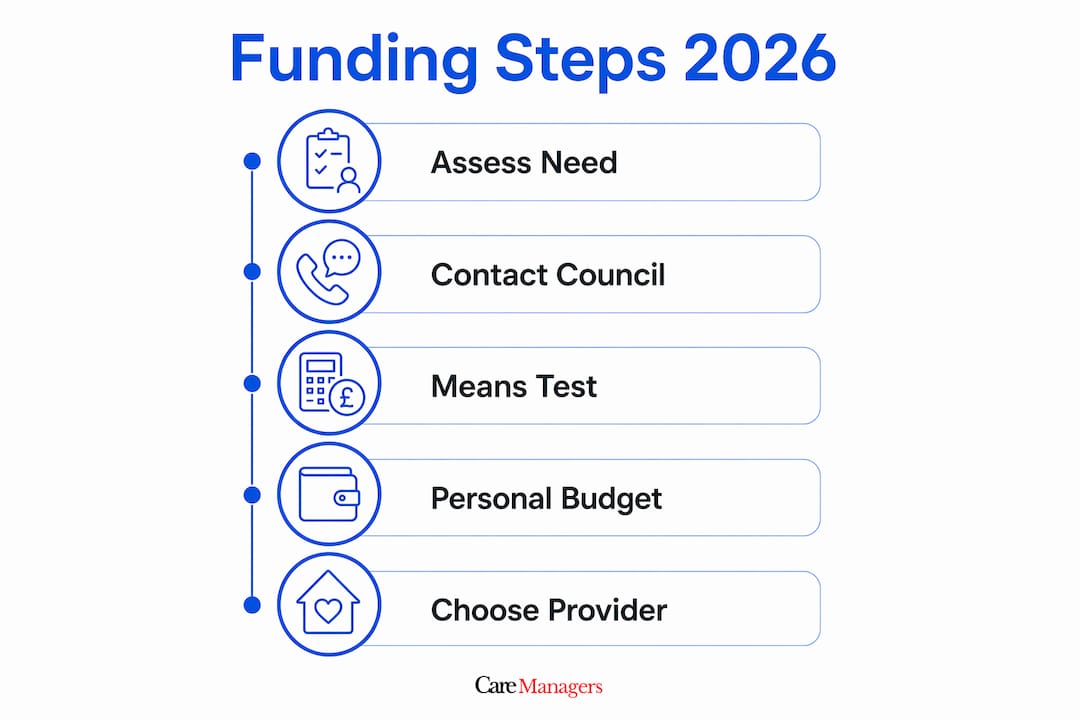
The gateway to council-funded home care is a care needs assessment, which your local authority is legally required to carry out on request. This assessment determines what care someone needs, and it must happen before any financial assessment takes place. Your level of savings is irrelevant at this stage.
Once eligible care needs are confirmed, the council conducts a financial assessment (means test). For 2026/27 in England, the thresholds are:
- Above £23,250 in capital — you fund your own care in full
- Between £14,250 and £23,250 — you pay a tariff income contribution of £1 per week for every £250 of capital above the lower limit, on top of what you can afford from income
- Below £14,250 — you pay only what you can afford from income; the council covers the rest
One detail many families miss: local authorities must disregard disability-related expenditure from income when calculating your contribution. Costs such as specialist equipment, continence products, or additional heating can all reduce the assessed amount you pay, but you need to claim and document them carefully.
If the council agrees to fund your care, you receive a personal budget. You can take this as a direct payment into your bank account to arrange your own care, let the council commission services on your behalf, or use a third-party organisation to manage the budget for you. The financial assessment process for home care is worth understanding in detail before your appointment.
Pro Tip: Contact your local authority as soon as you think you may need support. Councils only fund from the date of contact, so delaying that call — even by a few weeks — can mean losing out on funding you would otherwise be entitled to.
What does self-funding elderly home care actually cost?
When savings sit above the £23,250 threshold, you arrange and pay for care privately. Standard hourly home care rates in 2026 run from £15 to £30, depending on location and the complexity of care required. Live-in care, where a carer lives in the home full-time, costs £800–£1,600 per week on average. A recommended minimum hourly payment for homecare providers exists as a benchmark for quality to local authorities, which gives a useful benchmark when evaluating whether a provider’s rates reflect genuine quality.
Self-funders have several ways to meet these costs:
- Savings and pensions — the most straightforward route, though costs can deplete assets faster than families anticipate
- Equity release — allows homeowners to draw on property value without selling; seek regulated independent advice before proceeding
- Downsizing — selling the family home and moving to a smaller property to free up capital
- Immediate needs annuities — a lump-sum insurance product that pays care costs for life, removing the risk of outliving savings; specialist financial advice is essential
- Deferred payment agreements — the council lends you money against your property to cover care costs, repaid when the property is eventually sold
The critical planning point is timing. Once capital falls towards the £23,250 threshold, contact your local authority promptly. The council will reassess eligibility and begin contributing from the date you make contact, not the date your savings actually drop below the limit. Self-funders who explore all live-in care options early are far better placed to manage this transition.
For any of the more complex financial strategies, independent specialist advice from a regulated financial adviser with experience in later-life care funding is strongly recommended.
What benefits and NHS support can help pay for home care?
Several sources of financial aid for home care operate entirely outside the means test, meaning savings and income do not affect eligibility.
Attendance Allowance is available to people aged 66 and over who need help with personal care or supervision due to illness or disability. It is paid at two rates depending on the level of need and can be used towards any care costs. Attendance Allowance does not reduce council funding and does not affect most other benefits.
Personal Independence Payment (PIP) covers those under 66 and has two components: daily living and mobility. Like Attendance Allowance, it is non-means-tested and can be used flexibly to contribute towards home care costs. Both benefits are worth claiming as early as possible, as they can run alongside council-funded care or help self-funders stretch their budget further. Families researching non-means-tested benefits often find these are the most straightforward form of support to access.
NHS Continuing Healthcare (CHC) is a different category entirely. It provides a fully funded package of care, arranged and paid for by the NHS, for individuals with a primary health need arising from disability, accident, or illness. There is no means test and no capital limit. CHC can be delivered at home, meaning the NHS covers the full cost of your care package if you are found eligible. Eligibility is assessed using a national framework, and the process involves a multidisciplinary team review. It is worth requesting a CHC assessment if someone’s needs are primarily health-related and complex.
NHS-funded nursing care is a separate, narrower entitlement for people in care homes with nursing who do not qualify for full CHC but require registered nursing input. NHS reablement services offer short-term, free support after a hospital discharge to help someone regain independence at home, typically for up to six weeks.
Charitable organisations, including Age UK, Independent Age, and local community foundations, offer grants and practical support that can supplement statutory funding. These are worth exploring alongside formal assessments.
How do you navigate assessments and choose the right care provider?
The single most important step is requesting the care needs assessment before anything else. This is a statutory right. It establishes what care is needed on its own terms, independent of finances, and prevents the common mistake of assuming someone does not qualify for support because they have savings.
A few practical points that make a real difference:
- Claim disability-related expenditure — gather receipts and documentation for any extra costs linked to disability or health conditions before your financial assessment. These reductions can be significant and are often overlooked.
- Understand direct payment responsibilities — if you opt for direct payments, you become an employer. That means payroll, tax compliance, and employer duties under employment law. Many families use a payroll support service or a managed direct payment account to handle this.
- Contact the council early — as noted above, funding starts from the date of first contact, not the date needs become critical.
- Use multiple funding streams together — Attendance Allowance or PIP can run alongside council funding or self-funding, reducing the net cost of care.
- Seek independent financial advice — a specialist in later-life care funding can model different scenarios and help you avoid costly mistakes with equity release or annuity products.
When choosing a care provider, check registration with the Care Quality Commission (CQC) in England or the Care Inspectorate Wales. Ask about staff training, continuity of carers, and how the provider handles changes in care needs. A reputable provider will carry out their own assessment before care begins and review it regularly.
Pro Tip: Ask MoneyHelper (0800 111 379) or Age UK (0800 678 1602) for free, impartial guidance on benefits and financial assessments before committing to any financial product or care arrangement.

Caremanagers: personal home care support across South Wales and England
Navigating the funding system is one challenge. Finding a care provider you can genuinely trust is another.

Caremanagers provides professional home care services across South Wales and England, including personal care, dementia care, respite care, and hospital discharge support. What distinguishes Caremanagers is the depth of personalisation: care plans are built around each individual’s preferences, routines, and needs, not a standard package. Families who have spent weeks researching funding options often find that the harder question is who will actually deliver that care with consistency and compassion. Caremanagers’s staff are selected and trained to provide exactly that, whether the care is council-funded, privately arranged, or a combination of both. To discuss your family’s situation and find out how Caremanagers can help, get in touch through the home care services page.
Key takeaways
Council funding, non-means-tested benefits, and NHS Continuing Healthcare each operate independently, so pursuing all three simultaneously gives families the strongest financial position when arranging elderly home care.
| Point | Details |
|---|---|
| Capital thresholds for 2026/27 | The upper limit is £23,250; those between £14,250 and £23,250 pay tariff income of £1 per £250 above the lower limit. |
| Care needs assessment comes first | Request this before any financial assessment — it is a statutory right and determines eligible care regardless of savings. |
| Non-means-tested benefits | Attendance Allowance and PIP can be claimed alongside council funding or self-funding to reduce net care costs. |
| Self-funding costs in 2026 | Hourly home care runs £15–£30; live-in care averages £800–£1,600 per week. |
| Caremanagers | Provides personalised home care across South Wales and England, supporting both council-funded and privately arranged care. |
FAQ
What is the capital limit for council-funded home care in 2026?
For 2026/27 in England, the upper capital limit is £23,250. Those with savings above this threshold must self-fund; those between £14,250 and £23,250 pay a means-tested contribution.
Does NHS Continuing Healthcare cover home care costs?
Yes. If you are assessed as having a primary health need, NHS Continuing Healthcare covers the full cost of your care package at home, with no means test applied.
Can I receive Attendance Allowance and council funding at the same time?
Yes. Attendance Allowance is non-means-tested and does not reduce your entitlement to council-funded care. It can be used alongside any other funding source to help cover care costs.
When should I contact my local authority about funding?
Contact your local authority as soon as you anticipate needing support. Councils fund from the date of first contact, so waiting until savings have already fallen below the £23,250 threshold can result in a gap in funding.
What are my options if I cannot afford home care but own a property?
A deferred payment agreement allows the council to fund your care and recover costs from your property when it is eventually sold. Equity release and downsizing are also options, but both require independent financial advice before proceeding.