
Table of Contents
- Bluebird Care vs Independent Home Care Providers: What Actually Differs?
- CQC Care Provider Ratings: What They Show and What They Miss
- Service Models Compared: Live-In Care, Hourly Visits and Specialist Support
- How to Choose a Home Care Agency That Fits Your Family
- The Best Questions to Ask a Home Care Provider Before You Commit
- Finding the Right Home Care Providers for Your Situation
- Conclusion
- Frequently Asked Questions
Last Updated: September 9, 2026
Bluebird Care vs Independent Home Care Providers: What Actually Differs?
When families research home care providers in the UK, the comparison between national franchises like Bluebird Care and independent local providers often surfaces early. The differences run deeper than branding, touching on how care is staffed, managed, and delivered day to day.
The CQC inspects both against the same fundamental standards, yet the structure beneath each provider shapes how those standards are met. A national franchise operates under a corporate framework, while an independent provider typically builds its model around local relationships.
The Franchise Model vs Local Ownership
National franchises benefit from brand recognition, standardised training, and consistent procedures. However, the franchise model introduces layers between the person receiving care and the decisions affecting it, slowing responses when circumstances change quickly.
Independent providers operate with fewer layers. Decisions about care plans and carer assignments sit with people who know the local community and often know your family personally, so the person who answers can act immediately rather than escalating through a chain.
Ask any provider whether the person who conducts your initial care assessment will also be the person managing your care six months later. In franchise models, staff turnover at office level can mean you rebuild relationships repeatedly. Independent providers often keep the same care manager throughout.
Care Continuity and Carer Consistency
The single most common complaint about home care across the UK is inconsistency. Families describe a revolving door of different carers, each needing to learn their loved one’s routines from scratch. This issue affects both national franchises and independents, but the causes differ.
Franchise operations often manage large carer pools across wide areas, leading to fragmented scheduling when demand spikes. Independent providers typically maintain smaller, more stable teams with stronger ties to their communities.
CQC Care Provider Ratings: What They Show and What They Miss
CQC care provider ratings are the natural starting point for any comparison. The regulator inspects providers against five key questions: are they safe, effective, caring, responsive, and well-led? Ratings offer a useful baseline for filtering your options.
However, ratings capture a snapshot in time. A CQC inspection reflects the provider’s performance on the days inspectors visited, not necessarily the consistency of care across every week of the year. The Care Quality Commission’s guidance on how services are regulated explains that inspections are risk-based, meaning providers with previous concerns face more frequent visits than those with strong track records.
What ratings often miss is the texture of daily care. Two providers can both hold Good ratings while delivering very different experiences around communication and flexibility. When comparing home care providers, read the full inspection reports rather than stopping at the headline grade.
How to Read an Inspection Report Like a Regulator
The headline grade is the least informative part of a CQC report. The real signal lies in the narrative and specific evidence inspectors cite. Here is a practical framework for dissecting a report:
- Check the Date and Scope: Note when the inspection occurred and whether it was announced or unannounced. Unannounced inspections often reveal more about day-to-day operations. Also, check if the report covers the whole service or just one location or regulated activity.
- Analyse the ‘Well-Led’ Domain: This section is the most predictive of future performance. It assesses the provider’s leadership, governance, and culture. Look for phrases like “open and transparent,” “clear vision,” or conversely, “lack of oversight” or “ineffective quality assurance systems.” A provider rated Good for ‘Caring’ but Requires Improvement for ‘Well-Led’ may have dedicated frontline staff but poor management oversight.
- Look for ‘Must’ and ‘Should’ Actions: These are the legal requirements and recommendations the provider must address. A long list of ‘Should’ actions, even with a Good rating, indicates areas of systemic weakness that could deteriorate. A provider with a clean bill of health on these is a safer bet.
- Cross-Reference Complaints: The report will detail how complaints were handled. Look for patterns of complaints that were dismissed, not investigated, or where the provider failed to learn from mistakes. This is a direct window into how your family’s concerns would be treated.
- Compare the ‘Effective’ and ‘Responsive’ Domains: These are where you will find the detail on care planning and person-centredness. Does the report mention that care plans are reviewed regularly and updated with input from the person and their family? Or does it note that care is task-focused and inflexible?
The ‘Outstanding’ Premium: What It Really Takes
Achieving an ‘Outstanding’ rating is rare, with only a small percentage of adult social care providers holding this top grade. It requires demonstrable innovation and exceptional practice, such as a novel approach to dementia care or technology-enabled medication management.
When you see an ‘Outstanding’ rating, ask what specific practices earned that grade. If they cannot articulate them clearly, the rating may reflect a single area of excellence rather than whole-service culture. A ‘Good’ provider transparent about its improvement journey may be more reliable than one resting on a past ‘Outstanding’ grade.
Do not just look at the provider’s overall rating. Look at the ratings for each of the five key questions. A provider might be rated ‘Outstanding’ for ‘Caring’ but ‘Requires Improvement’ for ‘Safe’. The latter is a critical red flag that should outweigh the former.
Beyond the CQC: Other Quality Markers
While the CQC is the primary regulator, other accreditations can signal commitment to quality. Membership in bodies like the Home Care Association (HCA) or UK Homecare Association (UKHCA) requires adherence to a code of practice. Some providers also pursue BSI accreditation for ISO 9001 quality management systems. These are voluntary, so their presence indicates a proactive approach.
Finally, ask for the provider’s own quality monitoring data. A confident provider will have internal audits, satisfaction surveys, and complaint logs, offering a more current view than any CQC report.
Service Models Compared: Live-In Care, Hourly Visits and Specialist Support
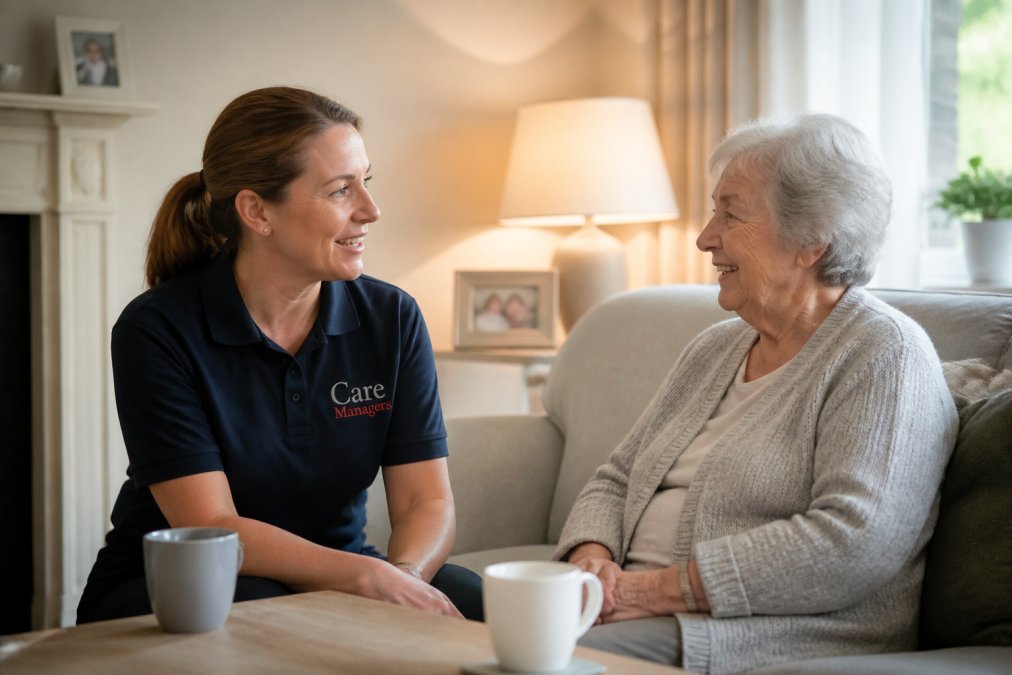
Home care providers generally offer three service models, and the right choice depends on the level of support needed. Hourly visits, sometimes called domiciliary care, involve carers calling at set times to help with washing, dressing, meal preparation, or medication prompts.
Live-in care places a carer in the home full-time, providing continuous support while respecting independence. This suits individuals with advanced dementia, mobility challenges, or those who prefer not to live alone. Specialist support covers conditions such as dementia, Parkinson’s, or post-hospital recovery.
| Service Model | Typical Duration | Best Suited For | Key Considerations |
|---|---|---|---|
| Hourly Visits | 30 mins to several hours | Light support, companionship, medication prompts | Frequency and timing flexibility matters |
| Live-In Care | 24/7 presence | Advanced dementia, mobility needs, safety concerns | Requires suitable home environment and space for carer |
| Specialist Support | Variable | Dementia, Parkinson’s, post-hospital recovery | Verify specific training and experience |
| Respite Care | Short-term or temporary | Carer holidays, family emergencies, post-surgery | Provides relief for family caregivers |
When comparing providers, ask which models they genuinely deliver versus which they merely list on their website. Some agencies advertise live-in care but struggle to maintain cover during carer holidays or sickness. Independent providers with local teams often manage these transitions more smoothly.
The Operational Reality of Each Model
The choice between a national franchise and an independent provider is also about how care is operationally delivered and sustained. The differences become stark when examining the logistics behind each model.
Hourly Visits: The 15-Minute Visit Problem
The most significant issue in hourly care is the prevalence of short, 15-minute visits. While appropriate for a medication prompt, they are often insufficient for personal care or companionship. A national franchise managing a large client roster may be more likely to schedule back-to-back short visits to maximise efficiency, leaving carers rushing with no time for human connection.
An independent provider with a smaller client base is often more willing to schedule longer, more flexible visits. Ask specifically about minimum visit length and policy on 15-minute calls. A provider that avoids them is likely prioritising quality over volume.
Live-In Care: The Backup Carer Challenge
The biggest risk with live-in care is what happens when your carer is on holiday, sick, or needs a day off. The CQC mandates that live-in carers have adequate rest breaks, meaning the provider must have backup carers. A national franchise may have a larger pool, but those carers may be unfamiliar with your loved one’s routines.
An independent provider with a strong local presence often has a closer-knit team, possibly with a dedicated ‘floating’ carer who covers absences and already knows several clients in the area. Ask any provider to explain their exact contingency plan for scheduled and emergency leave.
Specialist Support: Beyond a Certificate
Many providers claim to offer specialist dementia or Parkinson’s care, but a half-day online course does not make a carer a specialist. True specialist support requires ongoing, in-depth training and experience. Ask to see their training curriculum and whether it covers the specific challenges of your loved one’s condition.
Independent providers often build their reputation on a specific niche, such as dementia care, with carers holding years of dedicated experience. A national franchise may offer broader services but with less depth in any single specialism.
The Financial Trade-Off: Not Just a Unit Price
It is impossible to compare service models without addressing financial implications, though actual costs vary by region and level of need. The headline hourly rate is only the beginning. Ask for a detailed breakdown of what is included, including travel costs, minimum call-out time, and charges for evenings, weekends, and bank holidays.
For live-in care, the cost is typically a fixed weekly rate, though this can be affected by the need for a second carer if the primary carer requires more than legally mandated rest breaks. A provider may quote a single-carer rate, but if the care plan requires two carers, the cost rises significantly. An independent provider may structure a rota avoiding a second carer, whereas a national franchise might apply a rigid policy.
Always ask for a written breakdown of costs, including any additional fees for specialist training, care planning, or out-of-hours support. A transparent provider will be happy to provide this. A provider that is vague about costs is a red flag.
The most important comparison is not unit price but total value. A slightly higher hourly rate from an independent provider might include a more experienced carer, a consistent team, and a care manager who is always reachable.
How to Match the Model to the Provider’s Strengths
Ultimately, the best way to compare is to ask each provider how they would deliver your specific care plan. Instead of asking “Do you provide live-in care?”, ask “How would you structure a live-in care rota for my mother who has dementia and needs company at night?” A national franchise might describe a standard process, while an independent provider will likely discuss her specific routines and how they would match a carer to her personality.
How to Choose a Home Care Agency That Fits Your Family
Choosing a home care agency requires looking beyond glossy brochures and website testimonials. Start by confirming the provider is CQC-registered and reviewing their latest inspection report in full. Check whether they have experience with your loved one’s specific condition.
Consider the provider’s geographic coverage. A national franchise might serve your area, but an independent provider based nearby often responds faster to urgent requests and knows local healthcare professionals and specialist services.
Do not assume that a larger provider offers more reliable care. National franchises sometimes struggle with carer shortages in rural areas, leading to missed visits or last-minute substitutions. Ask directly about their contingency plans when a regular carer is unavailable.
Questions should also cover staffing practices. How are carers recruited and vetted? What training do they receive beyond the mandatory minimum? How does the agency handle safeguarding concerns? Vague answers may indicate weak systems.
The Best Questions to Ask a Home Care Provider Before You Commit
Before signing with any agency, schedule a conversation with the care manager, not just a sales representative. Ask how many different carers your loved one might see in a typical month, what happens if a scheduled carer calls in sick, and how the provider communicates with distant family members.
Enquire specifically about training for the conditions that matter in your situation. If your loved one has dementia, what specialised training do carers complete? How does the provider handle challenging behaviours? The answers reveal genuine expertise versus generic experience.
Also ask about care plan reviews. A good provider revisits care plans regularly and adjusts them as needs evolve, with reliable communication about any changes so families are never chasing updates.
The most revealing question you can ask is: “If my loved one’s needs change suddenly, how quickly can you adjust the care plan?” Providers with local decision-making and consistent care management can typically respond within days, while those with corporate approval processes may take weeks.
Finding the Right Home Care Providers for Your Situation
The search for home care providers ultimately comes down to fit. A provider that excels for one family may be wrong for another, depending on the level of care needed, the specific condition involved, and communication preferences.
If you are comparing how does Bluebird Care compare to other independent home care providers in the UK, consider what matters most in your circumstances. National franchises offer brand recognition and standardised processes. Independent providers often deliver greater flexibility, consistency of carers, and a more personal service. Independent providers with smaller local teams generally achieve higher consistency because carers work in familiar communities and build lasting relationships.
The regulatory framework provides a safety net, but it cannot guarantee the daily experience of care. Both must meet CQC standards, but the way providers interpret and exceed those standards varies considerably. For specialist services such as dementia care or faith-based support, local knowledge and tailored approaches make a tangible difference.
Conclusion
Choosing between a national franchise and an independent home care provider is not about which model is objectively better, but which fits your family’s specific needs. How does Bluebird Care compare to other independent home care providers in the UK? The answer depends on whether you value brand consistency or local flexibility, standardised processes or personalised care planning.
Frequently Asked Questions
What should I look for when choosing a home care provider?
Start with the CQC care provider ratings and read the latest inspection report, not just the overall grade. Then look at how the agency matches carers to your family, how it handles continuity when a carer is unavailable, and what training carers receive for specific conditions like dementia. Ask whether care plans are truly personalised or template-based, and check how the provider communicates with families about changes and concerns. A local independent provider may offer more flexibility and a more personal service than a national franchise.
How are home care agencies regulated by the Care Quality Commission?
Home care agencies in England must register with the Care Quality Commission (CQC), which inspects them against fundamental standards of safety, effectiveness, and leadership. Providers receive ratings from Outstanding to Inadequate, and inspection reports are published online for anyone to read. The CQC can require improvements or close a service that fails to meet standards. When comparing Bluebird Care with independent providers, check each local branch’s rating, as franchise ratings can vary between locations.
What is the difference between a franchise and an independent care provider?
A franchise like Bluebird Care operates under a national brand, but each local branch is independently owned and managed. This means quality and service can vary significantly between branches. An independent provider is usually a single local business with direct accountability to its community. Independents often offer more flexible, personalised care plans and quicker decision-making because there is no head office approval process. However, franchises may have more structured training and marketing resources behind them.
How does live-in care differ from hourly home care services?
Hourly home care involves a carer visiting for set periods, typically from 30 minutes to a few hours, several times a day or week. Live-in care means a carer lives with the person full-time, providing support around the clock. Live-in care suits people with high or unpredictable needs, such as advanced dementia, and costs more than a few hourly visits but can be comparable to a care home. Your choice depends on the level of care needed and whether family can supplement visits.
What are the benefits of choosing a local independent care provider?
Local independent providers often deliver more consistent care because the same small team visits regularly, which builds trust and rapport. They can adapt care plans quickly when needs change, without waiting for head office approval. Many are deeply embedded in their community and work closely with local GPs and social services. If faith-based or culturally specific care matters to your family, an independent provider is more likely to accommodate those preferences than a national franchise.
At Care Managers, we provide compassionate and professional home care, live-in care, and supported living services across South Wales and England. Our tailored care plans, faith-based options, and ongoing quality assurance keep your loved ones safe, comfortable, and independent in their own homes. Book a call with our team to discuss how we can support your family with consistent, dignified care.