
Table of Contents
- Understanding Your Home Care Needs
- What to Look for in a Home Care Agency
- Checking CQC Home Care Ratings and Inspection Reports
- Key Questions to Ask Home Care Agencies
- Vetting Care Workers and Safeguarding Checks
- Red Flags in Care Contracts and Service Agreements
- Making Your Final Decision and Getting Started
Last Updated: August 12, 2026
Understanding Your Home Care Needs
Before you start looking for reliable home care, you need to understand what kind of support you or your loved one actually requires. This clarity shapes every decision that follows, from the type of care provider you approach to the questions you’ll ask during interviews.
A care needs assessment is the starting point. This involves evaluating daily activities: mobility, personal hygiene, medication management, meal preparation, and any specialist requirements like dementia support or nursing care. Many families underestimate this step, assuming they know what’s needed. In practice, a formal assessment often reveals gaps, things like managing finances, coordinating appointments, or providing emotional support during difficult transitions.
Consider whether you need live-in care, hourly visits, or something flexible. Live-in care provides round-the-clock presence and continuity, which matters enormously when someone has advanced dementia or requires frequent assistance. Hourly visits suit those managing reasonably well but needing help with specific tasks. Respite care, meanwhile, offers temporary relief for family carers, essential if you’re juggling full-time work and caregiving.
Think about the person’s preferences too. Someone fiercely independent may resist full-time support but accept help with specific tasks. Others want a familiar face every day; inconsistent staffing will undermine trust and create anxiety. If faith matters to your family, faith-based home care options exist that align with religious observances and dietary practices, something many mainstream agencies overlook.
The strongest home care arrangements start with an honest assessment of what’s needed, not what’s assumed. Get this right and everything else becomes easier.
What to Look for in a Home Care Agency
Finding reliable home care means knowing what separates a genuinely good agency from one that merely exists. The quality of a home care agency hinges on three things: how they recruit and train staff, how they match people to clients, and how they handle problems when they arise.
Start by checking whether the agency is regulated. In this country, the Care Quality Commission (CQC) inspects and rates home care services. An agency without CQC registration is operating outside the regulatory framework, a serious red flag. Look for their CQC home care ratings on the official register. An "Outstanding" or "Good" rating means the service has been independently assessed and meets standards for safety, effectiveness, and person-centred care.
Beyond regulation, ask about their approach to staffing continuity. High staff turnover is one of the most common complaints from families. If carers are constantly changing, your loved one never settles, and you’re constantly rebuilding trust. Reliable agencies invest in staff retention through decent pay, training, and support. They also understand that matching the right person to the right client matters, not just any available carer will do.
Quality assurance should be visible. How do they monitor care? Do they do spot checks? How do they gather feedback from clients and families? An agency that takes quality seriously has systems in place. They’re not just hoping things go well; they’re actively checking that they are.
Ask about their safeguarding policies. This covers everything from DBS checks (Disclosure and Barring Service) to training on recognising abuse, handling concerns, and protecting vulnerable people. Safeguarding isn’t a box to tick, it’s a culture. Agencies that take it seriously have clear processes and staff who understand their responsibilities.
When you call an agency, listen to how they answer the phone. Are they rushed or unhurried? Do they ask questions about your situation or just try to book a call? The way they treat an initial inquiry often reflects how they’ll treat you as a client.
Checking CQC Home Care Ratings and Inspection Reports
The CQC home care ratings are your most reliable independent measure of quality. Every registered home care agency has a profile on the CQC website, showing their latest inspection report and rating.
Ratings run from Outstanding down to Inadequate. But a rating alone tells only part of the story. Read the actual inspection report. The inspectors assess five key areas: safety, effectiveness, responsiveness, caring, and leadership. The narrative in the report shows you what inspectors actually found, staffing levels, staff training, how complaints are handled, whether people feel respected.
Look for patterns in the findings. If an agency was rated Good but had minor concerns about training, that’s different from one rated Good with concerns about safeguarding or medication handling. The detail matters. Pay special attention to what inspectors say about staff knowledge, communication with families, and how the agency responds to concerns.
Check when the inspection took place. A rating from 2024 is more current than one from 2021. Services can change, sometimes for better, sometimes for worse. If an agency was previously rated Requires Improvement and is now Good, that shows they’ve made genuine changes. Conversely, if standards have slipped since the last inspection, you want to know.
Ask the agency directly about their CQC rating and any actions they’re taking on feedback. If they’re defensive or dismissive about inspection findings, that’s telling. A confident agency welcomes scrutiny and can explain what they’re doing to maintain or improve standards.

Key Questions to Ask Home Care Agencies
Once you’ve shortlisted agencies with good CQC ratings, have a detailed conversation. The questions you ask reveal how well they understand your situation and how seriously they take personalised care.
Start with staffing. How do they handle continuity? Do they aim to send the same carers? What happens if a regular carer is sick? How many carers will be involved in your loved one’s care? Reliable agencies will say they aim for consistency but acknowledge that some flexibility is inevitable. Vague answers suggest they haven’t thought this through.
Ask about their matching process. How do they decide which carer to send? Do they consider personality, interests, languages spoken, or cultural background? Do they involve the person receiving care in the decision? An agency that just assigns whoever is available isn’t thinking about fit. One that takes time to match is.
Explore their training. What training do all carers receive? What specialist training is available for dementia, physical disabilities, or other specific needs? How often is training refreshed? Carers who’ve had proper induction and ongoing development are more confident and capable.
Ask about communication. How will you stay informed? Will you get regular updates? How do you raise concerns? Can you contact the agency outside office hours if there’s an emergency? Families often complain about feeling in the dark. An agency with good communication systems keeps families in the loop without being intrusive.
Discuss care plans. How detailed is their assessment before care starts? Who develops the care plan, is your loved one involved? How often is it reviewed? A personalised care plan that reflects individual routines and preferences is what separates genuine support from box-ticking.
Finally, ask about flexibility. Life changes. Needs shift. Can they adjust care levels if required? How much notice do they need? Reliable agencies are responsive to changing circumstances.
If an agency won’t give you straight answers to these questions, or seems irritated by detailed inquiry, walk away. The right agency will welcome thorough vetting, they know it shows you care about quality.
Vetting Care Workers and Safeguarding Checks
The individual carer matters as much as the agency. Even the best-run organisation can send an unsuitable person if vetting isn’t rigorous.
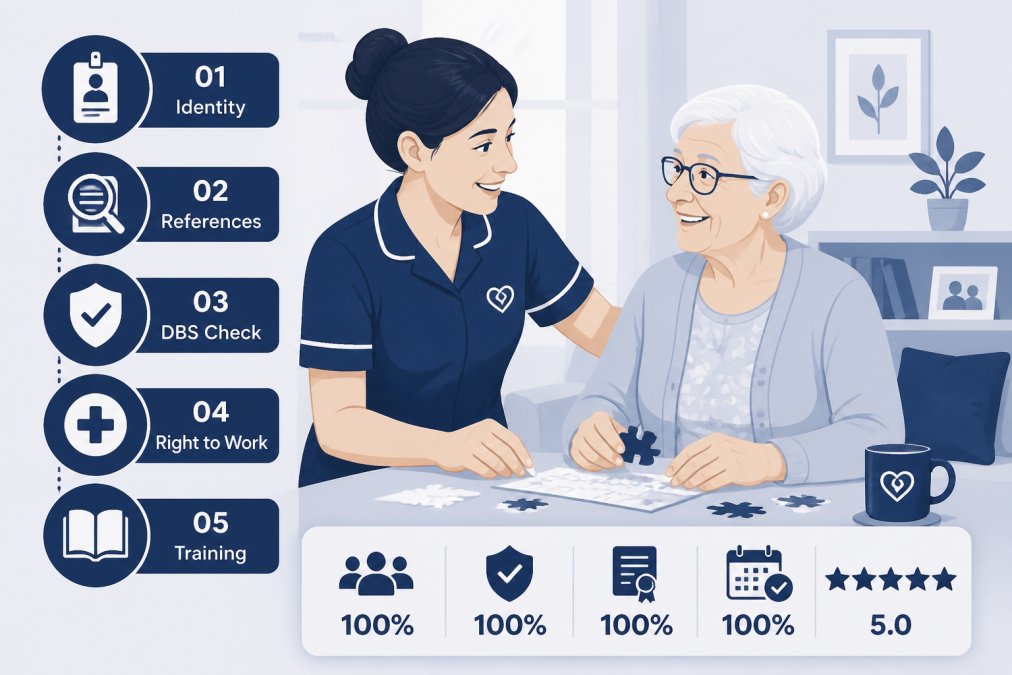
All carers working with vulnerable people must have a DBS check, a Disclosure and Barring Service check that reveals any criminal history relevant to safeguarding. But DBS is a baseline, not a guarantee. Ask the agency how they verify references from previous employment. Do they contact previous employers directly? Do they check that references are genuine? Sloppy reference-checking is a warning sign.
Ask about training in safeguarding and abuse recognition. Carers need to know how to spot signs of abuse, how to report concerns, and how to maintain dignity and respect. Training matters because an untrained carer might miss warning signs or, worse, be the source of harm.
Meet or speak with potential carers before they start. You have the right to know who’s coming into your home. Trust your instincts. Are they respectful, patient, and genuinely interested in understanding your loved one’s needs? Or do they seem dismissive, rushed, or uncomfortable with questions? A carer who’s confident in their skills and clear about boundaries is reassuring.
Ask about their experience and any specialisms. If your loved one has dementia, you want someone who’s cared for people with dementia before. They’ll understand behaviour changes, communication challenges, and the importance of routine. If there are mobility issues, experience with moving and handling is essential.
Discuss how they approach their role. Are they there to do tasks, or to support independence? The best carers work with their client, not for them. They encourage what the person can still do rather than taking over. This matters for dignity and for slowing decline.
Red Flags in Care Contracts and Service Agreements
Before you sign anything, read the service agreement carefully. This document sets expectations and protects both you and the agency. But some agreements hide problems in the fine print.
Watch for vague language around staffing. If the contract says "we will provide care as available" or "carers may vary," you have little recourse if consistency falls apart. Better contracts commit to specific arrangements with clear notice periods for changes.
Check the cancellation terms. What happens if you need to end the service? Is there a long notice period or early termination fee? Some agencies lock you in for months. Reliable providers understand that care relationships sometimes don’t work and allow reasonable exit.
Look at how complaints are handled. Is there a clear process? How long do they have to respond? What happens if you’re unhappy with their response? An agency with a strong complaints procedure shows they take feedback seriously.
Be cautious about blanket liability exclusions. Agencies can’t exclude liability for negligence or harm. If the contract says they’re not responsible for anything, that’s a problem. Reasonable contracts set clear expectations about what they’re responsible for and what they’re not.
Check what happens if a carer is sick or leaves. Do they have cover arrangements? Or will your care simply not happen? Reliable agencies have contingency plans.
Ask about fees and what’s included. Are there hidden charges? What happens if care takes longer than expected? Is there a minimum visit length? Transparent pricing and clear terms prevent disputes later.
A good service agreement is detailed enough to prevent misunderstanding but flexible enough to accommodate individual needs. If it reads like it was written to protect the agency first and the client second, be wary.
Making Your Final Decision and Getting Started
After all your research, you’re ready to decide. But this isn’t just about picking the agency with the best rating or the most convenient timing. It’s about which one feels like the right fit for your situation.
Compare your shortlist against what matters most to you. If continuity of care is essential, which agency has the strongest track record? If specialist support is needed, which has the most relevant experience? If communication is crucial, which has the clearest systems? Weight your criteria and see which agency scores highest across what actually matters.
Trust your gut. You’ve asked tough questions. You’ve checked ratings and read inspection reports. You’ve met carers or spoken with them. Does this feel like a team that will genuinely support your loved one? Or does something feel off?
Once you’ve chosen, the real work begins. The first few weeks are critical. Your loved one is adjusting to a new person in their home. The carer is learning routines and preferences. Stay involved. Check in regularly. Does the care match what was agreed? Is your loved one comfortable? Are there any early concerns?
If things aren’t working, say so early. Good agencies want to know if something’s not right. They can adjust the approach, change the carer, or modify the care plan. Problems that fester become bigger problems.
At Care Managers, we understand that finding reliable home care is one of the most important decisions families make. We’ve built our service around what actually matters: matching the right carer to the right person, maintaining consistency, and keeping families informed. Our tailored care plans are designed around individual routines and preferences, and our ongoing quality assurance means you’re never wondering whether standards are being met. Whether you need home care services, live-in care, or support with specific needs like dementia care, we’re here to provide the compassionate, professional support that lets your loved one stay safe and independent at home.
Frequently Asked Questions
How do I check the CQC rating of a home care agency?
Visit the Care Quality Commission website and search for the agency by name or location. The CQC rates domiciliary care services on five key areas: safety, effectiveness, responsiveness, caring, and well-led. Each agency receives a rating of Outstanding, Good, Requires Improvement, or Inadequate. Read the full inspection report, which details specific findings and any concerns raised. Pay attention to the date of the last inspection and any follow-up visits. This information is free and transparent, giving you a clear picture of how regulators have assessed the provider's quality and standards.
What questions should I ask a potential home care provider?
Ask about their care assessment process, how they match carers to your needs, staff training and qualifications, continuity of care (will you have consistent workers?), how they handle emergencies, their communication methods with family, safeguarding policies, and what happens if a carer is unavailable. Also ask about their experience with your specific care needs, whether that's dementia care, specialist medical needs, or faith-based requirements. Request references from current clients and ask how they ensure quality assurance. These questions reveal whether they offer personalised care plans tailored to your preferences or a one-size-fits-all approach.
What is a home care needs assessment, and how do I arrange one?
A home care needs assessment evaluates your or your loved one's physical, emotional, and social care requirements. It forms the foundation of a personalised care plan. You can request an assessment through your local authority's adult social care team, or a private care agency can conduct one as part of their intake process. The assessment considers mobility, personal hygiene, medication management, nutrition, mental health, and living situation. It identifies what support you need and how many hours of care are required. This assessment helps match you with the right type of care, whether hourly visits, live-in care, or respite care, and ensures the care plan reflects your individual routines and preferences.
How can I tell if a home care provider is reliable?
Look for consistency in staffing, clear communication channels, and a willingness to listen to feedback. Reliable providers invest in staff training, conduct thorough safeguarding checks including DBS verification, and maintain detailed care records. Check their CQC rating and read inspection reports for evidence of quality assurance. Ask how they handle staff turnover and whether they prioritise continuity of care. Speak to current clients if possible. Red flags include reluctance to answer questions, vague service agreements, frequent staff changes, or poor communication. A reliable provider will be transparent about their processes, responsive to concerns, and genuinely interested in understanding your individual needs rather than applying a standard template.
Finding reliable home care requires patience, thorough vetting, and trust in your own judgment. The process, asking hard questions, checking ratings, meeting carers, reading contracts, isn’t bureaucracy. It’s how you ensure your loved one gets the care they deserve. Take the time to get it right.
This article was written using GrandRanker