
TL;DR:
- Home care services include support like personal assistance, companionship, and complex clinical tasks within a person’s home. Funding options vary, with NHS Continuing Healthcare covering health-related needs, local authorities providing means-tested support, and families paying privately. Families should assess needs carefully, prioritize staff continuity, and start with a formal social care assessment to make informed decisions.
Home care services are defined as professional support provided to a person within their own home, ranging from companionship and personal care to complex clinical assistance. The term covers what the industry formally calls domiciliary care, and over 15,000 CQC-regulated providers now deliver these services across England alone. Understanding the types of home care services available is the first step to making a confident decision for an elderly relative or someone with complex needs. Funding routes, care settings, and individual circumstances all shape which option fits best.
What are the main types of home care services?
Home care is not a single service. It is a spectrum, and correctly classifying needs as social or health-led is the single most important step before choosing a provider or funding route.
Personal care
Personal care covers the daily tasks a person can no longer manage safely alone. This includes washing, dressing, toileting, grooming, and help with eating. Carers visit at agreed times, often morning and evening, to support these routines. For many families, this is the first type of support they arrange for an elderly relative.

Companionship and social support
Companionship care focuses on reducing isolation rather than physical assistance. A carer may accompany someone to appointments, sit and talk, assist with hobbies, or help with light tasks around the home. Social isolation carries serious health risks for older adults, and this category of support directly addresses that. It is often combined with personal care visits rather than arranged separately.
Practical and domestic support
Practical support covers household tasks such as cleaning, laundry, shopping, and managing correspondence or bills. This type of support helps people maintain a safe and comfortable home environment without needing to move into residential care. It is frequently funded privately or through a Local Authority direct payment.
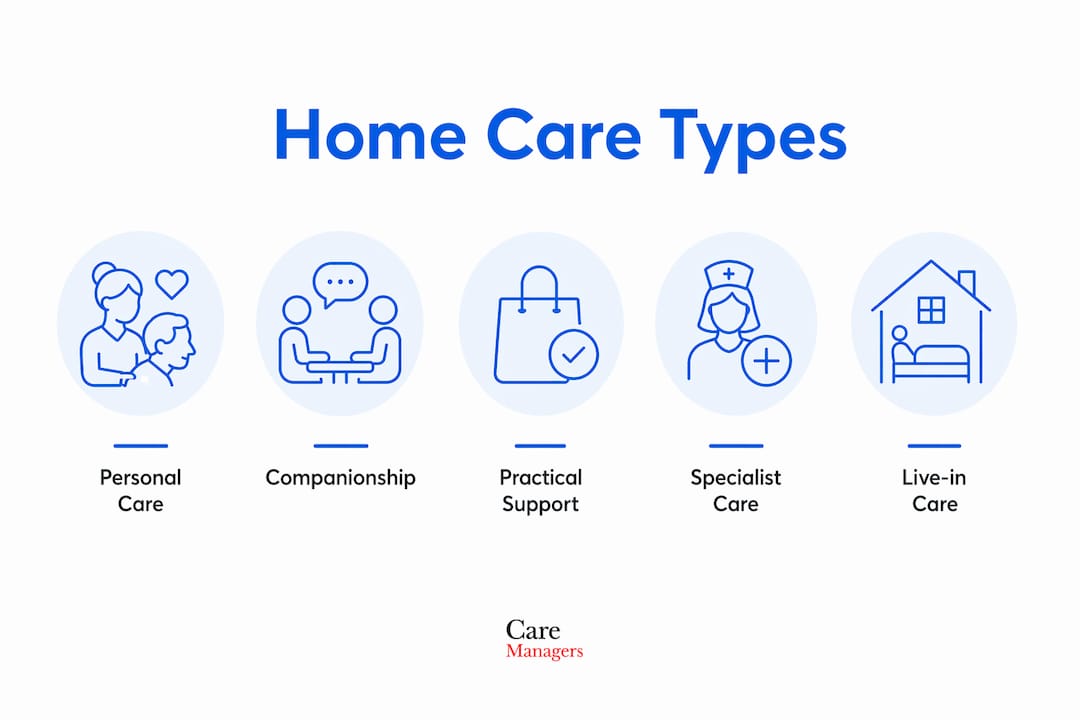
Specialist and complex care
This is the category most families underestimate. Home care includes complex clinical tasks such as PEG feeding, catheter care, medication management, and support for neurological conditions. Dementia care, palliative home care, and post-hospital discharge support all fall within this bracket. Specialist care requires trained staff and often qualifies for NHS funding rather than social care funding.
Live-in and overnight care
Live-in care means a carer resides in the home full time, providing support throughout the day and overnight when needed. This arrangement suits people with high dependency needs who want to remain at home rather than move to a care home. Overnight care, by contrast, involves a carer sleeping in the property and being available if needed during the night. Both options are available through CQC-regulated providers.
Pro Tip: Ask any provider whether their live-in carers are employed directly or sourced through an introductory agency. Directly employed carers are covered by the provider’s insurance and training standards, which gives families greater protection.
How do funding pathways affect home care access?
The three main funding routes for home care in the UK are Local Authority funding, NHS Continuing Healthcare (NHS CHC), and private self-funding. Each has different eligibility criteria and covers different types of need.
-
NHS Continuing Healthcare. NHS CHC provides full funding for people whose primary need is health-related. There is no means test. Families frequently overlook this route despite their relative being eligible, particularly after a hospital discharge or with a progressive neurological condition. Requesting a CHC assessment proactively is one of the most financially significant steps a family can take.
-
Local Authority funding. Local councils fund social care needs through a means-tested assessment. If a person’s assets fall below the threshold, the council contributes to or covers care costs. The assessment also produces a care plan that is useful even if you intend to fund privately.
-
Private self-funding. Families who fund care directly bear the full cost. Hourly home care averages £32 per hour across the UK, with the Homecare Association recommending a minimum sustainable rate of £34.42 for 2026/27. A five-hour weekly package costs over £8,300 annually at that rate. That figure makes early financial planning essential.
Regional costs vary considerably. London and South East rates often exceed £38 per hour, while Wales and Northern England can be £26 per hour or lower. Confirming provider availability in your specific postcode area is as important as comparing headline rates.
A full breakdown of all three routes is available in the home care funding guide published by Caremanagers, which covers eligibility criteria and application steps in plain language.
What should families consider when choosing home care?
Choosing the right type of elderly home care involves more than matching a service to a task list. The quality of the relationship between carer and client matters as much as the service itself.
- Start with a council assessment. A local authority social care assessment is recommended even when you plan to fund privately. It gives an objective picture of needs and is a useful reference when interviewing agencies.
- Match the care type to the risk level. Someone with mild mobility difficulties needs different support to someone with advanced dementia or a recent stroke. Mismatching care type to need is the most common and most avoidable mistake families make.
- Ask about staff continuity. 70% of CQC-regulated home care providers in England have not been recently rated. Staff turnover and continuity heavily influence care quality, particularly in dementia support at home, where familiar faces reduce anxiety and distress.
- Clarify what is included. Some providers charge separately for travel time, bank holidays, or specialist tasks. Get a written breakdown before committing.
- Check training standards. Ask specifically whether staff are trained in the condition your relative has, not just in general care.
Pro Tip: When interviewing a home care agency, ask: “What is your average carer-to-client ratio, and how do you handle cover when a regular carer is absent?” The answer tells you more about day-to-day quality than any brochure.
The domiciliary care assessment process is a practical starting point for families who are not sure where to begin.
How does home care differ from care homes and nursing homes?
The distinction between home care, care homes, and nursing homes is one that families frequently misunderstand, and the difference has significant financial and emotional implications.
Home care supports independent living at home through scheduled visits or a live-in carer. The person retains their own environment, routines, and possessions. Care homes provide round-the-clock support, accommodation, meals, and social activities on-site. Nursing homes add registered nursing care to that model, making them appropriate for people with complex clinical needs that cannot be safely managed at home.
| Care setting | Level of support | Accommodation included | Clinical nursing |
|---|---|---|---|
| Home care (visiting) | Scheduled visits, personal and social care | No | No |
| Live-in home care | 24-hour presence at home | No | No |
| Care home | Round-the-clock care and meals | Yes | No |
| Nursing home | Round-the-clock care and clinical nursing | Yes | Yes |
Home care is often preferable for people who wish to remain in familiar surroundings and whose needs can be safely met with visiting or live-in support. Care homes and nursing homes become appropriate when the level of need exceeds what home-based arrangements can safely provide. Families exploring alternatives to care homes often find that live-in care meets needs they assumed required residential placement.
Key takeaways
Home care is the most flexible and often the most cost-effective way to support an elderly relative, provided the care type, funding route, and provider are matched carefully to the individual’s needs.
| Point | Details |
|---|---|
| Home care covers a wide spectrum | Services range from companionship and personal care to complex clinical tasks like PEG feeding. |
| Funding route depends on need type | NHS CHC covers health-led needs in full; Local Authority funding is means-tested for social care needs. |
| Regional costs vary significantly | Hourly rates range from around £26 in Wales to over £38 in London; confirm local rates before budgeting. |
| Staff continuity affects quality | Ask providers directly about carer turnover, especially for dementia or complex care arrangements. |
| Start with a council assessment | A formal assessment clarifies needs objectively and supports better conversations with any provider. |
What I have learned from watching families navigate home care
The single biggest mistake I see families make is waiting too long to ask the right questions. They research care homes, compare costs, and then discover that live-in home care or a well-structured visiting package would have met their relative’s needs at a lower cost and with far less disruption.
The second mistake is assuming that NHS Continuing Healthcare is only for people in hospital. It is not. If the primary need is health-related, a CHC assessment can unlock full funding for home care, including specialist nursing support. Most families never request it. That is a significant and avoidable financial loss.
I would also push back on the idea that CQC ratings alone tell you enough about a provider. With the majority of providers not recently rated, the questions you ask during an initial call matter far more than a published score. Ask about staff turnover. Ask who covers your relative’s regular carer when they are off sick. Ask whether the same carer will visit consistently. Those answers reveal the operational reality behind any marketing.
Finally, do not underestimate the emotional weight of this decision. Choosing care for a parent or partner is not a procurement exercise. The right provider will treat your relative as an individual, not a schedule. That is worth more than a slightly lower hourly rate.
— Emm
How Caremanagers supports families at every stage
Finding the right home care service takes time, and the options can feel genuinely complex. Caremanagers works with families across South Wales and England to cut through that complexity with clear, personalised guidance.

From the first conversation, Caremanagers helps families identify the right type of support, whether that is visiting personal care, specialist dementia care, or a full live-in care arrangement. The team also guides families through funding routes, including NHS CHC eligibility, so no option is missed. Every care plan is built around the individual, not a standard package. If you are ready to take the next step, the home care services page sets out what Caremanagers offers and how to get started.
FAQ
What is the difference between domiciliary care and home care?
Domiciliary care is the formal industry term for care provided in a person’s own home, regulated by the Care Quality Commission (CQC). Home care is the everyday term for the same thing, covering everything from personal care visits to live-in support.
Who pays for home care in the UK?
Home care is funded through NHS Continuing Healthcare, Local Authority means-tested support, or private self-funding. NHS CHC covers the full cost for people whose primary need is health-related, with no means test applied.
How much does home care cost per hour in the UK?
Hourly home care averages £32 across the UK, with the Homecare Association recommending a minimum sustainable rate of £34.42 for 2026/27. Regional rates vary, with London often exceeding £38 per hour and parts of Wales falling below £26.
Can home care replace a care home?
Home care, including live-in arrangements, can meet the needs of many people who might otherwise move into a care home. When clinical nursing needs become too complex to manage safely at home, a nursing home becomes the more appropriate setting.
How do I start arranging home care for an elderly relative?
Request a social care assessment from your local council as the first step, even if you plan to fund care privately. The assessment defines needs objectively and provides a useful foundation for choosing the right type and level of support.