
TL;DR:
- A care plan is a personalized document that records an individual’s needs and specifies how those needs will be met. It is developed through a formal assessment and should be reviewed regularly to ensure its effectiveness. Active family involvement and prompt updates improve care quality and safety.
A care plan is defined as a formal, personalised document that records an individual’s assessed needs and sets out exactly how those needs will be met. It covers physical, emotional, and social support, and it guides every professional involved in delivering care. Families researching what does care plan mean will find it is far more than a form. The Care Quality Commission describes care planning as a process of engagement, with the written plan as its outcome. Understanding this distinction shapes how you use the document to protect your loved one.
What does a care plan mean in practice?
A care plan is a formal, reviewed document developed after professional assessment, detailing the type, provider, scope, and goal of care required to improve or maintain health. The definition of care plan in health and social care goes beyond a checklist. It is a structured record that translates an assessment into a clear, shared plan of action for everyone involved in a person’s care.

The care plan explained in its simplest form answers four questions: What are this person’s needs? What do we want to achieve? Who will do what? How will we know it is working? Every section of the document maps back to those four questions.
The core elements of a care plan
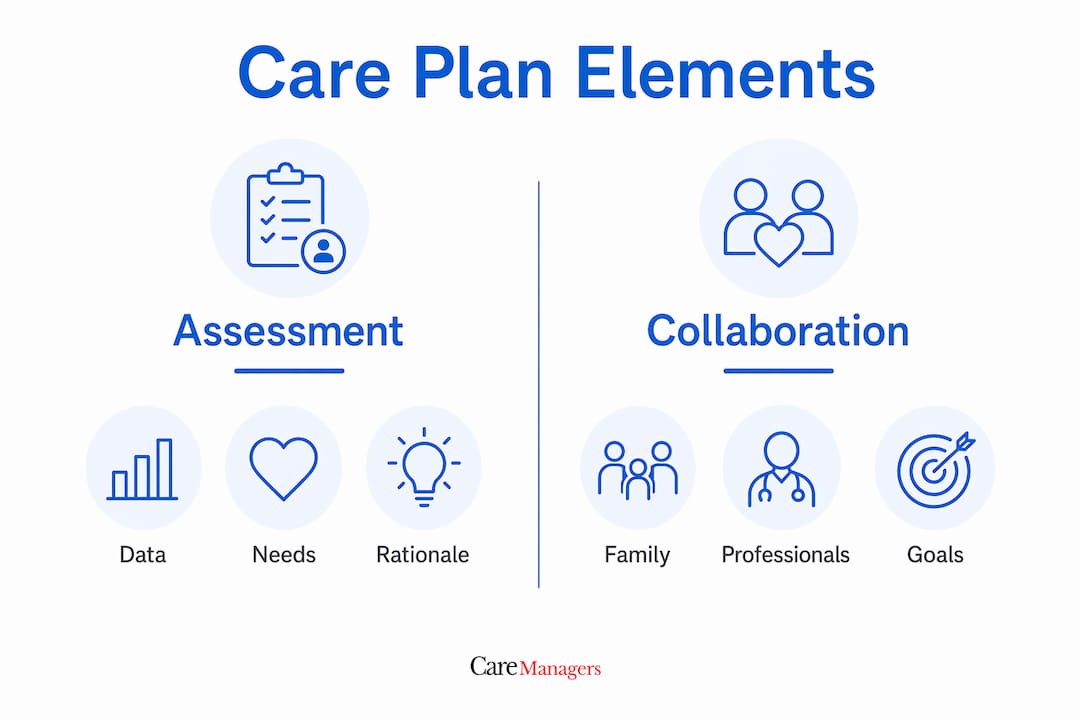
A well-constructed care plan includes the following components:
- Assessment data. Physical, emotional, and social needs identified through a formal assessment, including medical history, daily living abilities, and personal preferences.
- Personalised goals. Specific, measurable outcomes the individual wants to achieve, such as maintaining independence in the kitchen or managing pain effectively.
- Interventions. The actions care providers will take, including frequency, method, and the named professional or carer responsible.
- Rationale. The clinical or personal reasoning behind each intervention, ensuring evidence-based care rather than habit or assumption.
- Evaluation. Scheduled review points to measure progress and adjust the plan accordingly.
The table below shows how each element connects to a real outcome for the individual.
| Care plan element | Purpose in practice |
|---|---|
| Assessment data | Identifies what support is genuinely needed |
| Personalised goals | Keeps care focused on the individual’s priorities |
| Interventions | Tells every carer exactly what to do and when |
| Rationale | Justifies decisions and supports compliance |
| Evaluation | Confirms whether care is working or needs to change |
Pro Tip: Ask to see the rationale section of your loved one’s care plan. If it is missing or vague, the care may be based on routine rather than individual need. Families who ask this question consistently receive more tailored care.
Collaboration is central to good care planning. Individuals and families should be active co-creators of the plan, not passive recipients. When a person’s own preferences and goals shape the document, the care delivered reflects their real life rather than a generic template.
What does a carer support plan mean under the Carers Act 2014?
The Carers Act 2014 gives unpaid carers a legal right to their own assessment and support plan, separate from the person they care for. This is called an Adult Carer Support Plan or, for younger carers, a Young Carer Statement. Understanding what a carer support plan means is critical for families who provide regular, unpaid support to a relative.
The law requires that support plans are prepared within reasonable timescales after the carer’s situation and willingness to care have been assessed. That assessment looks at the carer’s own health, work, relationships, and personal goals, not just the needs of the person receiving care.
The Adult Carer Support Plan typically addresses:
- The carer’s own physical and emotional wellbeing.
- The impact of caring on their employment, education, and social life.
- Whether the carer is willing and able to continue in their role.
- Access to respite, breaks, and community resources.
- Any training or practical support that would help them care more safely.
“All unpaid carers have the right to an Adult Carer Support Plan to identify their needs and the support they require, separate from those they care for. The plan helps carers access respite and breaks, improving their wellbeing.”
National Care Service Charter of Rights, Scotland
Families often overlook this entitlement entirely. If you are providing regular care to a parent, partner, or sibling, you qualify for your own plan. Caremanagers can help you understand caregiver support resources and what to request from your local council.
Why care plans must be reviewed regularly
A care plan is not a static document. Failing to update care plans can lead to regulatory failures and direct risk to the individual. Health changes, preferences shift, and what worked six months ago may no longer be appropriate today.
The standard review cycle begins with an initial follow-up 6–8 weeks after the plan is set up. After that, reviews occur periodically, triggered either by a set schedule or by a significant change in the person’s condition or circumstances.
The consequences of an outdated care plan are serious:
- Care staff may follow instructions that no longer reflect the person’s abilities or wishes.
- Risk assessments become inaccurate, increasing the chance of falls, medication errors, or missed needs.
- Regulatory inspections by bodies such as the Care Quality Commission flag static plans as a compliance failure.
- The individual loses confidence that their voice is being heard.
The difference between adequate and exceptional care is how the plan directs daily care actions rather than existing as documentation only. A care plan that sits in a folder unread is not a care plan. It is paperwork.
Pro Tip: Request a copy of your loved one’s care plan and ask when it was last reviewed. If the answer is longer than three months ago and their health has changed, request a formal review immediately. You have every right to do so.
Understanding the care review process helps families know when to push for an update and what to expect when one takes place.
How do care plans improve quality of life?
Care plans improve outcomes by creating consistency across every professional involved in a person’s support. When a district nurse, a home carer, and a GP all work from the same document, care becomes coordinated rather than fragmented. That coordination reduces the risk of conflicting advice, missed medication, or duplicated effort.
Care plans have evolved from task lists to focus on individual unique needs and goals. That shift matters enormously for quality of life. A plan built around a person’s preferences, routines, and values delivers care that feels dignified rather than institutional.
The table below compares the outcomes of care delivered with and without a current, personalised care plan.
| Area of care | With a current care plan | Without a current care plan |
|---|---|---|
| Consistency | All carers follow the same approach | Approach varies by individual carer |
| Safety | Risks are identified and managed proactively | Risks may go unnoticed until an incident occurs |
| Person-centred focus | Preferences and goals are documented and respected | Care defaults to routine rather than individual need |
| Family involvement | Families know what to expect and can contribute | Families are often excluded from decisions |
| Regulatory compliance | Plans meet inspection standards | Outdated plans trigger compliance concerns |
For families managing complex conditions such as dementia, a detailed care plan is particularly valuable. It records communication preferences, behavioural triggers, and daily routines that carers might otherwise have to guess at. Caremanagers’ dementia home care support is built around exactly this kind of personalised planning.
Person-centred care is the principle that sits at the heart of every good care plan. It means the individual’s goals, preferences, and identity shape the care, not the other way around.
Key takeaways
A care plan is the foundation of safe, consistent, and person-centred care. Without it, even well-intentioned support becomes disorganised and risks missing what matters most to the individual.
| Point | Details |
|---|---|
| Definition of a care plan | A formal, personalised document recording assessed needs and how they will be met. |
| Core elements | Assessment, goals, interventions, rationale, and evaluation form the standard structure. |
| Carer support plans | The Carers Act 2014 gives unpaid carers a legal right to their own separate support plan. |
| Regular review is non-negotiable | Plans should be reviewed 6–8 weeks after setup and whenever health or circumstances change. |
| Active family involvement | Families who co-create and monitor care plans consistently achieve better outcomes for their loved ones. |
Care planning works best when families lead it
Care planning is more important than the paperwork. That is not a platitude. I have seen families hand over a signed care plan and assume the job is done. Months later, the plan bears no resemblance to how care is actually being delivered, and nobody flagged the gap because nobody was looking.
The families who get the best results treat the care plan as a working document. They read it. They ask questions at every review. They notice when a goal has been quietly dropped or when a new need has appeared but not been recorded. That level of attention is not intrusive. It is exactly what good care providers want from families, because it keeps everyone honest and focused on the person who matters.
The most common mistake I see is treating the care plan as a one-off exercise completed at the start of care. Circumstances change quickly, especially for older adults or those living with progressive conditions. A plan written in january may be dangerously out of date by april if nobody has checked in. Families should set a personal reminder to request a review every three months, regardless of whether the care provider has scheduled one.
Ask to be present at reviews. Ask what has changed since the last plan. Ask whether the goals still reflect what your loved one actually wants. These are not difficult questions, but they are the ones that separate good care from genuinely excellent care.
— Emm
How Caremanagers supports families with care planning

Caremanagers provides personalised home care services across South Wales and England, with care planning at the centre of every arrangement. The team works with individuals and families from the first assessment through to ongoing reviews, making sure the care plan reflects real needs and real preferences rather than a standard template. Whether you need support after a hospital discharge, specialist dementia care, or regular home visits, Caremanagers guides families through every stage of the process. Contact the team to discuss a personalised care plan for your loved one.
FAQ
What is a care plan in simple terms?
A care plan is a written document that records a person’s care needs and sets out exactly how those needs will be met, by whom, and when. It is developed after a professional assessment and reviewed regularly.
Who creates a care plan?
A care plan is created by a health or social care professional, such as a social worker, nurse, or care coordinator, in collaboration with the individual and their family. The person receiving care should always be involved in the process.
What does a carer support plan mean?
A carer support plan, formally called an Adult Carer Support Plan under the Carers Act 2014, is a separate document that records the needs of an unpaid carer rather than the person they care for. It can unlock access to respite, breaks, and additional support services.
How often should a care plan be reviewed?
Care plans are typically reviewed 6–8 weeks after they are first set up, then periodically thereafter. A review should also happen whenever the individual’s health, circumstances, or preferences change significantly.
Can families request changes to a care plan?
Families can and should request changes to a care plan if it no longer reflects the individual’s needs or wishes. Raising concerns directly with the care provider or requesting a formal review are both appropriate steps.