
TL;DR:
- Carer support services are legal rights providing practical, financial, and emotional assistance to unpaid carers. Conducting a Carer’s Assessment is essential for accessing funded help, but only 23% complete one annually. The 2026 benefits changes and NHS Continuing Healthcare improvements make support more accessible and comprehensive.
Carer support services are defined as government and community-provided resources that help unpaid carers manage the physical, emotional, and financial demands of caring for someone with health or social care needs. The Care Act 2014 gives every carer in England a legal right to a free assessment and places a duty on councils to meet eligible needs. In 2026, the government raised the Carer’s Allowance earnings limit by over £2,750, meaning carers can now earn approximately £10,000 annually and keep their benefits. Understanding carer support services explained in full means knowing not just what exists, but how to access it before exhaustion sets in.
What types of carer support services are available?
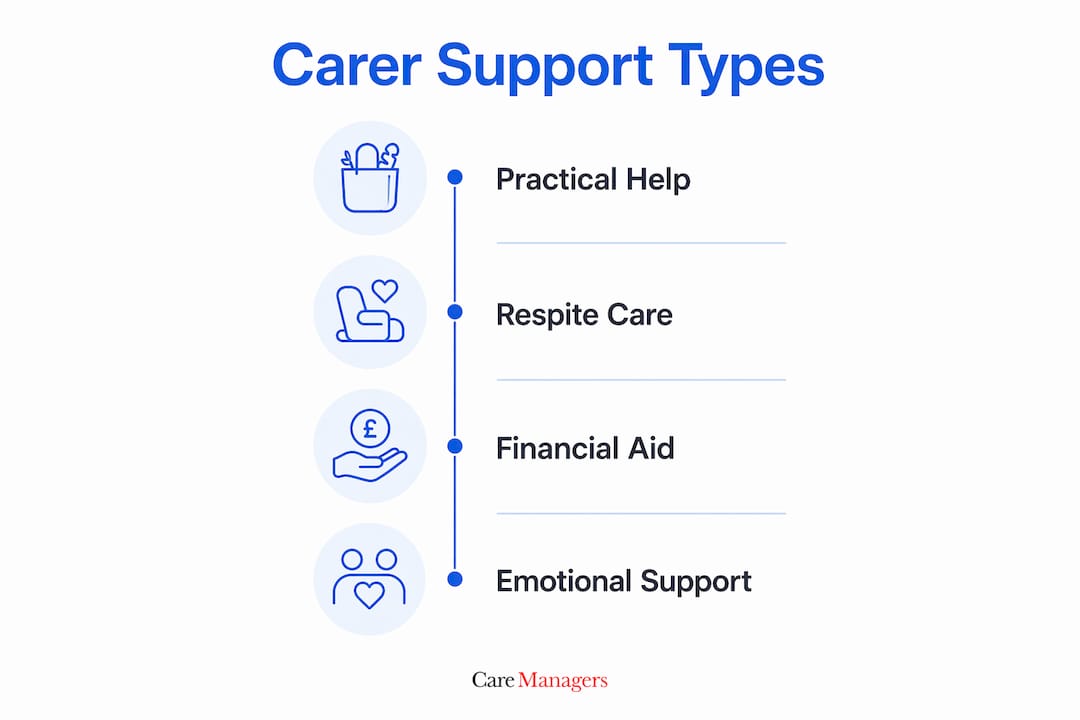
Carer support services fall into four broad categories: practical help, respite care, financial assistance, and emotional support. Each category addresses a different pressure point, and most carers need more than one type at any given time.
Practical support
Practical support covers the day-to-day tasks that become unmanageable when you are also providing care. This includes home care visits, equipment loans such as hoists or grab rails, and home adaptations funded through Disabled Facilities Grants. Local authorities can also arrange transport assistance and carer training, which councils may provide free of charge depending on your financial assessment.

Respite care
Respite care gives you a planned break from caring. It ranges from a few hours of sitting support at home to a full week of residential respite for the person you care for. Private home care costs £22–£35 per hour, and live-in respite runs between £1,000 and £1,800 weekly. Funding contributions from the council or NHS can reduce or eliminate that cost entirely, depending on eligibility.
Financial assistance
Financial support is one of the most misunderstood areas of carer assistance. The main routes are:
- Carer’s Allowance: a weekly benefit for carers providing 35 or more hours of care
- Universal Credit carer element: available to carers on low incomes who do not qualify for Carer’s Allowance
- Pension Credit carer addition: for carers over state pension age
- Local authority direct payments: personal budgets paid directly to carers to arrange their own support
1.1 million carers receive an extra £2,500 yearly through Universal Credit or Pension Credit. That figure shows how significant the financial safety net has become, even if many carers do not yet claim it.
Emotional and mental health support
Carer mental health is a genuine clinical concern, not a secondary issue. Local carer groups, counselling services funded through local authority assessments, and online peer networks all form part of the support picture. The NHS App’s ‘MyCarer’ section now allows carers to book appointments and access services digitally, reflecting the NHS 10-year Health Plan’s aim to integrate unpaid carers into the healthcare system more effectively.
Pro Tip: Contact your local Carers Centre before approaching the council. Many offer free counselling, emergency grants, and advocacy support that councils do not advertise.
How do Carer’s Assessments work and why do they matter?
A Carer’s Assessment is the single most important step in accessing funded support. It is a free legal right under the Care Act 2014, and it applies regardless of the financial situation of the person you care for. Only 23% of carers have completed one in the last 12 months. That low figure means the majority of carers are missing out on support they are legally entitled to receive.
The assessment is not a test. It is a structured conversation with your local council about how caring affects your life. Here is what the process typically involves:
- Request the assessment by contacting your local council’s adult social care team. You do not need a referral from a GP or hospital.
- Prepare your evidence before the meeting. Write down how many hours you care each day, which tasks you carry out, and how caring affects your sleep, work, relationships, and health.
- Attend the assessment either in person, by phone, or online. A social worker or carer support worker will ask about your wellbeing, your ability to continue caring, and whether you have any support needs of your own.
- Receive a support plan if the council finds you have eligible needs. This may include funded respite, counselling, equipment, or a direct payment to arrange your own support.
- Review the outcome and request a reassessment if your circumstances change or if you feel the outcome does not reflect your situation.
A completed Carer’s Assessment also strengthens your eligibility for NHS Continuing Healthcare funding. Without it, that evidence of caring burden does not exist on paper, and funding applications become much harder to support.
Pro Tip: Ask the assessor to record specific quotes from you about the impact of caring. Vague summaries carry less weight than your own words when councils review funding decisions.
What funding and financial support options exist for carers?
Funding for carer support services comes from three main sources: the local authority, the NHS, and the benefits system. Understanding which route applies to your situation saves significant time.
| Funding source | Who qualifies | What it covers | Means tested? |
|---|---|---|---|
| Local authority personal budget | Carers with eligible needs under Care Act 2014 | Respite, equipment, counselling, training | Yes, based on capital thresholds |
| NHS Continuing Healthcare (CHC) | Cared-for person with a primary health need | 100% of care costs, including respite | No |
| Fast-Track CHC | End-of-life cases | Full care package within 48 hours | No |
| Carer’s Allowance | Carers providing 35+ hours weekly | Weekly benefit payment | No |
| Universal Credit carer element | Low-income carers | Monthly top-up to income | Yes |
NHS Continuing Healthcare funds 100% of care costs with no means test when the cared-for person has a primary health need. That is a critical distinction. Many families assume CHC is only for people who are terminally ill, but eligibility depends on the daily impact of health needs, not on diagnosis alone.
Local authority means testing applies capital thresholds of £14,250 and £23,250. Below £14,250, the council pays in full. Between those thresholds, a sliding scale applies. Above £23,250, the family funds care privately until assets reduce.
The benefits system also changed materially in 2026. The raised Carer’s Allowance earnings limit means carers who work part-time no longer face the same cliff-edge loss of benefit. If you are unsure which benefits you qualify for, a caregiver support resources guide can help you map your options before speaking to a benefits adviser.
How to access respite and emergency carer support services effectively
Planned respite and emergency respite follow completely different pathways. Confusing the two is one of the most common mistakes families make.
For planned respite, the process works as follows:
- Book 6–8 weeks in advance. Most residential respite providers and home care agencies need this lead time to arrange staffing and assess the person you care for.
- Request a Carer’s Assessment first if you have not had one. The assessment unlocks council funding contributions that can reduce your out-of-pocket costs significantly.
- Check CHC eligibility for the person you care for. If they qualify, respite care costs may be covered in full by the NHS.
- Contact your local Carers Centre for a list of approved local providers. They often hold block-booked respite slots that are not publicly advertised.
Emergency respite works differently. Emergency-only respite pools exist in most councils and are accessible via duty lines or NHS 111, particularly when a carer is hospitalised or bereaved. Response time can be within hours. Do not wait for a standard referral in a crisis. Call the council duty line directly and state it is an emergency.
Hospital discharge teams also play a key role. When someone returns home after a hospital stay, the discharge team can fast-track a care package and flag carer support needs to the local authority simultaneously. If your family member is being discharged, ask the ward team explicitly about hospital discharge care planning and whether a carer’s needs assessment has been requested.
Pro Tip: Keep a written note of your council’s adult social care duty line number and NHS 111 on your phone. In an emergency, you will not have time to search for them.
Key takeaways
Carer support services are a legal entitlement, not a discretionary favour, and a Carer’s Assessment is the single most effective step to access funded respite, financial help, and emotional support.
| Point | Details |
|---|---|
| Legal right to assessment | Every carer in England can request a free Carer’s Assessment under the Care Act 2014, regardless of the cared-for person’s finances. |
| Low uptake is the core problem | Only 23% of carers complete an assessment, leaving most without access to funded support they are entitled to receive. |
| Emergency respite is faster than you think | Council duty lines and NHS 111 can arrange emergency respite within hours, not weeks. |
| NHS CHC removes the means test | If the cared-for person has a primary health need, NHS Continuing Healthcare covers 100% of care costs with no financial assessment. |
| 2026 benefits changes matter | The raised Carer’s Allowance earnings limit allows carers to earn approximately £10,000 annually without losing their benefit. |
What I have learned from watching families navigate carer support
The families I have seen struggle most are not the ones facing the hardest caring situations. They are the ones who waited too long to ask for help. There is a persistent belief that requesting a Carer’s Assessment is an admission of failure, or that it will trigger unwanted scrutiny. Neither is true. The assessment exists to document your reality, not to judge it.
The most effective carers I have encountered treat the assessment like a business meeting. They arrive with notes. They describe specific incidents, not general feelings. They say “I have not slept more than four hours a night for three months” rather than “I am quite tired.” That specificity changes outcomes.
Carer mental health is also routinely underestimated in these conversations. Carers often minimise their own distress because they are focused entirely on the person they care for. Councils and NHS teams are required to consider your wellbeing independently. You are allowed to say that caring is affecting your mental health, your relationships, and your ability to work. That information belongs in your assessment.
The 2026 NHS App changes and the ‘MyCarer’ feature are genuinely useful, but they are tools, not solutions. The system still requires you to advocate for yourself. Request the assessment. Document the impact. Follow up in writing. The support is there. The barrier is almost always access, not availability.
— Emm
How Caremanagers supports families through every stage of care
Arranging carer support can feel like a second full-time job on top of the caring itself. Caremanagers specialises in home care services across South Wales and England, providing practical relief for families managing elder care, dementia support, and recovery after hospital discharge.

Whether you need a few hours of respite each week or a full live-in care arrangement to give you a sustained break, Caremanagers builds a plan around your family’s specific needs. Every care package is personalised, and the team works directly with families to co-ordinate support that fits around existing routines. If you are ready to talk through your options, the Caremanagers team is available to guide you through the next step.
FAQ
What is a Carer’s Assessment and who can get one?
A Carer’s Assessment is a free legal right under the Care Act 2014, available to any adult who provides unpaid care. It evaluates how caring affects your wellbeing, work, and relationships, and it determines what funded support the council must offer you.
How much does respite care cost in the UK?
Private home care costs £22–£35 per hour, and live-in respite costs between £1,000 and £1,800 per week. Council funding or NHS Continuing Healthcare can reduce or eliminate these costs depending on eligibility.
How do I access emergency respite care quickly?
Contact your local council’s adult social care duty line or call NHS 111 directly. Emergency respite pools exist in most councils and can respond within hours when a carer is hospitalised or in crisis.
What is the Carer’s Allowance earnings limit in 2026?
The government raised the earnings limit by over £2,750 in 2026, allowing carers to earn approximately £10,000 annually while keeping their Carer’s Allowance. This change removes the previous cliff-edge loss of benefit for carers who work part-time.
Does NHS Continuing Healthcare cover respite care?
Yes. NHS Continuing Healthcare funds 100% of care costs, including respite, with no means test, when the cared-for person has a primary health need. Eligibility is based on daily health impact, not diagnosis alone.