
TL;DR:
- Effective elderly care coordination involves assigning clear roles and using shared communication tools to ensure equitable support. Families should involve professionals early and review responsibilities quarterly to prevent burnout and resolve conflicts. Professional home care services support families by filling gaps and maintaining consistent, dignified care.
Coordinating family elderly care responsibilities means organising tasks, communication, and support among relatives to provide consistent, equitable care for an elderly loved one. The professional term for this is elderly care coordination, and it covers everything from managing medical appointments to dividing household support and financial administration. Families who do this well share three things: clear role definitions, shared tools for communication, and regular structured reviews. Without these, one person typically absorbs the majority of the burden. Research shows that female relatives often provide over 50 hours of care weekly, frequently without adequate family support. That pattern is preventable with the right approach.
What are the essential roles in family elderly care coordination?
Elderly care coordination works best when families divide responsibilities into clear domains rather than assigning vague, overlapping duties. The five core domains are: medical coordination, financial and administrative management, in-person practical support, emotional and social support, and forward planning. Each domain requires different skills and time commitments, which is why role assignment by individual strength matters more than equal time splitting.
Consider these example roles:
- Medical coordinator: Attends appointments, liaises with GPs and specialists, manages prescriptions, and keeps records updated.
- Local lead: Provides in-person support for daily tasks such as meals, transport, and household errands.
- Financial lead: Manages bills, benefit claims, and care-related paperwork.
- Emotional anchor: Maintains regular phone or video contact, monitors wellbeing, and flags concerns to the wider family.
- Planning lead: Researches future care options, coordinates assessments, and keeps the care plan current.
One detail families consistently overlook is invisible administrative work, such as managing repeat prescriptions, fielding medical calls, and handling household logistics. These tasks consume significant time but rarely appear on a shared rota. Including them in your role map from the start prevents resentment later.
Pro Tip: Create a simple spreadsheet listing every care task, then assign each one to a named person before your first family meeting. Blank cells are a prompt for honest conversation, not accusation.
| Domain | Example tasks | Suggested role |
|---|---|---|
| Medical | GP liaison, prescriptions, hospital visits | Medical coordinator |
| Financial | Bills, benefits, care funding applications | Financial lead |
| Practical | Meals, transport, household tasks | Local lead |
| Emotional | Regular calls, social visits, wellbeing checks | Emotional anchor |
| Planning | Care assessments, future options research | Planning lead |
How can families set up shared communication tools for care?
The right communication tools reduce misunderstandings and keep every family member informed without requiring constant phone calls. The Jointly app by Carers UK is purpose-built for this. For a one-off payment of £2.99, it lets families assign tasks, share calendars, store care information securely, and send updates to a defined circle of carers. Some employers and local authorities provide it free of charge, so check before purchasing.

Beyond apps, scheduled family meetings are more productive than casual chats. Planned, structured meetings using video calls or neutral locations reduce defensive reactions and improve shared expectations. Aim for a fortnightly call with a short written agenda circulated in advance.
One rule that protects both family relationships and your elderly relative’s dignity: never use your relative as a messenger for family communication. Keep all coordination direct between family members. Placing your relative in the middle of caregiving disputes causes distress and erodes trust.
Pro Tip: Use a shared folder in Google Drive or a similar service to store copies of care plans, medical letters, and legal documents. Name files clearly with dates so every family member can find what they need quickly.
Secure document sharing is particularly useful after a hospital discharge, when care plans and medication lists change rapidly. A hospital discharge care plan should be stored centrally and updated whenever a clinician makes changes.
What steps help assign caregiving responsibilities fairly?
Fairness in caregiving is not about equal hours. Caregiving equity depends on each family member contributing according to their own ‘currency’: time, money, proximity, or specialist skills. A sibling who lives two hours away cannot provide daily practical support, but they can take on financial administration or fund professional care hours.
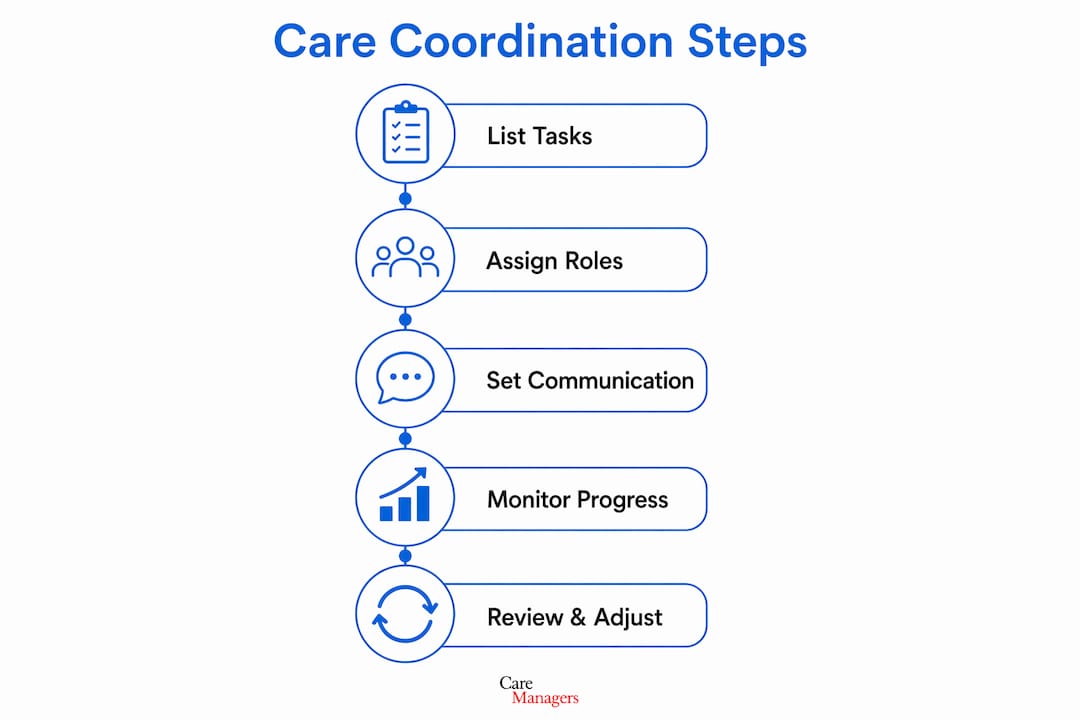
Follow these steps to reach a sustainable plan:
- Map every task. List all care tasks across the five domains before any discussion of who does what. This prevents the conversation from being dominated by whoever speaks first.
- Assess real constraints. Ask each family member honestly about their available time, location, work commitments, and financial capacity. Assumptions cause conflict.
- Assign by role, not by task. Giving someone ownership of a domain (e.g., all medical coordination) is more reliable than assigning individual tasks ad hoc.
- Build the rota around active contributors. Design care schedules around family members who are genuinely engaged. Non-participating relatives can be reintegrated later if they re-engage, but building a plan around unreliable commitments creates gaps in care.
- Set a trial period. Agree to run the plan for four to six weeks, then review. This removes the pressure of permanent commitment and makes it easier for people to flag problems early.
- Schedule regular reviews. Care needs change. A quarterly review meeting keeps roles relevant and prevents one person from quietly absorbing extra work.
The most common mistake families make is skipping step one. Without a full task map, the conversation defaults to who is already doing the most, which entrenches existing imbalances rather than correcting them.
Pro Tip: At your first role-assignment meeting, ask each person to write down what they think they currently contribute before anyone speaks. Comparing lists often reveals significant gaps in perception that are easier to address calmly in writing than in conversation.
How do you manage conflict and prevent carer burnout?
Family conflict in caregiving usually stems from two sources: perceived unfairness and communication breakdowns. Both are manageable with the right habits. Using ‘I’ statements in family discussions, such as “I feel stretched when I cover appointments alone,” reduces defensive responses compared with “You never help.” Holding difficult conversations in neutral settings, rather than at your relative’s home, also reduces emotional intensity.
The ‘expert trap’ is a specific risk worth naming. This is where one sibling takes on so much responsibility that others feel excluded or redundant, and the primary carer becomes indispensable to the point of exhaustion. The solution is deliberate delegation, even when it feels quicker to do things yourself.
Carer burnout is not a sign of weakness. It is the predictable result of sustained, unsupported effort. Recognising the early signs, including persistent fatigue, irritability, and withdrawal from social contact, and acting on them early protects both the carer and the quality of care your relative receives.
Practical steps to prevent burnout and maintain family harmony:
- Schedule regular respite breaks for the primary carer, planned in advance rather than requested in crisis.
- Rotate the most demanding tasks, such as overnight stays or hospital accompaniment, rather than leaving them to one person indefinitely.
- Use caregiver support resources from organisations such as Carers UK and Age UK, including helplines, local carer groups, and online forums.
- Bring in professional care support before the family reaches breaking point, not after.
- Acknowledge contributions explicitly. A simple “thank you for handling that” in a family message thread costs nothing and matters more than most people expect.
What formal care planning and legal steps should families coordinate?
Formal care planning gives your coordination structure and legal grounding. Under Age UK 2026 guidance, families are entitled to request a written care plan from the local authority following a hospital discharge. Designated family caregivers can receive copies of this plan, which should detail assessed needs, agreed support, and review dates.
Families should also address the following legal and financial arrangements together:
| Area | What to arrange | Who to involve |
|---|---|---|
| Lasting Power of Attorney | Health and welfare, and property and financial affairs | Solicitor, Office of the Public Guardian |
| Benefits entitlement | Attendance Allowance, Carer’s Allowance | Local authority, Citizens Advice |
| Care needs assessment | Formal assessment of your relative’s needs | Local authority social services |
| Caregiving agreements | Written record if compensating a primary carer | Family, solicitor if needed |
The domiciliary care assessment process is the formal route through which local authorities determine what funded support your relative qualifies for. Requesting this assessment early, rather than waiting for a crisis, gives families more time to plan and more options to consider.
Key takeaways
Effective elderly care coordination requires clear role assignment, shared communication tools, and formal care planning working together from the outset.
| Point | Details |
|---|---|
| Assign roles by domain | Give each family member ownership of a care domain, not just individual tasks. |
| Include invisible tasks | Add administrative and logistical tasks to your rota, not just in-person visits. |
| Use structured tools | The Jointly app and shared document folders keep all family members informed. |
| Build around active carers | Design rotas around those who are genuinely engaged; integrate others later. |
| Formalise care planning | Request a written care plan and address legal arrangements such as Power of Attorney early. |
What I have learned from watching families coordinate care
The families who manage elderly care coordination well are rarely the ones with the most resources. They are the ones who have the most honest conversations early. What I have observed, time and again, is that families delay the difficult discussion about roles until a crisis forces it. By that point, one person is already exhausted, resentments have built up, and the options available are narrower.
The insight that changed how I think about this is the idea of different ‘currencies.’ A sibling who cannot visit weekly is not necessarily contributing less. If they are managing all the financial administration and funding professional care hours, their contribution may be equal or greater. Families that accept this tend to have far less conflict than those who measure fairness purely by physical presence.
Professional care support, when introduced thoughtfully, almost always improves family dynamics rather than replacing family involvement. It removes the most draining tasks from the primary carer’s plate and gives the wider family a reliable point of contact for updates. The families I have seen struggle most are those who resist outside help for too long, treating it as an admission of failure rather than a practical choice.
My honest advice: review roles every three months, not just when something goes wrong. Care needs change gradually, and so do family circumstances. A plan that worked six months ago may now be placing unfair pressure on one person without anyone realising it.
— Emm
How professional home care supports family coordination
When family caregiving reaches its limits, professional home care fills the gaps without replacing the family’s role.
Caremanagers provides home care services across South Wales and England, including hospital discharge care, dementia care, and respite care. Each service is tailored to the individual, and families receive regular updates so every member stays informed regardless of location. For families weighing up their options, the guide to choosing home care services covers what to look for, what questions to ask, and how to arrange support without unnecessary stress. Caremanagers’ team works alongside families, not instead of them, so your relative receives consistent, dignified care at home.
FAQ
What does coordinating family elderly care responsibilities involve?
Elderly care coordination means dividing medical, practical, financial, and emotional support tasks among family members using clear roles and shared communication tools. The goal is consistent, equitable care for your relative without any one person bearing the full burden.
How do you divide caregiving tasks fairly between siblings?
Fairness is based on each person’s available time, location, skills, and finances, not equal hours. Assign role-based domains rather than individual tasks, and build the rota around family members who are actively engaged.
What communication tools help families manage elderly care?
The Jointly app by Carers UK allows families to assign tasks, share calendars, and store care information securely for a one-off fee of £2.99. Shared document folders and scheduled video calls also significantly improve coordination and reduce misunderstandings.
When should families request a formal care needs assessment?
Request a local authority care needs assessment as early as possible, ideally before a crisis occurs. Following a hospital discharge, families are entitled to a written care plan under Age UK guidance, which should be shared with all designated caregivers.
How can professional care services reduce family conflict?
Professional carers take on the most demanding tasks, reducing pressure on the primary family carer and giving all family members a reliable source of updates. This often reduces conflict by removing the conditions that cause resentment to build.