
TL;DR:
- Community care support involves coordinating health and social services to help individuals live independently at home. Anyone over 18 can request a free assessment, which guides personalized care planning and access to various services. Families can participate, request advocates, and challenge assessment decisions to ensure proper support.
Community care support is the coordinated provision of health and social services that helps individuals live independently within their own homes and local communities. Defined under the Care Act 2014, it covers everything from nursing visits and home help to mental health services and social work. The goal is not simply to manage illness. It is to preserve dignity, promote wellbeing, and reduce the need for hospital or residential care. If you are trying to understand what options exist for an elderly or disabled relative, this guide explains how the system works, what services are available, and how to access them.
What is community care support and how is it assessed?
Community care support is defined as the integrated set of health and social care services delivered to individuals in their homes or local community settings. The Care Act 2014 mandates that local authorities conduct assessments focused on helping people live independently with dignity and improved wellbeing. That legal duty is the foundation of everything families encounter when they first approach adult social services.

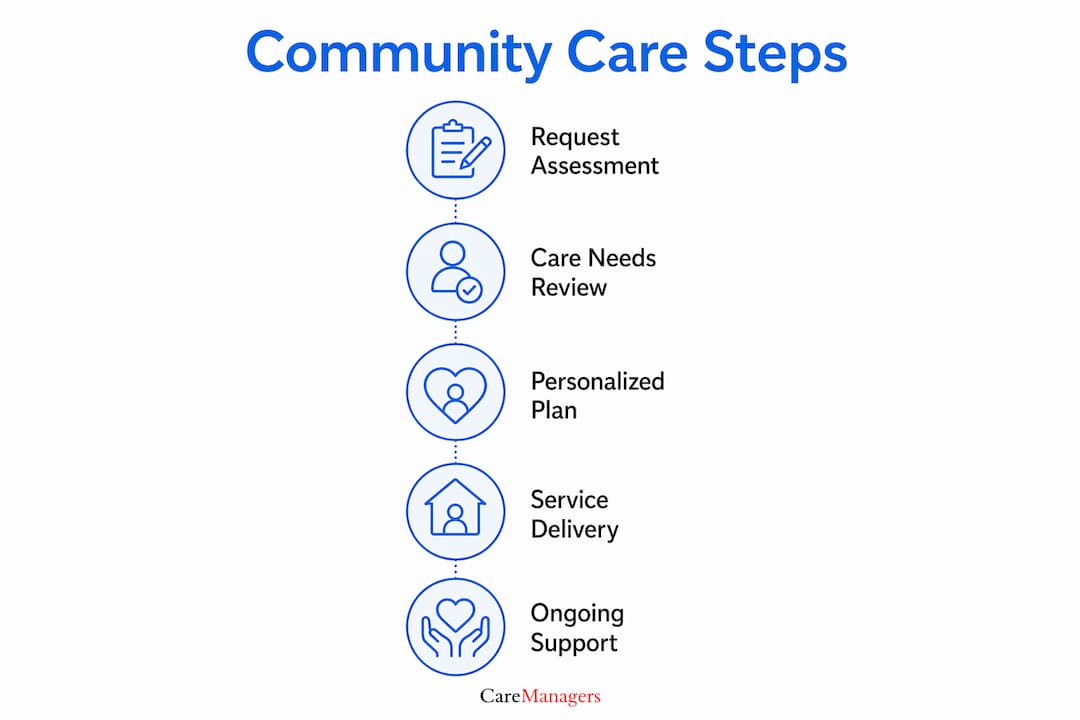
The process begins with a care needs assessment. Anyone over 18 who appears to need care and support can request one from their local authority adult social services, regardless of income or savings. The assessment is free. That point surprises many families who assume financial means testing happens first. It does not. Eligibility for the assessment itself is universal.
During the assessment, a social worker or care professional evaluates physical, emotional, and social needs. The outcome informs a personalised care and support plan, which sets out what services will be provided and how. The plan is not fixed. It can be reviewed as needs change, and families can request a reassessment at any time.
Key elements covered in a care needs assessment include:
- Physical needs: mobility, personal care, medication management
- Emotional and mental health needs: anxiety, depression, cognitive changes
- Social needs: isolation, community participation, relationships
- Carer capacity: whether family members can sustain their caring role
- Housing and environment: safety at home, need for adaptations
Families can request an independent advocate to support them through the assessment process. An advocate ensures the cared-for person’s voice is properly heard, particularly when communication is difficult due to dementia or other conditions. This is a right, not a privilege, and using one reduces stress considerably.
Pro Tip: Request the assessment in writing and keep a copy. This creates a clear record and triggers the local authority’s formal duty to respond within a reasonable timeframe.
What types of community care services are available?
Community care services cover a wide range, from nursing and therapies to mental health support, intermediate care, and social work. Understanding this breadth matters because families often assume community care means only a weekly visit from a carer. The reality is far more comprehensive.
Domiciliary and home help services
Domiciliary care, also called home care, provides personal care support in the individual’s own home. This includes help with washing, dressing, meal preparation, and medication prompts. It is the most commonly accessed form of community care for older adults and people with disabilities. Caremanagers delivers this type of support across South Wales and England, tailoring visits to each person’s routine and preferences.
Community nursing and therapy services
Community nurses visit people at home to manage wound care, administer medication, and monitor long-term conditions. Physiotherapists and occupational therapists also work in community settings, supporting recovery and helping people adapt their homes for safer living.
Intermediate care and reablement
Intermediate care is a short-term programme, typically lasting up to six weeks, designed to help people regain independence after a hospital stay or health crisis. Reablement focuses on rebuilding skills rather than doing tasks for someone. Both approaches reduce the risk of long-term dependency.
Mental health and social work services
Community mental health teams support people with conditions such as depression, anxiety, and psychosis. Social workers coordinate safeguarding, housing support, and access to community resources. These services operate alongside health provision rather than separately.
The table below summarises the main service categories and their primary purpose:
| Service type | Primary purpose |
|---|---|
| Domiciliary care | Personal care and daily living support at home |
| Community nursing | Clinical care and health monitoring in the home |
| Intermediate care | Short-term recovery and independence rebuilding |
| Mental health support | Emotional and psychological wellbeing in the community |
| Social work and safeguarding | Coordination, protection, and access to resources |
| Equipment and home adaptations | Safer living through aids and environmental changes |
Personal budgets and direct payments allow individuals and families to arrange care more flexibly than standard council-commissioned services permit. This means you can choose your own provider, set your own schedule, and fund care that fits your relative’s life rather than a generic rota. Understanding this option is one of the most practical things a family can do early in the process.
What are the benefits of community care support?
The primary benefit of community care support is that it allows people to remain in their own homes, surrounded by familiar people and places. This matters deeply for wellbeing. People who receive support at home consistently report greater satisfaction with their care than those in residential settings. The reasons are straightforward: autonomy, routine, and connection to community are preserved.
Community care support does more than manage physical needs. It protects identity. When a person remains in their own home, they keep their relationships, their habits, and their sense of self. That continuity is not a luxury. It is a clinical and human necessity.
The Better Care Fund framework emphasises proactive, integrated care delivered close to home, with a clear aim of preventing hospital admissions and supporting recovery. Fewer hospital admissions mean less disruption for the individual and less pressure on NHS services. The policy direction is deliberate: keeping people well at home costs less and produces better outcomes than reactive institutional care.
For families, the benefits extend beyond the person receiving care:
- Reduced carer burnout: Regular professional support gives family carers time to rest and recover.
- Clearer information: Assessments and care plans give families a shared understanding of needs and responsibilities.
- Confidence in safety: Knowing a professional visits regularly reduces anxiety for relatives who live at a distance.
- Support for complex conditions: Specialist community services manage conditions such as dementia, Parkinson’s disease, and stroke recovery without requiring a care home placement.
Learning why home care matters for families can help you frame these conversations with your relative and with professionals involved in their care.
How do you access community care support?
Accessing community care support starts with a single phone call or written request to your local authority’s adult social services department. You do not need a GP referral. You do not need to prove financial need at this stage. The request triggers the assessment process described above.
Follow these steps to navigate the process effectively:
- Contact adult social services. Find your local authority’s adult social services team through the GOV.UK website. Ask specifically for a care needs assessment for your relative.
- Prepare for the assessment. Write down your relative’s daily difficulties, medical conditions, and what support they currently receive. Include observations about emotional wellbeing and social contact.
- Bring a family member or advocate. You have the right to attend the assessment with your relative. An independent advocate can also attend if your relative finds the process difficult to manage alone.
- Understand the financial assessment. If the local authority agrees to fund care, a separate means test will follow. This assesses savings, income, and property to determine how much the council contributes. Self-funding is also an option if your relative does not meet the financial threshold.
- Request a review if needed. Initial assessment decisions are not final. If you disagree with the outcome, you have the right to request a formal review or raise a complaint.
- Contact Age UK for guidance. Age UK’s advice line operates daily and provides expert guidance on navigating care options and identifying home-based support services. It is a practical first step if you are unsure where to begin.
Pro Tip: Ask the assessor to explain the eligibility criteria they are applying. Local authorities use the Care Act 2014 eligibility framework, and understanding it helps you advocate clearly if needs are underestimated.
Once a care plan is agreed, you can explore what a personalised care plan means for your family’s day-to-day life. Choosing a provider, setting visit times, and agreeing on specific tasks are all decisions the family can shape.
Key takeaways
Community care support is the most effective way to maintain independence, dignity, and quality of life for elderly or disabled individuals outside of a residential setting.
| Point | Details |
|---|---|
| Assessment is universal | Anyone over 18 can request a free care needs assessment, regardless of income. |
| Services are broad | Community care covers nursing, therapy, mental health, home help, and social work. |
| Families have rights | You can attend assessments, use an advocate, and challenge decisions through formal review. |
| Personal budgets offer flexibility | Direct payments let families choose providers and schedules that suit their relative. |
| Early access prevents crisis | Requesting support before needs become severe reduces hospital admissions and carer burnout. |
Community care is not what most families expect
Most families I speak with arrive at the community care system with the same assumption: that it is a medical service, managed by the NHS, and accessed through a GP. All three parts of that assumption are wrong, and the misunderstanding costs people time they do not have.
Community care connects GPs, pharmacies, hospitals, and social care into a coordinated response to complex needs. It is not owned by any single organisation. That is its strength and, admittedly, its most confusing feature. The person who coordinates your relative’s care may be a social worker, a community nurse, or a care manager, depending on the presenting need.
The second misconception I encounter regularly is that community care is a last resort. Families wait until a crisis, a fall, a hospital admission, or complete carer exhaustion before making contact. The Better Care Fund’s neighbourhood health model exists precisely because early intervention produces better outcomes at lower cost. Waiting makes everything harder.
My honest advice is this: request the assessment before you think you need it. The process takes time, and having a care plan in place before a crisis means you are choosing care rather than accepting whatever is available in an emergency. That distinction matters enormously for the quality of support your relative receives.
— Emm
How Caremanagers supports families with home care
Caremanagers works with families across South Wales and England to provide personalised home care and live-in support that fits each person’s life, not a generic schedule.
Whether your relative needs help recovering after a hospital stay, managing a long-term condition, or simply maintaining their independence at home, Caremanagers offers professional home care services designed around individual needs and preferences. The team also supports families in understanding their options, from assessment preparation to choosing the right level of care. If you are ready to take the next step, explore choosing home care for elderly relatives to find the right fit for your family’s situation.
FAQ
What is community care support?
Community care support is the coordinated provision of health and social services that helps individuals live independently in their own homes and communities. It is defined and governed by the Care Act 2014 in England.
Who is eligible for a care needs assessment?
Anyone over 18 who appears to need care and support can request a free care needs assessment from their local authority adult social services, regardless of income or savings.
What services does community care include?
Community care services include domiciliary care, community nursing, physiotherapy, mental health support, intermediate care, social work, and home adaptations, all delivered in or close to the individual’s home.
Can families be involved in the assessment process?
Yes. Family members can attend the care needs assessment, and an independent advocate can also be requested to support the cared-for person throughout the process.
What happens if you disagree with an assessment outcome?
If you disagree with the outcome of a care needs assessment, you have the right to request a formal review or raise a complaint. Initial decisions are not final.