
TL;DR:
- Families must actively monitor home care quality using frameworks like the CQC’s five key questions to ensure safety and dignity. They should track weekly indicators, provide feedback, and verify that issues are resolved through a closed-loop process. Personal oversight and communication fill the gaps between official inspections to protect loved ones continually.
Monitoring home care quality standards means using established regulatory frameworks, systematic evidence gathering, and ongoing quality governance to keep elderly family members safe, well-cared-for, and treated with dignity. For families arranging home care services in the UK, this is not a one-off task. It is a continuous process that sits alongside the work of professional regulators. The Care Quality Commission (CQC) sets the legal baseline, but families who understand how to assess care quality day-to-day are far better placed to spot problems early and act on them. This guide explains the frameworks, tools, and practical steps that give you real oversight.
What quality standards and frameworks guide home care in the UK?
Home care quality standards in the UK are defined primarily by the CQC’s fundamental standards, which every registered provider must meet by law. These cover areas including person-centred care, dignity and respect, consent, safe care, safeguarding, and good governance. No provider can legally operate below these standards.
The CQC Single Assessment Framework (SAF), introduced at the end of 2023, is the unified evidence-led model now used to assess all regulated care services. It replaced the previous inspection-heavy approach with a continuous evidence model built around five key questions.
| CQC key question | What it asks |
|---|---|
| Safe | Are people protected from harm and abuse? |
| Effective | Does care achieve good outcomes? |
| Caring | Are staff kind, respectful, and compassionate? |
| Responsive | Is care tailored to individual needs? |
| Well-led | Is the service well-managed and improving? |
Each key question is supported by quality statements, which describe what good care looks like in practice. Providers must hold retrievable evidence across these categories at all times, not just during inspections. That shift matters enormously for families. It means a well-run provider should be able to show you evidence of quality on any given week, not just when the CQC visits.
Other countries offer useful comparisons. Australia’s Quality Indicator (QI) Programme mandates quarterly data collection on health and wellbeing metrics to monitor and reduce adverse events in aged care. In the United States, the CMS 2028 HCBS Quality Measure Set promotes standardised quality measurement across states to drive continuous improvement and enable comparative reporting. Both approaches reinforce the same principle: consistent measurement is the foundation of better care.
Which tools can families use to assess home care quality?
The most practical tool for families is a weekly evidence-lite dashboard aligned with the SAF’s five key questions. Rather than waiting for an annual CQC report, you track a small set of indicators yourself. This approach mirrors regulatory evaluation and gives you a running picture of care quality between formal inspections.
Here is a simple framework to follow each week:
- Medication assistance: Were all medications given correctly and on time? Note any missed doses or errors.
- Care plan adherence: Did care workers follow the agreed care plan, or were tasks skipped or changed without explanation?
- Visit punctuality: Were visits on time? Persistent lateness signals staffing or management problems.
- Staff consistency: Is your loved one seeing familiar faces, or is there constant turnover? High turnover correlates with poorer outcomes.
- Complaint handling: Were any concerns raised this week? Were they acknowledged promptly and resolved?
- Supervision records: Has the provider carried out staff supervision recently? Ask to see the schedule.
Effective quality monitoring balances structure, process, and outcomes. Structure covers whether the right staff and systems are in place. Process covers whether care is delivered as planned. Outcomes cover whether your loved one’s health and wellbeing are actually improving or stable.
Pro Tip: Keep a simple notebook or shared digital document where you log observations after each care visit. Date every entry. This creates a personal evidence record that is invaluable if you ever need to raise a formal concern with the provider or the CQC.

Providers are legally required to maintain continuous quality governance, including documented audits and complaint handling records. You have every right to ask to see summaries of these. A provider that resists sharing this information is a provider worth questioning.
How can families set up effective feedback loops with providers?
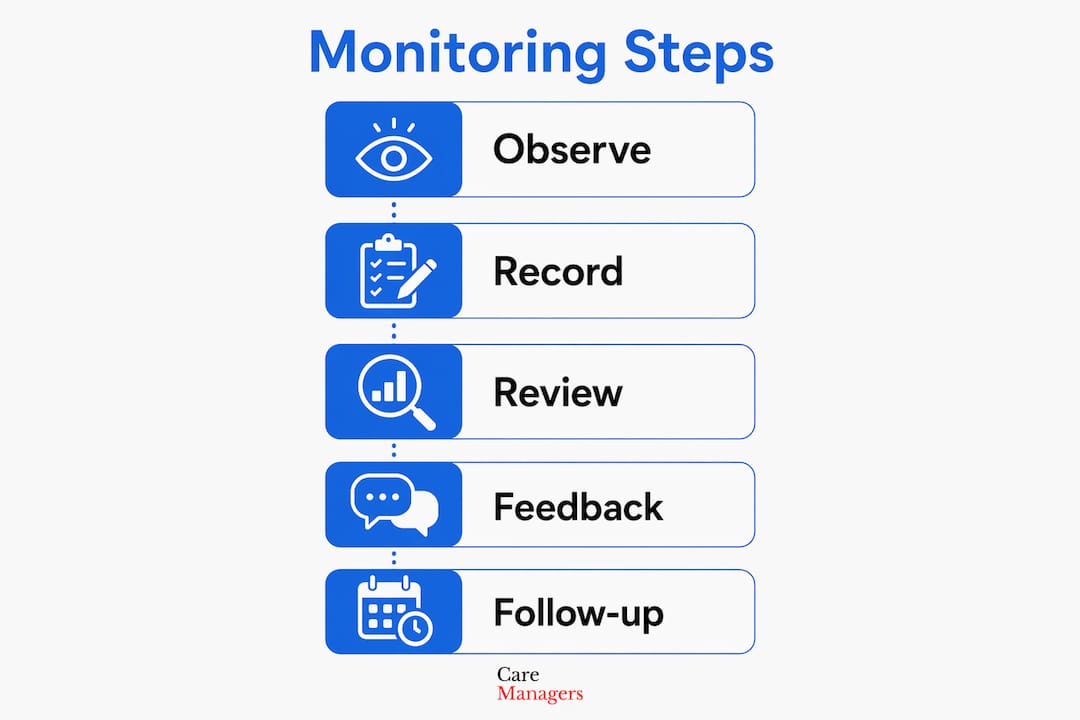
A closed-loop feedback process is the single most effective way to sustain care quality over time. Closed-loop means a concern is not just logged. It is reviewed, acted upon, and then verified to check whether the action actually worked. Caregivers achieve better outcomes when they demand this full cycle, with clear timelines at each stage.
Setting up this process with your provider does not require formal procedures. Start with these steps:
- Request a named contact. Every family should have one person at the provider they can call with concerns. Anonymous complaint lines are not enough.
- Agree a response timeline. Ask the provider how quickly they will acknowledge a concern and how long a full resolution takes. Write it down.
- Ask for written confirmation. When a concern is resolved, ask for a brief written summary of what changed and why.
- Follow up after four weeks. Check whether the change has held. If the same problem recurs, escalate.
“People’s feedback helps identify unseen safety risks and can influence inspection timing, making service user experience critical for quality monitoring.” — CQC
The CQC values people’s feedback as a pivotal evidence source to detect risks between inspections. Your observations as a family member carry genuine regulatory weight. Submitting feedback directly to the CQC via its website is straightforward and can influence when and how a service is inspected.
Pro Tip: Ask your provider directly: “Can you show me how you have responded to feedback in the last three months?” A good provider will have examples ready. A provider that cannot answer this question has a governance gap worth noting.
When quality measure sets require governance action on worsening indicators, not just reporting, the same logic applies to families. Spotting a decline is only half the work. Verifying that the provider has responded effectively is the other half.
What mistakes do families commonly make when monitoring care quality?
The most common mistake is relying entirely on paperwork. Care plans, risk assessments, and audit reports are necessary, but they do not tell you what actually happens during a visit. Observation matters. If you can, spend time at home during a care visit and watch how staff interact with your loved one.
A second mistake is ignoring subtle early signs of decline. These include:
- A loved one becoming quieter or more withdrawn after visits
- Unexplained bruising or skin changes
- Medication appearing untouched or incorrectly administered
- Staff seeming rushed or dismissive when you ask questions
- Care plans that have not been updated despite changes in your loved one’s condition
Each of these signals warrants a direct conversation with the provider. Do not wait for a pattern to develop before raising a concern.
A third mistake is failing to align observations with the SAF’s five key questions. When you raise a concern, framing it within the regulatory language (for example, “I am concerned this relates to the Safe key question”) signals to the provider that you understand the framework. It also makes your concern easier to escalate to the CQC if needed.
Finally, many families raise concerns but never follow up. A complaint that is logged and forgotten achieves nothing. Continuous feedback with learning and follow-up within defined timelines is what sustains improvement. Treat every concern as open until you have verified the resolution. Understanding why home care quality matters for your family’s peace of mind is the first step toward staying proactive rather than reactive.
Key takeaways
Effective monitoring of home care quality standards requires families to combine regulatory knowledge, structured observation, and closed-loop feedback to protect their loved ones continuously.
| Point | Details |
|---|---|
| Use the CQC SAF as your guide | The five key questions (Safe, Effective, Caring, Responsive, Well-led) give you a clear framework for assessing any provider. |
| Track a weekly dashboard | Monitor medication, visit punctuality, care plan adherence, and staff consistency every week, not just at review meetings. |
| Demand closed-loop feedback | Every concern should be logged, reviewed, actioned, and verified within agreed timelines. |
| Observe as well as read | Paperwork alone does not reveal care quality. Spend time present during visits to see care in practice. |
| Submit feedback to the CQC | Your observations carry regulatory weight and can influence inspection timing between formal reviews. |
Why family monitoring is more powerful than most people realise
I have spoken with many families who assumed that once a care agency had a good CQC rating, the job was done. That assumption is understandable, but it is also the most common reason quality quietly slips. Ratings reflect a point in time. The care your loved one receives tomorrow depends on what is happening in that service today.
What I have seen work consistently is families who treat themselves as active partners in quality governance, not passive recipients of a service. They ask questions at every review. They keep records. They know the names of the staff who visit. They notice when something feels off, even if they cannot immediately explain why. That attentiveness is not intrusive. It is protective.
The gap between CQC inspections can be significant. Families who build a personal evidence record and maintain open communication with their provider fill that gap in a way no regulator can. The SAF’s continuous evidence model was designed with exactly this in mind. It rewards providers who are transparent and penalises those who only perform well under scrutiny.
The hardest part is not knowing what to look for. It is finding the confidence to raise concerns when you see them. If you have done the groundwork, kept your records, and framed your concerns clearly, you are not being difficult. You are doing exactly what good quality governance requires.
— Emm
How Caremanagers supports families with home care quality
Caremanagers works with families across South Wales and England to provide personalised home care that meets and exceeds CQC fundamental standards. Every care package includes a tailored care plan, regular quality reviews, and a named contact for families who have questions or concerns.
Whether you are choosing home care for an elderly loved one for the first time or reviewing an existing arrangement, Caremanagers can help you understand what good care looks like and how to assess it. The team offers specialist services including dementia care, hospital discharge support, and respite care, all delivered by staff who understand the importance of consistency, dignity, and transparency. Speak to Caremanagers today to find out how their quality-led approach can give your family genuine peace of mind.
FAQ
What is the CQC Single Assessment Framework?
The CQC Single Assessment Framework (SAF) is the unified model used to assess all regulated care services in England across five key questions: Safe, Effective, Caring, Responsive, and Well-led. Introduced at the end of 2023, it uses continuous evidence rather than relying solely on scheduled inspections.
How often should families review home care quality?
Families should review care quality weekly using a simple dashboard of indicators such as medication accuracy, visit punctuality, and care plan adherence. A formal review with the provider should take place at least every three months.
What signs suggest home care quality is declining?
Key warning signs include unexplained changes in a loved one’s mood or physical condition, missed or incorrect medication, frequent staff changes, and care plans that are not updated when needs change. Any of these warrants an immediate conversation with the provider.
Can families submit feedback directly to the CQC?
Yes. The CQC accepts feedback from families and service users directly via its website, and this feedback influences inspection timing and regulatory focus. Your observations carry genuine weight in the regulatory process.
What is a closed-loop complaint process in home care?
A closed-loop complaint process means a concern is logged, reviewed, acted upon, and then verified to confirm the action worked. Families should ask providers to confirm resolution in writing and follow up after four weeks to check the improvement has held.