
TL;DR:
- A care review reassesses a person’s Care and Support Plan to ensure it still meets their current needs. Regular reviews, especially after significant changes, help keep care appropriate, safe, and person-centered. Families should actively participate and promptly request reviews when circumstances change to ensure their loved ones’ well-being.
A care review is the scheduled reassessment of a person’s Care and Support Plan to confirm it still meets their current needs and goals. Under the Care Act 2014, local authorities in England have a statutory duty to review these plans regularly. The process is not a formality. It is a structured opportunity to ensure that the care your loved one receives remains appropriate, safe, and genuinely person-centred. For families exploring home care options for elderly relatives, understanding how care reviews work is one of the most practical steps you can take.
What is a care review and why does it matter?
A care review is defined as revisiting an existing Care and Support Plan to confirm it still meets the person’s needs, updating it if circumstances change. The Care Act statutory guidance places wellbeing and personal outcomes at the centre of every review. That means the process is not about ticking boxes. It is about asking whether the care your relative receives today still fits the life they want to live.
The distinction matters for families. A care plan written six months ago may no longer reflect a person’s health, mobility, or daily routine. A review catches that gap before it affects quality of life. Regular reviews support person-centred care, improve satisfaction, and adapt support to evolving medical and personal needs. That is why the review process carries real weight, not just administrative significance.
Care reviews also serve as a feedback loop. Effective reviews guide improvements rather than simply checking whether past care was delivered. That shift in purpose, from audit to active improvement, is what makes them genuinely useful for families.
How often are care reviews conducted?
Review frequency follows a clear pattern set by statutory guidance. Local authorities must conduct an initial review within 6–8 weeks of a new Care and Support Plan starting. After that, annual reviews apply to stable plans. Reviews should also happen sooner whenever needs or circumstances change significantly.
In practice, the timing works like this:
- Initial review: 6–8 weeks after the care plan begins. This early check catches mismatches between what was planned and what is actually working.
- Annual review: For plans that are stable and meeting outcomes well, a yearly review keeps things current.
- Triggered review: Any significant change, such as a new diagnosis, a fall, a hospital admission, or a shift in family circumstances, should prompt an out-of-cycle review without waiting for the scheduled date.
- Lighter check-ins: Some care managers conduct shorter, informal reviews between full assessments to monitor progress and flag concerns early.
The difference between a full reassessment and a lighter review matters. A full reassessment re-evaluates eligibility and needs from the ground up. A lighter review checks whether the existing plan is still working. Families often confuse the two, which can lead to missed opportunities to request the right level of scrutiny.
Pro Tip: If your relative’s health or living situation changes at any point, do not wait for the next scheduled review. Contact the care manager or local authority directly to request an out-of-cycle assessment. Early action prevents small problems from becoming serious ones.
What happens during a care review?
A care review is a structured meeting, not a casual conversation. Reviews focus on outcome achievement, evidence of change, and updating care plans accordingly. Knowing who is involved and what to expect helps families participate with confidence.
Who takes part
The people present at a review typically include:
- The individual receiving care, whose voice is central to every decision
- Family members or informal carers who provide day-to-day support
- The care manager or social worker responsible for the plan
- Healthcare professionals such as a GP or community nurse, where relevant
- An advocate, if the person needs support to express their wishes
What the review covers
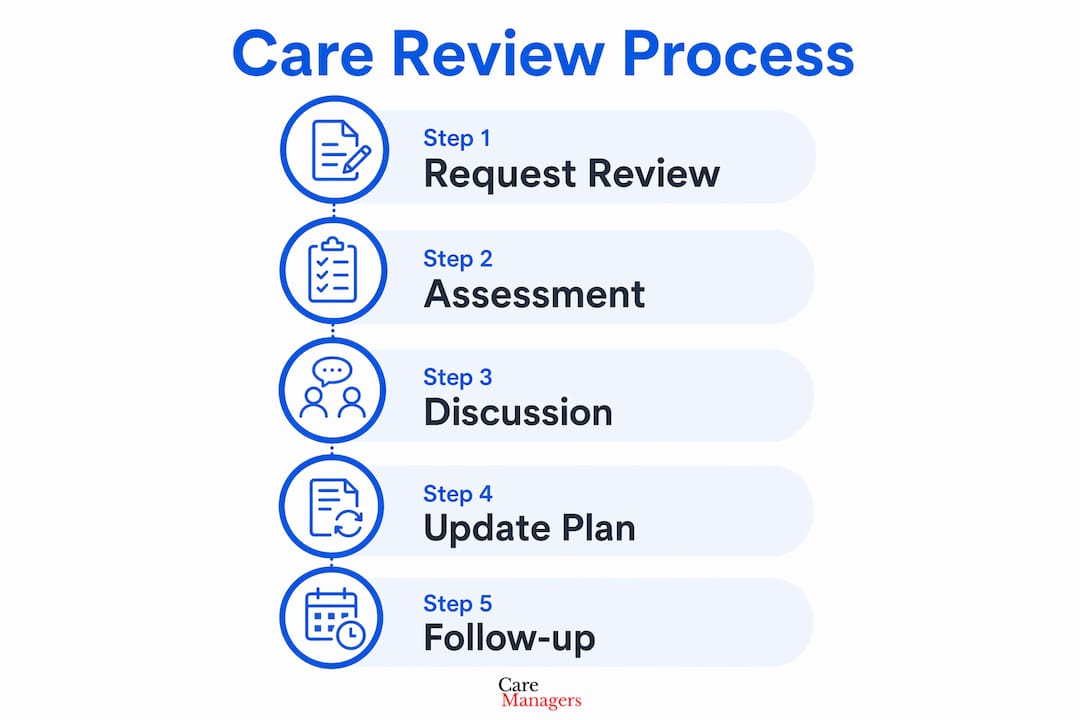
The review works through several clear steps:
- Evidence gathering: The care manager collects information about what has changed since the last review, including health updates, medication changes, and any new challenges in daily life
- Outcome assessment: Each goal in the care plan is examined. Is the person achieving what was intended? If not, why not?
- Discussion of effectiveness: Everyone present shares their observations. Family members often notice changes that formal records miss
- Plan update: If the review identifies gaps or changes, the Care and Support Plan is revised to reflect them. This might mean adjusting visit frequency, adding a new type of support, or changing a carer’s approach to a specific routine
Documentation is updated at the end of the review. The revised plan should be shared with everyone involved, including the family.
Pro Tip: Bring written notes to the review. A brief list of changes you have noticed, such as new medication, altered sleep patterns, or increased anxiety, gives the care manager concrete evidence to work with. Verbal accounts are helpful, but written records carry more weight when updating a formal plan.
What are the benefits of care reviews for families?
Care reviews deliver practical benefits that go well beyond paperwork. The most direct benefit is that care stays matched to the person’s actual needs rather than the needs they had when the plan was first written.
“A care review is a structured decision-making forum, not just paperwork, ensuring care remains effective and appropriate after health or lifestyle changes.” — Care planning guidance
For families, the review is also an opportunity to raise concerns in a formal setting. If a carer’s approach is not working, if routines have become difficult, or if your relative’s confidence has changed, the review is the right place to say so. That feedback directly shapes what happens next. Reviews also support independence. When care is calibrated correctly, people can do more for themselves, which improves both wellbeing and dignity. Families who engage actively with reviews report greater confidence in the care their relatives receive. The review process gives you a voice in decisions that affect someone you love.
Understanding why home care matters for families helps put reviews in context. They are not isolated events. They are part of an ongoing commitment to quality that runs through every aspect of good home care.

How to navigate common challenges in the care review process
The care review process has real pitfalls. Knowing them in advance helps you avoid them.
- Missed early reviews: Early checks at 6–8 weeks are the most commonly skipped. If your relative’s initial review has not happened within that window, chase it. Early reviews catch plan mismatches before they become entrenched.
- Unclear communication: Reviews can feel one-sided if families do not know what to expect. Ask the care manager in advance what the review will cover and what information would be helpful to bring.
- Lack of evidence: Vague concerns are harder to act on than specific ones. Keep a simple diary of changes you notice between reviews. Dates, descriptions, and examples make a real difference.
- Waiting too long: Statutory guidance is clear that reviews should happen when circumstances change, not only on a fixed schedule. If your relative has had a fall, a new diagnosis, or a significant change in behaviour, request a review immediately.
- Confusing review with reassessment: A review checks whether the existing plan works. A reassessment re-evaluates eligibility and needs from scratch. If needs have changed substantially, ask whether a full reassessment is more appropriate.
- Not involving the right people: If your relative has difficulty communicating their wishes, an advocate can attend the review on their behalf. This is a right, not an exception. The home care assessment process explains how advocates and family members can be formally included.
Preparation is the single most effective thing a family can do. A well-prepared family member changes the outcome of a review.
Key takeaways
A care review is the most direct tool families have for ensuring home care remains appropriate, person-centred, and genuinely effective over time.
| Point | Details |
|---|---|
| Statutory timing | Initial reviews happen at 6–8 weeks, then annually for stable plans. |
| Triggered reviews | Request an out-of-cycle review immediately when health or circumstances change. |
| Active participation | Bring written evidence of changes to strengthen the review outcome. |
| Review vs reassessment | A review checks the existing plan; a reassessment re-evaluates needs from scratch. |
| Family voice | Families have a formal role in reviews and can bring an advocate if needed. |
Care reviews: what I have learned from years of watching families navigate them
The families who get the most from care reviews are not the ones who know the most about social care law. They are the ones who show up prepared and treat the review as a conversation rather than an inspection.
The most common mistake I see is passivity. Families assume the care manager will identify every problem. In reality, the care manager sees your relative for a fraction of the time you do. Your observations are not supplementary. They are central. A care manager cannot update a plan around changes they do not know about.
The second mistake is waiting. The statutory framework is clear that reviews should happen when circumstances change, not just when the calendar says so. I have seen families wait months for a scheduled review while a care plan quietly stopped working. That delay has real consequences for the person receiving care.
What I find genuinely encouraging is how much difference active engagement makes. When families attend reviews with notes, ask direct questions, and follow up on agreed changes, outcomes improve. The review stops being a formality and becomes what it was always meant to be: a working conversation about someone’s life.
Care reviews are not the most exciting part of home care planning. But they are one of the most consequential. Treat them accordingly.
— Emm
How Caremanagers supports families through care reviews
Navigating a care review is much easier when you have experienced support alongside you. Caremanagers provides personalised home care services across South Wales and England, with care planning built around each individual’s goals and preferences.

The Caremanagers team works closely with families to prepare for reviews, document changes, and ensure care plans reflect what your relative actually needs. Whether you are arranging care for the first time or reassessing an existing plan, the team brings local knowledge and genuine commitment to every conversation. If your loved one’s needs have changed, or if you are not sure whether their current care still fits, Caremanagers can help you take the right next step. Explore home care options tailored to your family’s situation.
FAQ
What is a care review in home care?
A care review is a formal reassessment of a person’s Care and Support Plan to confirm it still meets their current needs and goals. Under the Care Act 2014, local authorities in England are required to conduct these reviews regularly.
How often should a care review take place?
An initial review should happen within 6–8 weeks of a new care plan starting, with annual reviews for stable plans. Reviews should also be arranged sooner if health or circumstances change significantly.
Who is involved in a care review?
The individual receiving care, family members, the care manager, and relevant healthcare professionals all take part. An advocate can attend if the person needs support to express their wishes.
What is the difference between a care review and a reassessment?
A care review checks whether the existing plan is working and updates it as needed. A full reassessment re-evaluates a person’s eligibility and care needs from the beginning, usually when needs have changed substantially.
Can a family member request a care review?
Yes. Families can request an out-of-cycle review at any time if they believe circumstances have changed. Statutory guidance confirms that reviews should not wait for scheduled dates when material changes occur.