
TL;DR:
- Self-directed care gives individuals control over their social support, funding, and provider choices. It is a legal right requiring ongoing dialogue with authorities and offers four funding models to suit different needs. Managing this support involves legal responsibilities, but personalized arrangements often result in better care outcomes.
Self-directed care is defined as a legal framework that gives individuals and families direct control over how their social care and support is arranged, funded, and delivered. Known formally as self-directed support, it shifts decision-making away from local authority systems and places it firmly with the person receiving care. Rather than accepting whatever services a council assigns, you choose who provides your support, when they arrive, and how your budget is spent. This approach is grounded in person-centred care principles and is backed by statutory frameworks across England and Wales.
What is self-directed care and how does it work?
Self-directed care is not a single product or service. It is a way of organising support that puts you at the centre of every decision. Local authorities assess your care needs, calculate a personal budget to meet those needs, and then hand control of that budget to you in one of several forms.

The co-production model is central to how this works in practice. That means the success of your arrangement depends on ongoing, meaningful conversations between you and your local authority, not a single plan written once and filed away. Self-directed support is also a legal right, not a discretionary benefit. Local authorities are legally required to fund care at rates that reflect actual local market costs.
Understanding this distinction matters. You are not asking for a favour. You are exercising a right that councils must honour.
What are the different models of self-directed care funding?
Four principal funding options exist under self-directed support. No single option is the default. The right choice depends on your confidence, capacity, and personal preference.
| Funding model | How it works | Best suited to |
|---|---|---|
| Direct Payments | Budget paid as cash directly to you | Those who want full control |
| Individual Service Fund | Budget held by a provider on your behalf | Those who want choice without admin |
| Managed Budget | Local authority manages spending for you | Those who prefer less involvement |
| Combination | Mix of the above options | Those with varied support needs |
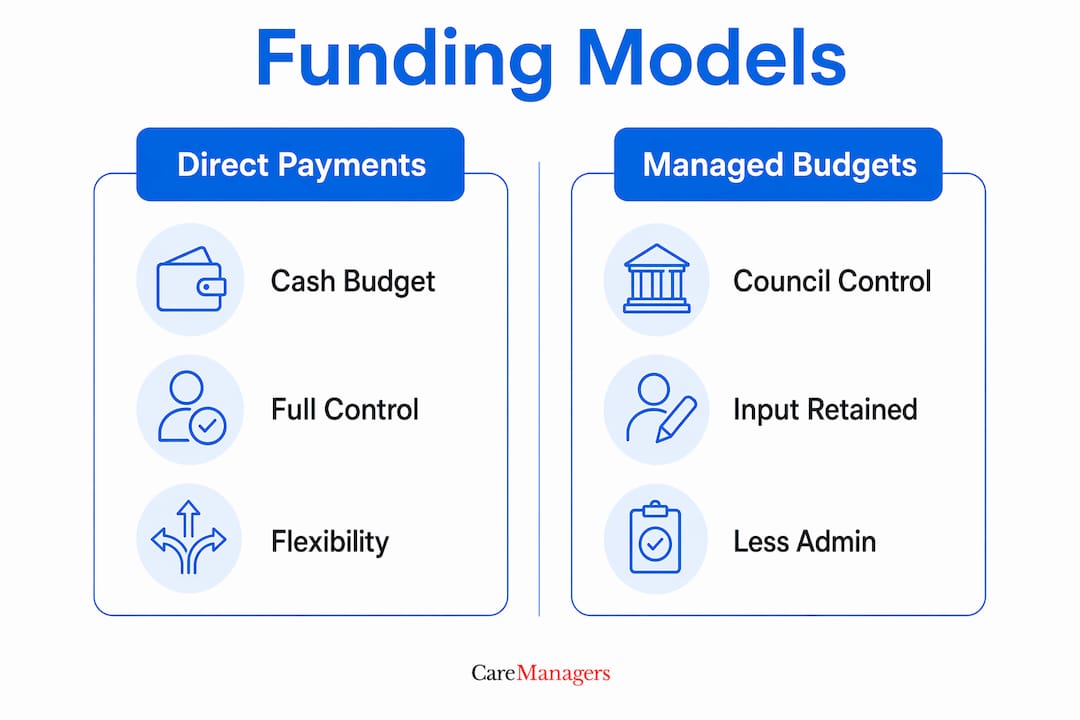
Direct Payments give you the most flexibility. You receive your personal budget as regular cash payments and use them to hire staff, buy services, or arrange support in whatever way meets your agreed care outcomes. The local authority retains oversight to confirm value for money, but day-to-day decisions are yours.
An Individual Service Fund sits between full control and full delegation. A provider of your choosing holds the budget and spends it according to your agreed plan. You direct the support without managing the finances directly. This suits families who want genuine choice but find payroll and administration burdensome.
A Managed Budget keeps the council in control of spending while you retain input into what services are purchased. This is the least hands-on option and suits those who find the administrative side of care management difficult.
Combining funding methods is common and practical. You might use Direct Payments to employ a personal assistant for daily support while asking the council to manage a specialist therapy service on your behalf.
Pro Tip: Ask your local authority to walk you through each option before committing. Many families choose Direct Payments by default without realising a managed alternative would suit them far better.
Who is eligible for self-directed care and how is a personal budget set?
Eligibility for a personal budget follows a clear process. Your local authority conducts a care needs assessment to determine whether your needs meet the threshold for funded support. Most councils fund care assessed as substantial or critical in severity.
A financial assessment runs alongside the care assessment. The key savings threshold is £23,250. If your savings exceed this figure, you are expected to contribute to or fully fund your own care until your assets fall below that level. Below the threshold, the council funds the agreed support.
Once eligibility is confirmed, the council calculates a personal budget. This figure is based on the cost of meeting your assessed needs at local market rates. The process for setting this amount should be transparent, and you have the right to challenge it if you believe it is insufficient.
Reviews are built into the system by law. The first review must take place within six months of your initial payment. After that, reassessments happen regularly to reflect any changes in your needs or circumstances.
The steps to establishing your personal budget are:
- Request a care needs assessment from your local authority.
- Complete a financial assessment to determine your contribution.
- Agree on a personal budget amount with your care coordinator.
- Choose your preferred funding model from the four options.
- Develop a support plan detailing how the budget will be spent.
- Begin receiving support and prepare for your six-month review.
Understanding the domiciliary care assessment process in detail helps you prepare for each of these steps with confidence.
What responsibilities come with managing self-directed care?
Managing your own care budget carries real legal duties. These are not optional, and understanding them before you start prevents costly mistakes.
When you use Direct Payments to employ a personal assistant or carer directly, you become an employer. Employer responsibilities include recruitment, payroll, tax compliance, employers’ liability insurance, and adherence to employment law. This is a significant commitment that many families underestimate at the outset.
Key legal duties when using Direct Payments include:
- Registering as an employer with HMRC and operating a compliant payroll.
- Obtaining employers’ liability insurance before your first member of staff starts.
- Conducting right-to-work checks and keeping employment records.
- Following disciplinary and grievance procedures if issues arise.
- Keeping a separate bank account for Direct Payment funds.
There are also restrictions on who you can employ. Local authorities generally prohibit using Direct Payments to employ close family members who live in the same household. Exceptions exist where the care needs are exceptionally complex and no suitable alternative is available, but these require council approval.
Where someone lacks the mental capacity to manage their own budget, an authorised person can take on legal responsibility for the Direct Payment on their behalf. This might be a family member, a trusted friend, or a professional deputy appointed by the Court of Protection.
You also have the right to request independent advocacy at any point during your assessment or care planning. Independent advocacy is a legal right, not a courtesy. An advocate can attend meetings with you, help you understand your options, and ensure your voice is heard when decisions are made.
Local authorities retain a duty to monitor your care arrangement. They check that your support is safe, effective, and achieving the outcomes set out in your plan. This oversight protects you and does not diminish your control.
Pro Tip: Many councils and charities offer Direct Payment support services at no extra cost. These services handle payroll and HR on your behalf, removing the administrative burden while keeping you in control of who provides your care.
How can self-directed care be personalised to fit your life?
The real strength of self-directed support lies in its flexibility. You are not limited to a single provider or a standard package of services. You can build an arrangement that fits your daily routine, cultural preferences, and long-term goals.
Practical examples of personalised arrangements include:
- Employing a personal assistant who speaks your first language and understands your cultural background.
- Arranging support at times that suit your family’s schedule rather than a provider’s rota.
- Combining professional care with community activities, such as funding transport to a day centre alongside home support.
- Using part of your budget for equipment or technology that reduces your reliance on human assistance.
Mixed funding models make this personalisation possible. You might blend funding types by taking Direct Payments for your personal assistant while asking the council to manage a specialist nursing service. This reduces your administrative load for complex clinical care while keeping everyday support firmly under your control.
Co-production is the mechanism that makes personalisation sustainable. The Local Government Association identifies ongoing dialogue between individuals and local authorities as the defining factor in whether self-directed support achieves genuine outcomes. A support plan written once and never revisited will not serve you well. Regular conversations with your care coordinator keep your arrangement aligned with your changing needs.
Home care services from a trusted provider can form a central part of any personalised arrangement, whether funded through Direct Payments or a managed budget.
Key takeaways
Self-directed care is a legal right that gives individuals and families control over their personal budget, their choice of provider, and the shape of their daily support.
| Point | Details |
|---|---|
| Legal right, not a favour | Local authorities must fund care at local market rates; you can challenge an insufficient budget. |
| Four funding models | Direct Payments, Individual Service Funds, Managed Budgets, and combinations each suit different needs. |
| Savings threshold applies | Savings above £23,250 affect your financial contribution before council funding begins. |
| Employer duties are real | Using Direct Payments to hire staff makes you a legal employer with payroll and insurance obligations. |
| Review is mandatory | Your first formal review must happen within six months of your initial payment. |
Why self-directed care is worth the effort, even when it feels complicated
I have spent years working alongside families who arrive at self-directed support feeling cautious. The paperwork looks daunting. The employer responsibilities sound alarming. The financial assessments feel intrusive. I understand why people sometimes step back from the process before they have even begun.
What I have seen consistently, though, is that families who push through that initial complexity end up with care arrangements that are genuinely better. Not marginally better. Significantly better. The person receiving support gets a carer who fits their personality, arrives at a time that works for the household, and understands their specific needs in a way that a generic agency rota rarely achieves.
The administrative burden is real, and I would never minimise it. But it is manageable, particularly when you use the free Direct Payment support services that most councils and third-sector organisations offer. The mistake I see most often is families assuming they must handle everything alone. You do not. Advocacy, payroll support, and care coordination help exist precisely because this process has moving parts.
My honest advice is this: treat your first conversation with the local authority as a fact-finding exercise, not a commitment. Ask every question. Request independent advocacy if you feel uncertain. And do not let the complexity of the system convince you that a standard care package is your only option. It rarely is.
— Emm
How Caremanagers supports families with self-directed care
Caremanagers works with families across South Wales and England who are navigating self-directed support for the first time and those who want to change an existing arrangement. The team understands how funding models work in practice and helps families identify which option fits their situation before any commitment is made.
Whether you are considering Direct Payments for the first time or looking for a trusted provider to work within an Individual Service Fund, Caremanagers offers tailored home care services built around your personal plan. From dementia care to hospital discharge support, every arrangement is designed around your needs, not a standard template. If you are ready to explore your options, arranging home care with Caremanagers is a straightforward starting point.
FAQ
What does self-directed care mean in the UK?
Self-directed care, formally called self-directed support, is a legal framework giving individuals control over their personal care budget and how their support is arranged. Local authorities assess needs, set a budget, and the individual chooses how that budget is spent.
Can a family member be paid through Direct Payments?
Local authorities generally prohibit using Direct Payments to employ close family members living in the same household, except in exceptional circumstances where no suitable alternative exists.
How is a personal budget amount decided?
The local authority calculates your personal budget based on your assessed care needs and the cost of meeting those needs at local market rates. You can challenge the figure if you believe it does not reflect your actual support requirements.
What happens at the six-month review?
The first review checks whether your support plan is working, whether your needs have changed, and whether your budget remains appropriate. It is a legal requirement, not optional.
Do I have to manage everything myself with self-directed care?
No. You can choose a Managed Budget or Individual Service Fund if you prefer less administrative involvement. Even with Direct Payments, free payroll and HR support services are widely available through councils and third-sector organisations.