
TL;DR:
- Home care provides non-medical, paid support to help individuals maintain independence at home.
- Families should understand the different types, funding sources, and how to select a reliable provider.
Home care is paid support delivered at home to help with daily activities and personal care, enabling people to remain independent rather than moving into a residential facility. Also known as domiciliary care, it covers everything from help with bathing and dressing to meal preparation, medication prompts, and companionship. The NHS and organisations such as Age UK recognise home care as a distinct category of support, separate from both hospital treatment and care home placement. For families weighing up options, understanding what home care includes, how it is funded, and how it differs from medical home health care is the clearest starting point.
What is home care and what does it include?
Domiciliary care is personal care support arranged so that people living with illness, disability, or frailty can manage at home with assistance. The term “home care” is the everyday phrase most families use, while “domiciliary care” is the formal industry term you will encounter in council documents and Care Quality Commission (CQC) reports. Both refer to the same thing.

The scope of home care services is wider than most people expect. At one end, a carer might visit once a day to help prepare a meal or collect a prescription. At the other end, a full live-in carer provides round-the-clock support for someone with complex needs such as advanced dementia or a recent stroke.
Common services covered by home care include:
- Personal care: bathing, showering, dressing, toileting, and oral hygiene
- Practical help: housework, laundry, shopping, and meal preparation
- Medication support: prompting or administering prescribed medicines
- Companionship: social interaction, accompanying to appointments, and transport
- Health-related assistance: wound care, catheter care, and physiotherapy exercises
Pro Tip: Plan for how needs may change over time. A person who needs only meal preparation today may require personal care within a year. Choosing a provider who can scale support avoids the disruption of switching agencies.
How does home care differ from home health care and care homes?
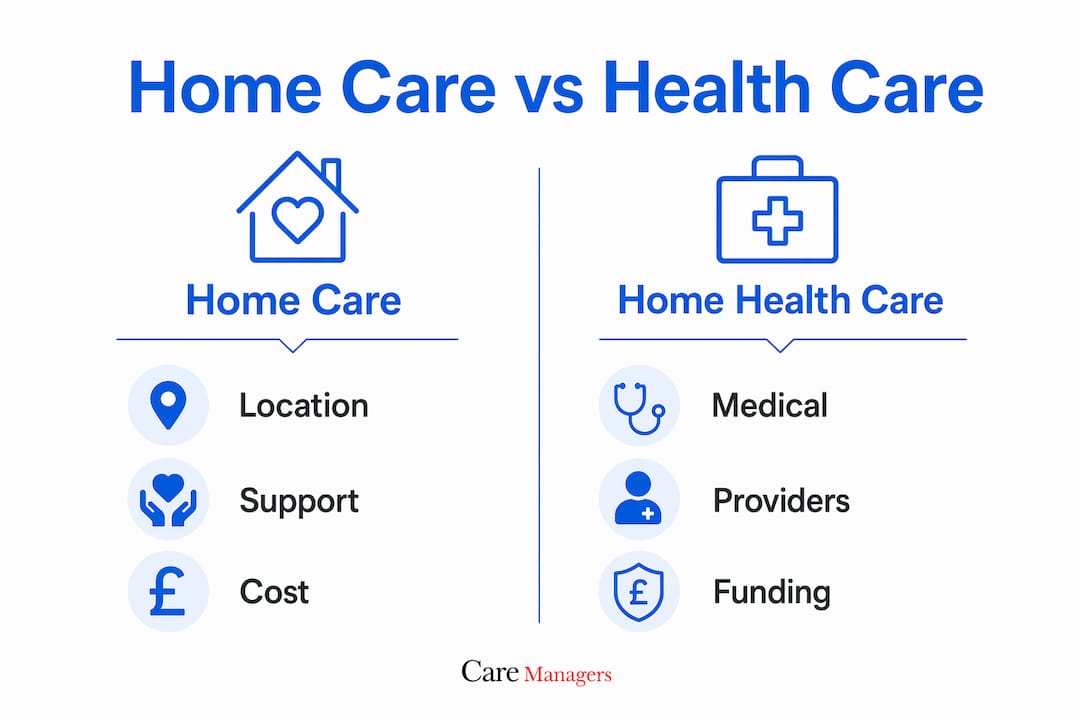
Home care and home health care are not the same thing, and confusing the two leads families to arrange the wrong type of support. Home care is non-medical. It is provided by trained care workers who assist with daily living tasks. Home health care, by contrast, is doctor-ordered skilled nursing delivered at home, covering services such as intravenous therapy, post-surgical wound management, or occupational therapy assessments.
Clarifying this distinction helps families choose the right care package and understand who funds what. Home health care in the UK is typically arranged through the NHS following a hospital discharge or GP referral. Home care is usually arranged through a local council or paid for privately.
The table below summarises the key differences:
| Feature | Home care (domiciliary care) | Home health care | Care home |
|---|---|---|---|
| Location | Person’s own home | Person’s own home | Residential facility |
| Care type | Non-medical daily support | Skilled clinical nursing | Personal and nursing care |
| Typical provider | Care agency or individual | NHS or private nurse | Registered care home |
| Funding route | Council or self-funded | NHS or self-funded | Council, NHS, or self-funded |
| Independence level | High, person stays at home | High, person stays at home | Lower, person moves in |
Pro Tip: Always confirm in writing which tasks your care worker is authorised to carry out. A home care worker cannot administer injections or make clinical decisions. If medical tasks are needed, request a separate NHS referral for home health care.
What are the types of home care available in the UK?
Home care services range from practical help and personal care through to companionship and health-related assistance, depending on individual needs. UK homecare providers typically offer these services through one of three delivery models.
Visiting care is the most common arrangement. A care worker visits at agreed times, typically for 30 minutes to several hours. This suits people who are largely independent but need help at specific points in the day, such as getting up in the morning or going to bed at night.
Live-in care places a carer in the person’s home full time. This is the closest alternative to a care home and suits people with complex or unpredictable needs. It preserves the person’s familiar environment, which is particularly valuable for those living with dementia. Research from Harvard Health confirms that ageing in place preserves independence, confidence, and community connection in ways that residential care cannot replicate.
Specialist care covers conditions requiring specific training, including dementia care, Parkinson’s disease support, end-of-life care, and post-hospital discharge care. Caremanagers, for example, provides dementia care at home as a distinct service, recognising that the needs of someone with dementia differ substantially from general personal care.
How do you access home care services in the UK?
Accessing publicly funded home care in the UK follows a clear two-step process. Understanding it in advance saves time and reduces stress when a care need arises suddenly.
-
Request a care needs assessment. Contact your local council’s Adult Social Care team. The assessment is free and open to anyone who appears to need care and support. A social worker or occupational therapist will visit to discuss daily routines, difficulties, and risks at home.
-
Complete a financial assessment. If the care needs assessment identifies eligible needs, the council carries out a means test to determine how much, if anything, you contribute towards the cost. Funding thresholds vary across England and Wales.
-
Choose how care is arranged. The council can arrange care directly with an approved provider, or you can request direct payments to manage your own care budget and choose your own agency.
-
Prepare before the assessment. Documenting specific difficulties before the visit, including how often they occur and what risks they create, leads to a more accurate assessment. A list of daily routines, medications, and recent incidents is more useful than a diagnosis alone.
-
Request a carer’s assessment if relevant. Unpaid family carers are entitled to their own assessment of their needs, separate from the person they support. This can unlock additional support or respite care.
Describing concrete routine breakdowns is more effective than listing diagnoses when preparing for an assessment. Telling the assessor “my mother cannot get out of the bath safely and has fallen twice this month” carries more weight than “she has arthritis.”
Most people who do not qualify for council funding pay for home care privately. Costs vary by region and by the level of support required. Self-funding families should factor in the possibility of increasing hours over time.
How do you choose and work with a home care provider?
Choosing the right provider shapes the quality of care your relative receives every day. The following factors separate good providers from poor ones.
- Regulatory registration: All home care agencies in England must be registered with the CQC. In Wales, registration is with Care Inspectorate Wales (CIW). Check the relevant register before making any commitment.
- Staff consistency: Frequent changes of care worker disrupt routines and erode trust, particularly for people with dementia or anxiety. Ask providers directly about their staff turnover rate.
- Written care plans: A good provider produces a written care plan that specifies tasks, timings, and preferences. Vague verbal agreements lead to gaps in care.
- Communication channels: You should be able to reach a named coordinator easily. If a provider cannot tell you who to call with concerns, that is a warning sign.
- Flexibility: Needs change. A provider who cannot adjust hours or add services without lengthy delays will create problems as care requirements evolve.
Care plans work best when families describe specific daily routines and the exact points where support is needed. Telling a provider “Dad needs help getting dressed and takes 20 minutes because of his shoulder” produces a more accurate plan than “he needs personal care.”
Pro Tip: If you need to switch providers, do not wait until care has broken down entirely. Caremanagers has guidance on changing home care providers that can help you manage the transition without a gap in support.
Key takeaways
Home care is non-medical, home-based support that enables people to live independently, and accessing it in the UK requires a care needs assessment followed by a financial assessment from your local council.
| Point | Details |
|---|---|
| Home care definition | Paid, non-medical support at home covering personal care, practical tasks, and companionship. |
| Types of home care | Visiting care, live-in care, and specialist care each suit different levels of need. |
| Home care vs home health care | Home care is non-medical; home health care involves skilled nursing ordered by a doctor. |
| Accessing UK home care | Request a care needs assessment from your local council’s Adult Social Care team first. |
| Choosing a provider | Confirm CQC or CIW registration, written care plans, and staff consistency before committing. |
What I have learned about home care decisions
The families I have spoken with most often say the same thing: they wish they had started looking earlier. Home care tends to be arranged reactively, after a fall or a hospital admission, when stress is high and time is short. The families who navigate it best are those who had at least one conversation about preferences before a crisis forced the issue.
There is also a tendency to underestimate how much the right match between carer and client matters. A technically competent carer who clashes with a person’s personality or ignores their routines will cause friction every single day. Dignity and familiarity are not soft extras. They are the difference between care that works and care that is merely tolerated.
One thing I would push back on is the assumption that a care home is always the “safer” option for someone with high needs. Ageing in place with well-matched support preserves a person’s sense of self in ways that residential settings often cannot. That is not a sentimental argument. It is backed by evidence from geriatric care research.
Finally, involve more than one family member in the decision. Care decisions made by one exhausted person, in isolation, rarely reflect the full picture of what a parent or relative needs or wants.
— Emm
How Caremanagers supports families across South Wales and England
Caremanagers provides personalised home care services across South Wales and England, covering visiting care, live-in support, dementia care, and hospital discharge care. Every care plan is built around the individual, not a standard package.
If you are trying to arrange care after a hospital stay, Caremanagers offers dedicated hospital discharge support to help your relative return home safely and with the right level of assistance in place from day one. For families at the beginning of the process, the Caremanagers team can guide you through what to expect from a care needs assessment and help you understand your options before committing to anything. Get in touch to discuss your situation with a care specialist who knows the local area.
FAQ
What is the home care definition in simple terms?
Home care is paid support provided in a person’s own home to help with daily tasks such as bathing, dressing, meal preparation, and medication prompts. It enables people to remain at home rather than moving into a care facility.
What does home care include in the UK?
UK home care services typically include personal care, housework, meal preparation, companionship, medication support, and transport. Some providers also offer specialist support for conditions such as dementia or post-surgical recovery.
How is home care different from a care home?
Home care is delivered in the person’s own home, preserving independence and familiar surroundings. A care home is a residential facility where the person moves in and receives care on site.
Who pays for home care in the UK?
Funding depends on a financial assessment by the local council. People who meet the eligibility threshold receive council-funded care; those above the threshold pay privately. Costs vary by region and level of support required.
How do I arrange home care for an elderly relative?
Contact your local council’s Adult Social Care team to request a free care needs assessment. If your relative is leaving hospital, ask the ward team to arrange a discharge assessment before they come home.